Water hyacinth baskets appear in almost every interior design magazine, and they belong to several styles rather than one. That's the short answer to a question people search regularly: there isn't a single style that owns them.
They're most strongly associated with coastal, bohemian, and Japandi interiors, and they appear frequently in Scandinavian and contemporary schemes as a texture element.
This covers what the material actually is, which styles use it and why, and how to use it without producing something that looks like a catalogue page.
What Water Hyacinth Is
Water hyacinth is a floating aquatic plant, native to South America and now growing invasively across South and Southeast Asia. It clogs waterways, blocks light to aquatic life, and is difficult to control.
Harvesting it for weaving turns a management problem into a material. The stems are dried, twisted into rope, and woven — usually over a metal or rattan frame for structure.
Characteristics
Colour: Natural pale brown to mid-tan, often slightly variegated. Takes dye but usually left natural.
Texture: Thicker and chunkier than seagrass or rattan. The weave is visibly coarse, which is part of the appeal.
Weight: Light. Large baskets remain easy to move even when full.
Durability: Good for dry indoor use. Not suitable for damp environments — bathrooms with poor ventilation will cause it to soften and eventually break down.
Sustainability: Genuinely strong. It's a fast-growing invasive plant, harvesting reduces ecological damage, and it's biodegradable.
Try DecoAI Free
3 free credits. No credit card needed. Stage any room in 30 seconds.
Get 3 Free CreditsHow It Differs From Similar Materials
These get confused constantly.
| Material | Source | Texture | Typical use |
|---|---|---|---|
| Water hyacinth | Aquatic plant stems | Chunky, coarse weave | Large storage baskets, planters |
| Seagrass | Marine grass | Finer, smoother, slightly green | Baskets, rugs, chair seats |
| Rattan | Climbing palm | Rigid, smooth canes | Furniture frames, chairs |
| Wicker | Not a material — a technique | Varies by fibre used | Any woven item |
| Jute | Plant fibre | Rough, ropey | Rugs, cord, softer baskets |
| Bamboo | Grass stem | Rigid, glossy | Furniture, screens, blinds |
The most common confusion: wicker isn't a material. It's a weaving method that can use water hyacinth, rattan, willow, or synthetic fibre.
Which Styles Use It
Coastal — Strongest Association
Water hyacinth is close to definitional in coastal interiors.
Why it fits: natural fibre, sun-bleached tones, and an association with water and warm climates. It reads as relaxed and unpolished, which is the coastal register.
Typical use: large floor baskets for throws, planters, storage in whitewashed or pale blue rooms.
Palette it sits in: white, sand, pale blue, driftwood grey.
Bohemian — Very Strong
Natural fibres are central to Bohemian, and water hyacinth is among the most used.
Why it fits: texture-led rather than colour-led, handmade appearance, warm earth tone.
Typical use: stacked baskets, hanging planters, storage beneath a console, alongside rattan furniture and layered textiles.
Palette it sits in: terracotta, rust, ochre, warm cream.
Japandi — Strong
The blend of Japanese minimalism and Scandinavian warmth relies heavily on natural materials used sparingly.
Why it fits: natural, handmade, imperfect — all central to the wabi-sabi influence in Japandi.
Typical use: one large basket, deliberately placed. Japandi uses fewer objects, so each one carries more weight.
Palette it sits in: warm white, pale wood, black accents, muted green.
Scandinavian — Moderate
Used, but less prominently than in the styles above.
Why it fits: natural material, functional storage, adds warmth to a pale scheme.
Typical use: one or two baskets for blankets or firewood, alongside sheepskin and wool.
The distinction: Scandinavian uses them functionally. Bohemian uses them decoratively.
Contemporary — Moderate
Increasingly common as texture in otherwise neutral schemes.
Why it fits: the current preference for texture over pattern makes woven fibre useful. It adds interest without adding colour.
Typical use: a single large basket beside a sofa, or a planter.
Where It Doesn't Fit
Modern (mid-century or strict) — the style favours moulded and manufactured forms over handmade natural ones.
Traditional — woven baskets read as too casual against period formality.
Industrial — the softness fights the hard materials.
Luxury — natural fibre reads as relaxed rather than premium. A single piece can work as contrast; more than that undermines the register.
Try DecoAI Free
3 free credits. No credit card needed. Stage any room in 30 seconds.
Get 3 Free CreditsHow to Use It Well
One Large Rather Than Several Small
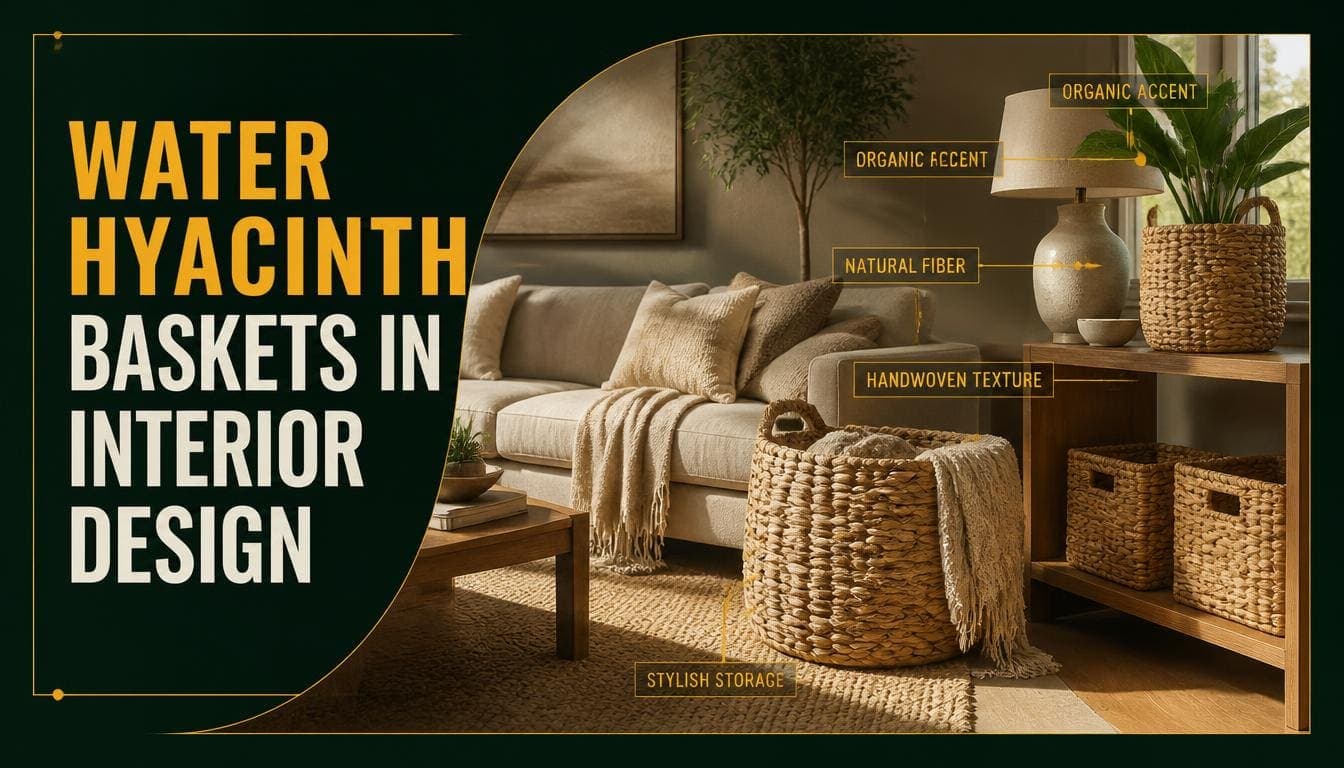
A single substantial basket reads as intentional. Three or four small ones scattered around a room read as clutter.
Rule of thumb: one large floor basket per room, maximum two.
Give It a Function
A basket holding throws, firewood, or a plant reads as useful. An empty basket sitting in a corner reads as decoration for its own sake.
The most useful applications:
- Blanket storage beside a sofa
- Plant pot cover for a large indoor plant
- Firewood beside a fireplace
- Toy storage in family living rooms
- Laundry in bedrooms
Match the Scale to the Room
A 30cm basket in a large living room disappears. A 60cm basket in a small bedroom dominates.
| Room size | Basket diameter |
|---|---|
| Small bedroom | 30–40cm |
| Standard living room | 40–50cm |
| Large living room | 50–70cm |
Pair It With Contrasting Texture
Woven fibre against a smooth surface produces the contrast that makes texture work.
Good pairings: basket on a wooden floor, against a plaster wall, beside a leather or linen sofa.
Weak pairings: basket on a jute rug next to a rattan chair beside a seagrass wall hanging. Too much of the same texture flattens the effect.
Keep the Colour Natural
Dyed water hyacinth — particularly grey or black — loses the material's main advantage, which is the warm natural tone.
The exception: black-dyed woven baskets work in Japandi, where the black accent is part of the palette.
Common Mistakes
1. Too Many
The most common error. Baskets multiply because they're useful and inexpensive, and a room with five reads as cluttered.
2. Using Them in Bathrooms
Water hyacinth softens and degrades in damp conditions. Bathroom storage should use a material that tolerates humidity.
3. Leaving Them Empty
An empty basket has no function and reads as filler.
4. Wrong Scale
Undersized baskets disappear; oversized ones dominate. Match the diameter to the room.
5. Too Much Matching Texture
Basket plus jute rug plus rattan chair plus seagrass wall art. Individually good, collectively flat.
6. Using Them in Formal Schemes
Traditional and Luxury interiors read woven fibre as too casual. One piece as contrast can work; a collection can't.
For Property Presentation
Why They Photograph Well
Woven texture catches light in a way smooth surfaces don't, producing subtle shadow variation that gives a photograph depth.
In an otherwise neutral staged room, a single woven basket adds visual interest without adding colour or pattern that could divide opinion.
Where to Place One
Living room: beside the sofa, holding a folded throw.
Bedroom: at the foot of the bed, or beside a chair.
Hallway: for shoes or umbrellas — practical and reads as lived-in.
Beside a fireplace: for logs. One of the strongest placements because the function is obvious.
The Staging Note
Woven baskets appear frequently in AI-generated staging, particularly in Scandinavian, Bohemian, and coastal styles. That's appropriate — they belong in those schemes.
What to check: whether the generated image has one basket or several. Multiple baskets in a staged room is one of the more common overstyling errors, and it reads as a catalogue photograph rather than a home.
Care and Practicalities
Cleaning: vacuum with a brush attachment. Wipe with a barely damp cloth if needed, then dry immediately.
Avoid: soaking, humid environments, direct prolonged sunlight which fades the fibre.
Lifespan: several years in dry indoor use. Considerably less in damp conditions.
Structure: most water hyacinth baskets are woven over a metal or rattan frame. A basket without a frame will lose shape when loaded.
Cost: typically $20–$60 for a large floor basket, less for small ones. One of the cheapest ways to add texture to a room.
Frequently Asked Questions
Which interior design style uses water hyacinth baskets?
Most strongly coastal, bohemian, and Japandi. They also appear in Scandinavian and contemporary schemes as a texture element.
What is water hyacinth?
A fast-growing invasive aquatic plant. The stems are dried, twisted into rope, and woven over a frame to make baskets and storage.
Is water hyacinth the same as seagrass?
No. Water hyacinth is a freshwater plant with a chunkier, coarser weave. Seagrass is marine, finer, smoother, and slightly greener.
What's the difference between wicker and water hyacinth?
Wicker isn't a material — it's a weaving technique. Water hyacinth is one of several fibres that can be woven into wicker items.
Can I use water hyacinth baskets in a bathroom?
Not advisable. The material softens and degrades in damp conditions. Use a humidity-tolerant material instead.
How many baskets should a room have?
One large one, maximum two. More reads as clutter, and it's the most common error with this material.
Is water hyacinth sustainable?
Genuinely, yes. It's an invasive species that damages waterways, so harvesting reduces ecological harm. It's also biodegradable.
Which styles should avoid woven baskets?
Traditional, Luxury, Industrial, and strict Modern. In the first two they read as too casual; in the latter two they fight the material palette.
How do I clean a water hyacinth basket?
Vacuum with a brush attachment. If it needs more, wipe with a barely damp cloth and dry immediately. Never soak it.
Summary
The style answer: coastal, bohemian, and Japandi most strongly. Scandinavian and contemporary as a secondary texture element.
What it is: an invasive aquatic plant, dried and woven over a frame. Genuinely sustainable, warm natural tone, coarse texture.
How to use it: one large basket with an actual function, scaled to the room, paired with contrasting rather than matching texture.
The main error: too many. Baskets multiply easily and a room with five reads as cluttered rather than textured.
Where it fails: bathrooms and damp areas, and formal schemes where woven fibre reads as too casual.
Check the staging for overstyling. DecoAI gives 3 free credits with no card required — worth reviewing generated images for multiple baskets, which is a common overstyling error in natural-fibre styles.