Every other staging style aims not to alienate anyone. Bohemian doesn't. It's the one style that accepts a narrower appeal in exchange for a stronger reaction from the people it does reach.
That trade is right for some properties and wrong for most. On Airbnb, where memorability drives saves and bookings, Bohemian outperforms neutral styles substantially. On a suburban family listing, it can read as cluttered and personal.
This guide covers what defines the style, where the trade pays off, and how to apply it without crossing into visual chaos.
What Bohemian Design Is
The term comes from 19th-century Paris, where bohémien described artists and writers living unconventionally — often in cramped quarters filled with objects collected rather than bought as a set.
The aesthetic that emerged reflects that: layered, accumulated, personal, and unconcerned with matching.
Core Characteristics
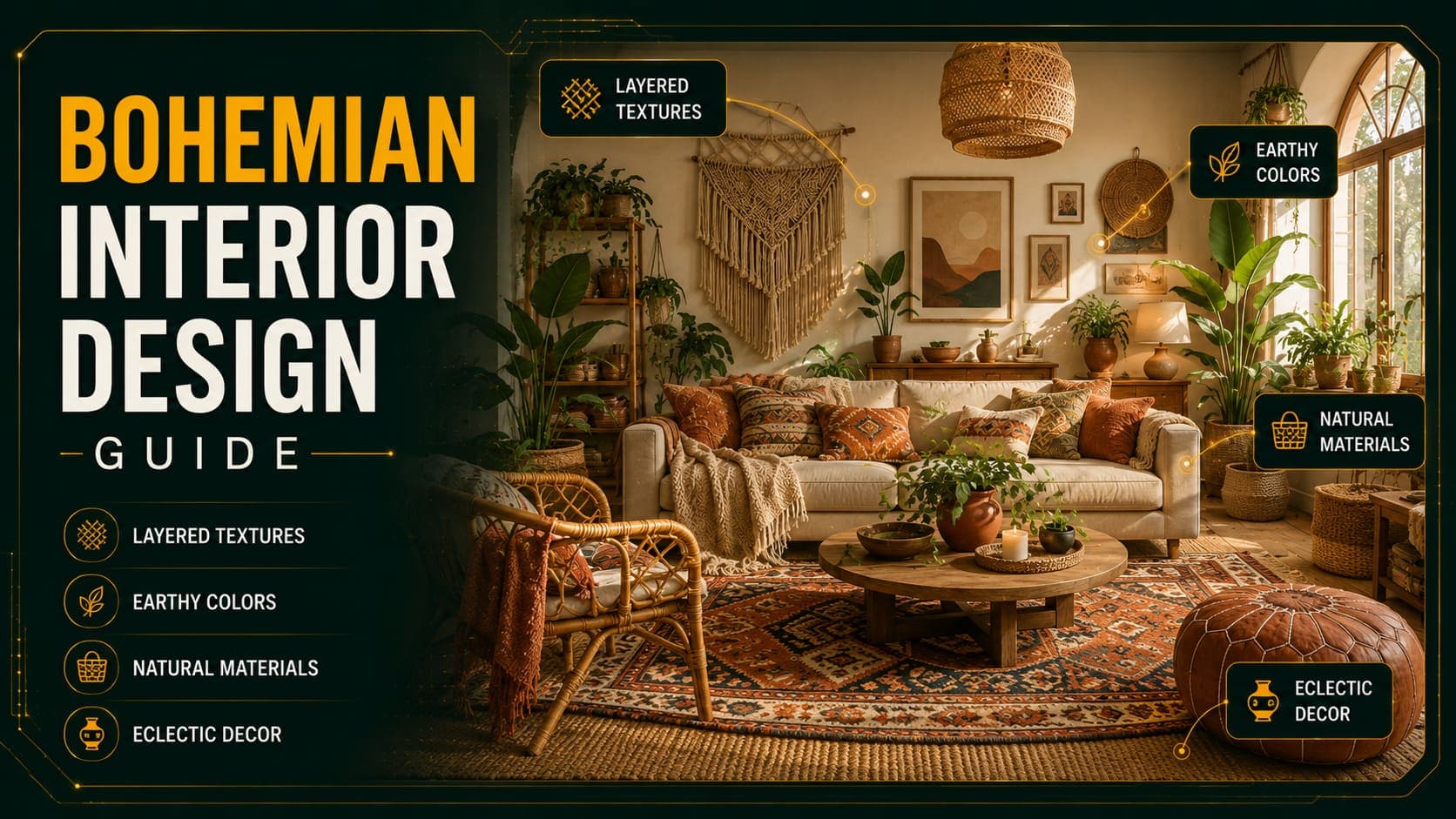
Layering — Rugs over rugs, cushions on cushions, textiles draped over furniture. Depth through accumulation.
Warm earth palette — Terracotta, rust, ochre, mustard, deep teal, warm cream.
Natural fibres — Rattan, jute, cane, wicker, macramé, cotton, linen.
Pattern mixing — Multiple patterns coexisting deliberately. Kilim, block print, geometric, floral.
Plants, abundantly — More than any other style. Trailing plants, large-leaf specimens, hanging planters.
Global influences — Moroccan, Indian, Turkish, and North African references, particularly in textiles.
Low seating — Floor cushions, poufs, low sofas. A more relaxed posture than other styles.
Nothing matches deliberately — Mismatched chairs, varied wood tones, collected rather than purchased.
Try DecoAI Free
3 free credits. No credit card needed. Stage any room in 30 seconds.
Get 3 Free CreditsThe Bohemian Palette
Base Colours
- Warm cream and oatmeal — the usual wall colour
- Terracotta — the defining Bohemian tone
- Rust and burnt orange
- Warm white
Accent Colours
- Mustard and ochre
- Deep teal
- Olive green
- Dusty pink
- Deep burgundy
Unlike most styles, Bohemian uses several accents together. The combination is part of the aesthetic.
Materials
- Rattan and cane
- Jute and sisal
- Macramé
- Cotton and linen in natural weaves
- Reclaimed and light wood
- Ceramic and terracotta
- Brass in small applications
What It Avoids
- Cool greys and blues
- High-gloss finishes
- Chrome and polished steel
- Matched furniture sets
- Stark minimalism
Bohemian by Room
Living Room
Furniture: Low sofa in cream or oatmeal, rattan armchair, low wooden coffee table, floor cushions or a pouf Palette: Warm cream walls, layered warm tones in textiles Textiles: A large jute rug with a patterned rug layered over it, five or six cushions in mixed patterns, a throw Plants: Two or three, including one large specimen and one trailing Detail: Macramé wall hanging, woven baskets, ceramic vessels
This is the strongest Bohemian room — it has the most surfaces to layer.
Bedroom
Furniture: Low or rattan bed frame, mismatched bedside tables Palette: Warm cream walls, layered bedding in cream, terracotta, and mustard Textiles: A patterned throw, multiple cushions, a rug on each side Plants: One trailing plant on a shelf Detail: Woven headboard or a textile hanging behind the bed
Dining Area
Furniture: Wooden table, mismatched chairs — often a mix of wood and rattan Lighting: Woven or rattan pendant Detail: Patterned table runner, ceramic vessels, a bench on one side
Home Office
Furniture: Simple wooden desk, rattan or wooden chair Palette: Warm cream, natural wood Plants: One or two Detail: Woven baskets for storage, one textile hanging
Outdoor Spaces
Bohemian works exceptionally well on balconies, patios, and terraces — rattan furniture, layered outdoor textiles, plants, and lanterns.
This is worth noting because outdoor space is a significant booking driver for short-term rentals.
Where Bohemian Wins
Short-Term Rentals and Airbnb
The clearest case. On platforms where guests browse dozens of listings in a session, memorability matters more than broad appeal.
Bohemian interiors generate saves, screenshots, and shares at a rate neutral styles don't. In a feed of beige apartments, character stands out.
Vacation and Leisure Markets
Coastal properties, holiday homes, and second homes sell on lifestyle rather than practicality. Bohemian communicates lifestyle better than any neutral alternative.
Creative Urban Neighbourhoods
Markets where the buyer demographic skews creative, younger, or design-conscious.
Properties with Character
Older buildings, converted spaces, and homes with unusual architecture pair naturally with Bohemian's accumulated feel.
Outdoor-Focused Properties
Balconies, terraces, courtyards, and gardens — Bohemian's natural materials and plants suit these spaces particularly well.
Small Spaces with Good Light
Counter-intuitively, Bohemian can work in compact rooms if the light is good. The warm palette and natural textures add depth without the visual weight of darker styles.
Where Bohemian Fails
Conservative and Suburban Markets
Family buyers in established markets frequently read Bohemian as cluttered or too personal. Traditional or Contemporary performs considerably better.
Premium and Luxury Properties
Bohemian signals relaxed informality, which conflicts with the presentation standard premium buyers expect.
Corporate and Investor Markets
Buyers purchasing for rental yield or as investment want broad tenant appeal, which means neutral.
Very Small Rooms with Poor Light
The layering that defines the style needs space and light to read as rich rather than crowded.
Modern New Builds
Clean-lined contemporary architecture fights Bohemian's accumulated warmth. Modern or Scandinavian suits new builds better.
The Clutter Line
The single hardest thing about Bohemian is knowing when to stop.
Signs You've Gone Too Far
- More than three distinct patterns visible in one frame
- Cushions in more than four different fabrics
- Plants numbering more than four in a single room
- Every surface holding an object
- No visible clear floor
Where the Line Sits
Good Bohemian: Layered but readable. The eye can rest somewhere. Individual pieces are distinguishable.
Over-Bohemian: Visually noisy. No focal point. The eye doesn't know where to settle.
Practical rule: for every layer you add, ensure one clear surface remains. A patterned rug and mixed cushions work if the coffee table is clear.
Try DecoAI Free
3 free credits. No credit card needed. Stage any room in 30 seconds.
Get 3 Free CreditsCommon Bohemian Mistakes
1. Using It in the Wrong Market
The defining error. Bohemian's trade — narrower appeal for stronger reaction — only pays off in markets where distinctiveness matters.
2. Crossing Into Clutter
More layering isn't better layering. The style needs breathing room to read as intentional.
3. Cool Tones
Grey and cool blue don't belong. Bohemian's palette is warm throughout — terracotta, rust, ochre, warm cream.
4. Matching Everything
Bohemian's charm is that pieces look collected rather than bought as a set. Matched furniture undermines it.
5. Too Few Plants
Plants are central, not decorative additions. A Bohemian room with no greenery reads as incomplete.
6. Using It in Premium Properties
Relaxed informality conflicts with premium presentation expectations.
7. Ignoring Texture
Bohemian is textural before it's colourful. Rattan, jute, macramé, and woven fibres do more work than the palette.
Softening Bohemian for Broader Appeal
For properties where full Bohemian is too much, a moderated version works well:
Keep: Warm palette, natural fibres, one or two plants, a rattan piece, textured cushions
Reduce: Pattern mixing to one or two patterns maximum, cushion count to three, layered rugs to a single rug
Drop: Macramé wall hangings, floor cushions, heavy global references
This reads as Contemporary with Bohemian warmth — broader appeal, but with more character than plain neutral.
Frequently Asked Questions
What is bohemian interior design?
A layered, eclectic style characterized by warm earth tones, natural fibres, mixed patterns, abundant plants, global influences, and deliberately unmatched furniture.
What colours are used in bohemian design?
Terracotta, rust, ochre, mustard, deep teal, olive, and warm cream. Unlike most styles, several accents are used together.
Is bohemian good for property staging?
For short-term rentals, vacation properties, and creative urban markets, yes. For suburban family markets and premium properties, more neutral styles perform better.
Why does bohemian work well for Airbnb?
Airbnb guests browse many listings quickly, so memorability drives clicks. Bohemian interiors get saved and shared at higher rates than neutral ones.
How do I stop bohemian looking cluttered?
Limit visible patterns to three, cushions to four, and plants to four per room. Keep at least one clear surface for the eye to rest on.
What's the difference between bohemian and eclectic?
Bohemian is a specific aesthetic with a defined warm palette and natural-fibre emphasis. Eclectic simply means mixing styles, with no particular palette or material rule.
Does bohemian work in small rooms?
If the light is good, yes — the warm palette adds depth without visual heaviness. In dim rooms, the layering reads as crowded.
What plants suit bohemian interiors?
Large-leaf specimens like monstera and fiddle leaf fig, trailing plants like pothos, and hanging planters. Quantity matters more than variety.
Should I use bohemian for a family home?
Usually not in conservative or suburban markets, where it can read as cluttered. Contemporary with Bohemian warmth is a safer middle ground.
Summary
Bohemian accepts a narrower appeal in exchange for a stronger reaction. That's a good trade in some contexts and a poor one in most.
Use it for: Short-term rentals and Airbnb, vacation and leisure properties, creative urban markets, character buildings, and outdoor spaces.
Skip it for: Suburban family markets, premium properties, investor-focused listings, and modern new builds.
The line to watch: layering is the style; clutter is the failure. Three patterns, four cushions, four plants, and one clear surface is roughly where the boundary sits.
Test it against a neutral alternative. DecoAI gives 3 free credits with no card required — enough to compare Bohemian against Scandinavian and see which suits your property and market.