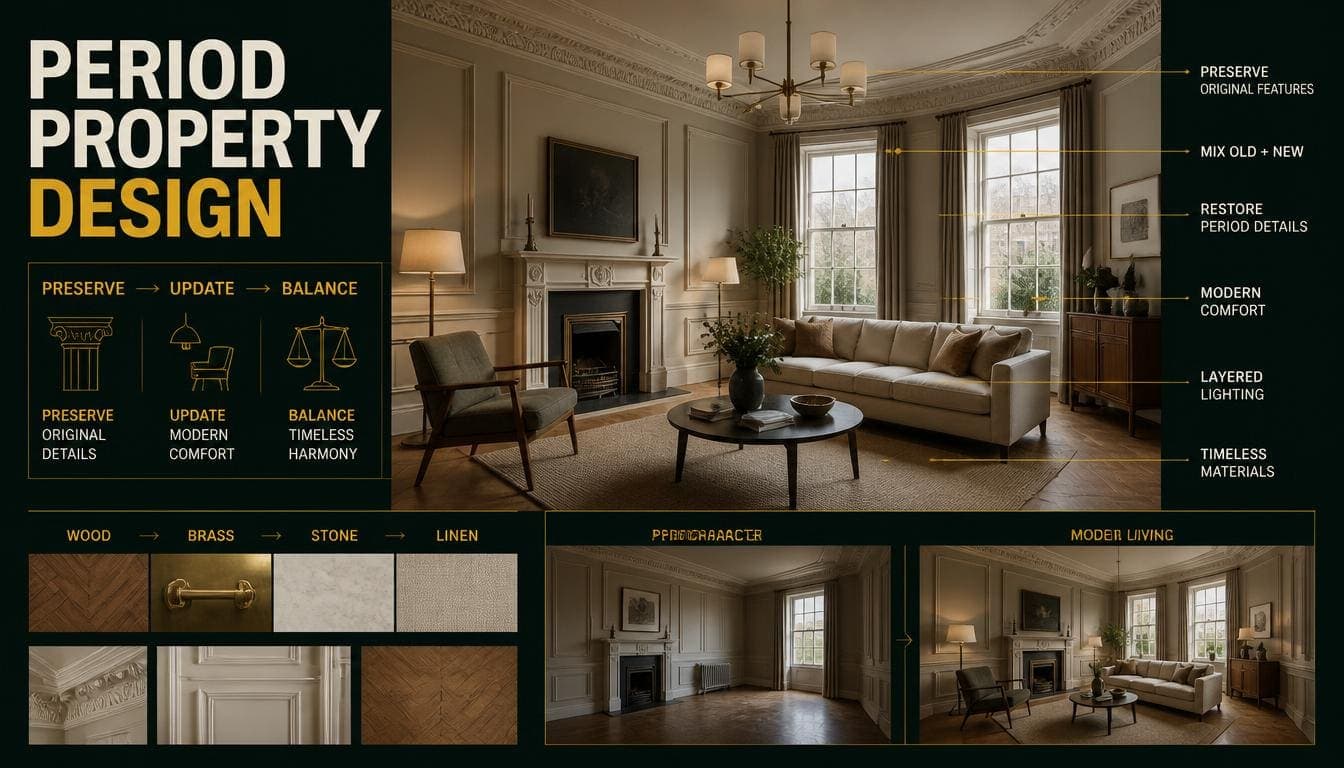
Period properties present a specific design problem: the architecture has strong character that either supports your decisions or fights them. The same contemporary scheme that works in a new build produces visual conflict in a Victorian room with cornicing and a marble fireplace.
That doesn't mean period properties need period interiors. It means the decisions have to acknowledge what's already there.
This covers what's worth keeping, what's worth changing, and where the conflicts arise.
What Period Features Actually Are
Worth being specific, because "period features" is used loosely.
Structural and Architectural
Cornicing and ceiling roses — plaster mouldings at the wall-ceiling junction and around light fittings.
Fireplaces and chimney breasts — often with a surround, hearth, and register grate.
Sash windows — vertically sliding, with glazing bars.
Panelled doors — four or six panel, with period ironmongery.
Picture rails and dado rails — horizontal mouldings at roughly 2000mm and 900mm.
Skirting — deeper and more profiled than contemporary equivalents.
Original flooring — floorboards, often pine, sometimes parquet or tile in hallways.
Ceiling height — Victorian and Georgian ground floors are frequently 2700mm+.
Why They Matter
Buyers pay for them. Period features are among the most consistently valued characteristics in older properties.
They're irreplaceable in practice. Reproduction cornicing and fireplaces exist and rarely match the original.
They set the register. A room with deep cornicing and a marble fireplace reads as formal, which affects what furnishing works.
Try DecoAI Free
3 free credits. No credit card needed. Stage any room in 30 seconds.
Get 3 Free CreditsWhat's Worth Restoring
High Value, Worth the Effort
Original fireplaces. Even blocked ones. Opening up a bricked fireplace and restoring the surround is among the highest-return period restorations.
Cornicing. Repairing damaged sections and stripping accumulated paint layers. Cornicing with twenty coats of paint loses all definition.
Sash windows. Repairing rather than replacing. Original sashes with draught-proofing and secondary glazing perform adequately and preserve the elevation.
Original floorboards. Sanding and finishing. Frequently found under carpet in reasonable condition.
Panelled doors. Stripping and refinishing, rather than replacing with flush doors.
Moderate Value
Picture rails. Easy to reinstate if removed, though their absence isn't a significant loss.
Dado rails. More divisive. They cut walls at an awkward height and some period schemes are better without them.
Original ironmongery. Handles, hinges, and escutcheons. Cheap to source in reproduction, worth keeping where original.
Low Value or Negative
Servants' bells and speaking tubes. Curiosities rather than features.
Original single glazing without secondary. The character is in the frame and glazing bars, not the performance. Secondary glazing preserves both.
Original electrical and plumbing. These need replacing regardless of period.
What's Worth Updating
Period properties have genuine functional problems.
Insulation
Solid walls, suspended timber floors, and single glazing all perform poorly.
Options:
- Loft insulation — cheapest and highest return
- Floor insulation — under suspended timber floors, disruptive but effective
- Internal wall insulation — effective, but reduces room size and can cause condensation if done badly
- External wall insulation — effective, but destroys the elevation. Rarely appropriate in period properties
The caution: period buildings were designed to breathe. Sealing them with impermeable insulation can trap moisture and cause damp. Breathable materials matter here more than in modern construction.
Heating
Original systems are usually long replaced, but radiator positioning frequently isn't.
Common problem: radiators under sash windows, which was correct when heat loss through single glazing needed countering. With secondary glazing, that position is less necessary and often awkward.
Bathrooms and Kitchens
Period properties frequently have these in inconvenient positions — bathrooms downstairs, kitchens in a rear extension.
Reconfiguring is often the highest-value change, though it needs to work with the structure rather than against it.
Electrical
Almost always needs full replacement. Socket positions in period properties are typically inadequate for modern use.
Damp
Common in period properties, and frequently misdiagnosed.
Actual causes: failed pointing, blocked airbricks, raised external ground levels, defective gutters, and impermeable modern finishes trapping moisture.
The frequent misdiagnosis: rising damp, which is far rarer than the number of injected damp-proof courses would suggest.
Practical: investigate the cause before treating the symptom. Most period damp is a maintenance problem rather than a structural one.
Try DecoAI Free
3 free credits. No credit card needed. Stage any room in 30 seconds.
Get 3 Free CreditsWhere Contemporary Design Conflicts
Cornicing and Flat Ceilings
The conflict: contemporary schemes typically use flat, undecorated ceilings. Cornicing draws the eye to the junction and reads as ornament.
Resolution: paint the cornicing the same colour as the ceiling and walls. It becomes sculptural rather than decorative, and it stops competing.
Deep Skirting and Minimal Furniture
The conflict: deep profiled skirting reads as traditional; minimal low furniture reads as contemporary. Together they can look unresolved.
Resolution: paint the skirting in the wall colour. It reduces the visual weight substantially.
Fireplaces and Modern Layouts
The conflict: a fireplace is a strong focal point that dictates furniture arrangement. Contemporary open-plan layouts frequently want the focus elsewhere.
Resolution: work with it. A fireplace is an asset, and arranging around it is easier than fighting it.
Sash Windows and Contemporary Window Treatments
The conflict: minimal or absent window treatments read as contemporary; sash windows have a strong frame that benefits from softening.
Resolution: simple full-length curtains, hung high and wide. They soften without adding period fussiness.
Period Proportions and Modern Furniture
The conflict: Victorian and Georgian rooms are frequently taller than they are wide, with high ceilings. Low contemporary furniture emphasizes the height, sometimes uncomfortably.
Resolution: taller elements — a large mirror, full-height curtains, a tall bookcase — balance the proportion.
Style Approaches That Work
Transitional
Traditional furniture forms with contemporary restraint. Warm neutrals, one pattern, mixed wood tones, simple curtains.
Why it works: it acknowledges the architecture without recreating a period interior.
The strongest general choice for period properties.
Traditional
Full period-appropriate furnishing.
Where it works: properties with substantial original detail, and markets where buyers expect it.
The risk: reads as dated if executed heavily. The lighter Transitional version is usually safer.
Contemporary With Period Detail Retained
Modern furniture and neutral palette, with cornicing, fireplaces, and skirting kept and painted into the walls.
Why it works: the architecture provides character; the furnishing provides the current register.
The requirement: paint the detail into the walls rather than picking it out in white. Contrasting white cornicing against contemporary furniture is the conflict.
Eclectic
Mixing periods, unified by palette or material.
Why it works: period properties have an inherent historical layer, which supports mixed furnishing better than a new build does.
What Doesn't Work
Industrial — exposed ductwork against cornicing is unresolved.
Coastal — the relaxed register conflicts with period formality.
Minimalist — the restraint fights the ornament. Unless the period detail has been removed entirely.
Heavy Country — works in rural period properties, reads as themed in urban ones.
Colour in Period Properties
Historic Colours
Manufacturers produce ranges based on historical pigments — deeper, more muted, and often more saturated than contemporary neutrals.
Where they work: rooms with substantial period detail, and properties where a period register is appropriate.
The caution: historically accurate doesn't mean it suits how the room is used now. Victorian interiors were often dark by contemporary standards.
The Contemporary Approach
Warm whites and soft neutrals throughout, with the architecture providing the interest.
Why it works: it lets the cornicing, fireplace, and proportions be the character rather than adding more.
Colour Drenching
Walls, cornicing, skirting, and doors in one colour.
Particularly effective in period rooms, because it makes the ornament sculptural rather than decorative, and it removes the busy effect of picked-out white detail.
What to Avoid
Picking out cornicing in white against a coloured wall. It emphasizes the ornament and reads as dated in most contemporary schemes.
Very pale schemes in rooms with heavy detail. The contrast between white ornament and white walls flattens the detail.
For Property Presentation
Show the Features
Period features are what buyers are paying for. They should be visible in the photographs.
Practical:
- Include the cornicing in the frame — shoot with enough ceiling visible
- Photograph the fireplace directly
- Show the window from an angle that displays the sash and glazing bars
- Include original flooring where it exists
Don't Fight the Architecture
Contemporary staging in a heavily period room creates visual conflict. Transitional or restrained Traditional staging works better.
Practical: if you're staging digitally, Traditional or Transitional almost always outperforms Modern or Minimalist in a period property.
Be Honest About Condition
Period properties are surveyed thoroughly, and problems surface.
Practical: damp, structural movement, and roof condition are all found. Presenting them accurately is better than the alternative.
What Buyers Assess
Which features survive. Buyers of period properties actively look for cornicing, fireplaces, and original doors.
What's been removed. A Victorian property with all detail stripped out is worth less to buyers who wanted the character.
Modernisation quality. Poorly executed previous work — uPVC windows in a Georgian elevation, artex over cornicing — is a genuine negative.
Running costs. Period properties are expensive to heat, and buyers know it.
Worth Doing Before Selling
Strip paint from cornicing if it's lost definition — labour-intensive but transformative.
Open a blocked fireplace if there's one behind the wall — one of the highest-return period restorations.
Sand and finish original floorboards if they're under carpet — $15–$30 per m² and it reveals a genuine feature.
Repair rather than replace sash windows.
Not worth doing: full period restoration to sell. Buyers frequently have their own plans.
Common Mistakes
1. Replacing Sash Windows With uPVC
Destroys the elevation and reduces value to period-property buyers. Repair with secondary glazing instead.
2. Removing Period Detail
Cornicing, fireplaces, and original doors are what buyers pay for.
3. Picking Out Cornicing in White
Emphasizes the ornament and reads as dated. Paint it into the wall colour.
4. Impermeable Insulation and Finishes
Period buildings were designed to breathe. Sealing them traps moisture and causes damp.
5. Misdiagnosing Damp
Most period damp is failed pointing, blocked airbricks, or raised ground levels — not rising damp.
6. Contemporary Staging in a Period Room
Creates visual conflict. Transitional or Traditional works better.
7. External Wall Insulation
Effective thermally, destroys the elevation. Rarely appropriate in period properties.
8. Full Period Restoration to Sell
Expensive, and buyers frequently have their own plans.
Frequently Asked Questions
What are period features?
Cornicing, ceiling roses, fireplaces, sash windows, panelled doors, picture and dado rails, deep skirting, and original flooring. They're among the most consistently valued characteristics in older properties.
Which period features are worth restoring?
Fireplaces, cornicing, sash windows, original floorboards, and panelled doors — roughly in that order of return.
Should I replace sash windows?
Repair rather than replace. Original sashes with draught-proofing and secondary glazing perform adequately and preserve the elevation, which uPVC destroys.
How do I modernise a period property without ruining it?
Keep the architectural detail, paint it into the wall colour rather than picking it out, use Transitional furnishing, and update the services rather than the fabric.
What colour should cornicing be?
The same as the walls and ceiling in most contemporary schemes. Picking it out in white emphasizes the ornament and reads as dated.
Why do period properties get damp?
Usually failed pointing, blocked airbricks, raised external ground levels, defective gutters, or impermeable modern finishes trapping moisture. Rising damp is far rarer than commonly diagnosed.
What style works in a period property?
Transitional is the strongest general choice. Traditional works where the detail is substantial. Contemporary works if the period detail is painted into the walls rather than contrasted.
Can I insulate a period property?
Yes, but with breathable materials. Period buildings were designed to breathe, and impermeable insulation can trap moisture and cause damp.
Should I restore period features before selling?
Opening a blocked fireplace and sanding original floorboards return well. Full period restoration rarely does — buyers frequently have their own plans.
Summary
What's worth restoring: fireplaces, cornicing, sash windows, original floorboards, panelled doors.
What's worth updating: insulation with breathable materials, electrical, heating, and bathroom and kitchen positions.
The conflict to resolve: contemporary furnishing against period ornament. The fix is usually painting the detail into the wall colour rather than contrasting it.
The strongest style: Transitional. Traditional forms with contemporary restraint.
On damp: investigate the cause. Most period damp is maintenance, not structure.
For selling: show the features, stage Transitional rather than Contemporary, and be accurate about condition.
Stage to suit the architecture. DecoAI gives 3 free credits with no card required — Traditional and Transitional consistently outperform Contemporary in period rooms.