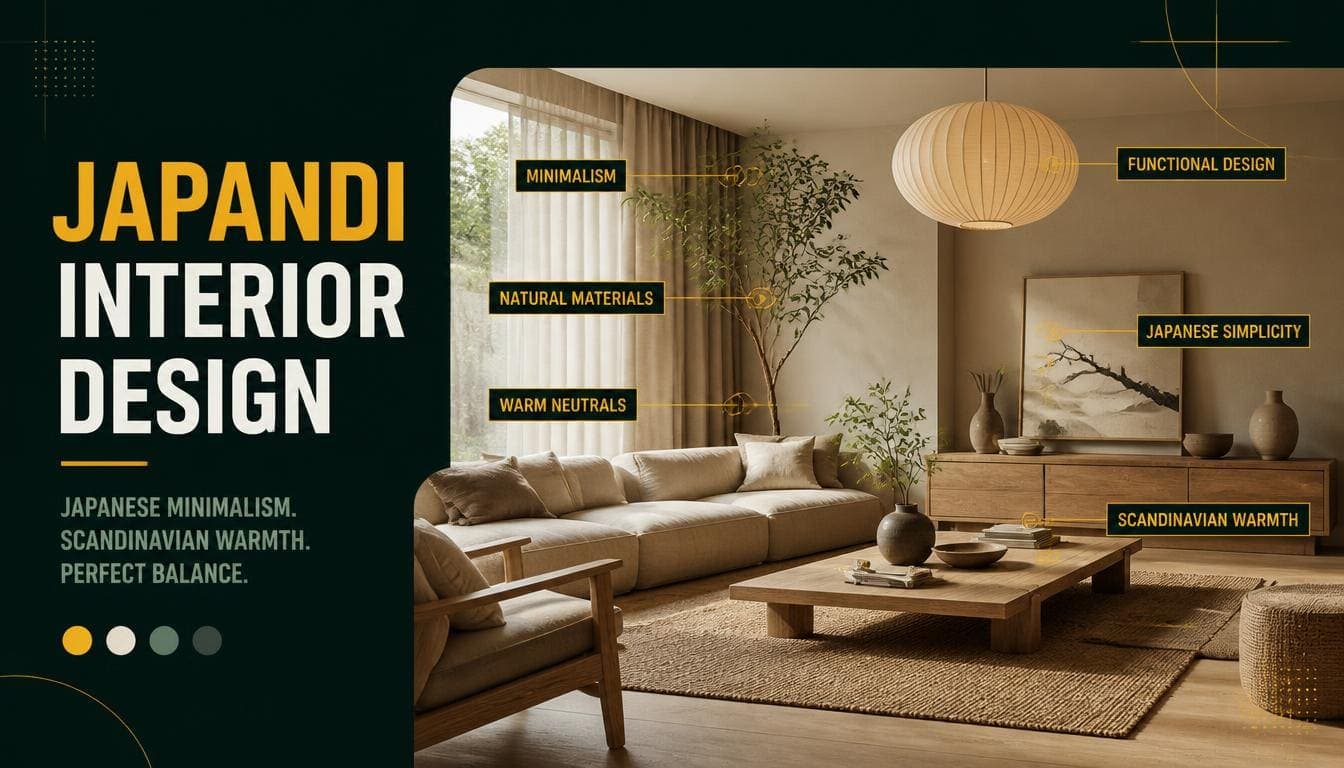
Japandi combines Japanese and Scandinavian design, which works better than most hybrid styles because the two traditions already share a great deal — restraint, natural materials, craft, and functional simplicity.
What each contributes differs. Japanese design brings discipline, asymmetry, and an acceptance of imperfection. Scandinavian brings warmth, comfort, and light.
The result is calmer and darker than Scandinavian, and warmer and softer than Japanese minimalism.
What Each Tradition Contributes
From Japanese Design
Wabi-sabi — Finding beauty in imperfection, wear, and asymmetry. A handmade ceramic with an uneven glaze is preferred to a flawless machine-made one.
Ma — Negative space treated as an active element rather than an absence. Empty space is part of the composition.
Restraint in quantity — Very few objects, each deliberately chosen.
Low furniture — Seating and tables closer to the floor than Western equivalents.
Natural materials, minimally finished — Wood with visible grain, paper, stone, unglazed ceramic.
Asymmetry — Deliberate off-centre arrangement rather than balanced symmetry.
From Scandinavian Design
Warmth through texture — Wool, sheepskin, linen. Comfort as a design value.
Light maximized — Pale surfaces, unobstructed windows, functional lighting.
Functional comfort — Furniture designed to be sat in for hours, not just looked at.
Hygge — Cosiness as a deliberate outcome.
Practical craft — Well-made everyday objects rather than decorative ones.
Try DecoAI Free
3 free credits. No credit card needed. Stage any room in 30 seconds.
Get 3 Free CreditsThe Defining Characteristics
Restrained object count. Fewer things than Scandinavian, and considerably fewer than most styles.
Two-tone wood. Pale Scandinavian woods alongside darker Japanese-influenced tones. The contrast is characteristic.
Black as a structural accent. Black metal frames, black-stained timber, black ceramic. Used sparingly and deliberately.
Handmade objects. Ceramics with visible throwing marks, textiles with irregular weave, wood with knots left in.
Low furniture. Lower sofas, lower tables, sometimes floor cushions.
Natural texture over pattern. Almost no pattern. Interest comes from material.
Muted greens. Sage, olive, and moss as the primary colour accent when there is one.
Deliberate asymmetry. Arrangements that are balanced but not symmetrical.
The Japandi Palette
Base Colours
- Warm white and bone — walls
- Pale wood — ash, birch, light oak
- Dark wood — walnut, charred or stained timber
- Warm grey and greige
- Black — used structurally rather than as a field colour
Accent Colours
Fewer and more muted than Scandinavian:
- Sage and olive green
- Clay and terracotta — used sparingly
- Deep charcoal
What Japandi avoids: bright colour of any kind, pastels, and the softer pinks and blues that appear in Scandinavian interiors.
The Two-Tone Wood Rule
The most characteristic palette decision.
How it works: pale wood for larger surfaces — flooring, larger furniture — with darker wood for smaller pieces and accents. Or the reverse.
Why it matters: all-pale reads as Scandinavian. All-dark reads as heavy. The contrast between the two is what makes it Japandi.
Materials
Core Materials
Wood — Both pale and dark, with visible grain. Left natural or lightly oiled rather than lacquered.
Linen — Loose weave, natural drape, in bone or grey.
Wool — Textured rather than smooth. Chunky knit throws, flat-weave rugs.
Paper — Rice paper lampshades, screen panels where the architecture allows.
Stone and ceramic — Unglazed or matte-glazed. Handmade preferred to uniform.
Black metal — Frames, legs, lighting, hardware.
Rattan and cane — Used sparingly, more restrained than in Bohemian or Coastal.
What It Avoids
- High gloss and lacquer
- Chrome and polished metal
- Synthetic materials that look synthetic
- Anything mass-produced-looking
- Heavy upholstery
Try DecoAI Free
3 free credits. No credit card needed. Stage any room in 30 seconds.
Get 3 Free CreditsJapandi vs Scandinavian
The comparison people search for most.
| Factor | Japandi | Scandinavian |
|---|---|---|
| Object count | Very few | Few |
| Wood tone | Two-tone, pale and dark | Predominantly pale |
| Black accents | Characteristic | Occasional |
| Colour accents | Sage, olive, very muted | Sage, dusty blue, soft pink |
| Symmetry | Deliberately asymmetric | Often symmetric |
| Furniture height | Lower | Standard |
| Texture | Present but restrained | Layered, prominent |
| Imperfection | Valued | Not emphasized |
| Overall feel | Calm, disciplined | Cosy, warm |
The simplest distinction: Scandinavian is warm and comfortable. Japandi is warm and disciplined. Scandinavian layers textiles; Japandi restrains them.
Japandi vs Minimalist
| Factor | Japandi | Minimalist |
|---|---|---|
| Warmth | Present through wood and texture | Deliberately absent |
| Materials | Natural, handmade | Manufactured, precise |
| Imperfection | Valued | Avoided |
| Palette | Warm neutrals plus black | Monochrome |
| Feel | Calm | Austere |
Japandi is minimalism with warmth and craft. Minimalism is restraint for its own sake.
Japandi by Room
Living Room
Furniture: Low sofa in linen or wool, one or two low wooden chairs, a low coffee table in dark wood
Palette: Bone or warm white walls, pale flooring, dark furniture accents
Textiles: One textured wool throw, two cushions maximum, a flat-weave rug in a natural tone
Lighting: Paper pendant or a simple black metal fixture
Detail: One handmade ceramic vessel, one plant. That's the whole accessory count.
Bedroom
The strongest Japandi room, because bedrooms benefit from the restraint.
Furniture: Low platform bed, simple wooden bedside tables
Palette: Bone walls, linen bedding in natural or grey
Textiles: Linen bedding, one wool throw, no decorative cushions
Lighting: Paper or fabric shade, low and warm
Detail: Nothing on the bedside table except a lamp and possibly one object.
Dining Area
Furniture: Simple wooden table, low-backed chairs — often in a contrasting wood or black
Lighting: A single pendant, paper or black metal
Detail: One ceramic bowl or vessel. No runner, no place settings.
Kitchen
Cabinets: Flat-front, handleless, in pale wood or matte white with dark accents
Worktops: Stone or timber, matte finish
Detail: Minimal open shelving with a very few ceramics
Home Office
Furniture: Simple wooden desk, low bookshelf, black metal or wooden chair
Palette: Bone walls, two-tone wood
Detail: One plant, minimal visible storage
Where Japandi Works
Small and Mid-Sized Rooms
The restraint suits compact spaces. Few objects means maximum visible floor.
Properties With Good Natural Light
The style depends on light to prevent the darker wood and black accents reading as heavy.
Contemporary and Renovated Properties
Clean architecture suits it. Japandi doesn't need period detail and can feel at odds with it.
Bedrooms Particularly
Where calm is the goal, Japandi's discipline works better than Scandinavian's layering.
Urban Apartments
Broad demographic appeal, works in compact spaces, reads as considered.
Where It Falls Short
Family Homes With Children
The style depends on very few objects and clear surfaces. That's difficult to maintain with a family, and staging it can set an expectation the property can't sustain in use.
Very Large Rooms
Japandi's restraint leaves generous rooms looking underfurnished.
Dark Rooms
The darker wood and black accents need light. In a dim north-facing room, Japandi goes heavy.
Period Properties With Ornate Detail
Cornicing, panelling, and carved detail conflict with the style's discipline.
Markets Wanting Warmth Above All
In family and suburban markets where comfort signals matter most, Contemporary or Scandinavian usually performs better.
Common Mistakes
1. Too Many Objects
The most common. Japandi's restraint is more severe than Scandinavian's, and a room with eight accessories isn't Japandi.
2. All Pale Wood
Without the darker wood contrast, it's just Scandinavian.
3. Too Much Black
Black is a structural accent — frames, legs, one fixture. Black as a field colour pushes toward Industrial or Minimalist.
4. Adding Pattern
Japandi is essentially patternless. Interest comes from material and texture.
5. Perfect, Uniform Objects
The wabi-sabi element matters. Machine-perfect ceramics and flawless finishes work against the register.
6. Layering Textiles Like Scandinavian
Two cushions and one throw, not six cushions and three throws.
7. Using It in Dark Rooms
The palette needs light to avoid reading as heavy.
Frequently Asked Questions
What is Japandi interior design?
A blend of Japanese minimalism and Scandinavian warmth — very few objects, two-tone wood, black structural accents, natural materials, muted greens, and deliberate asymmetry.
What's the difference between Japandi and Scandinavian?
Japandi uses fewer objects, two-tone wood rather than predominantly pale, black accents, deliberate asymmetry, and lower furniture. Scandinavian layers textiles more and reads warmer and cosier.
What colours are Japandi?
Warm white and bone as base, pale and dark wood, warm grey, and black as a structural accent. Sage and olive as the main colour accent, used sparingly.
What is wabi-sabi?
A Japanese concept valuing beauty in imperfection, wear, and asymmetry. In Japandi it appears through handmade objects, visible craft marks, and natural irregularity.
Does Japandi work in small rooms?
Yes, well. The restrained object count maximizes visible floor and the style suits compact spaces.
Is Japandi the same as minimalism?
No. Minimalism is restraint without warmth. Japandi adds natural materials, texture, and craft, which makes it calm rather than austere.
What furniture suits Japandi?
Low profile, simple forms, in wood with visible grain. Linen or wool upholstery. Black metal frames as accents.
Does Japandi work for family homes?
Difficult. The style depends on very few objects and clear surfaces, which is hard to sustain with a family in the property.
What's the most common Japandi mistake?
Too many objects. The restraint is more severe than Scandinavian's, and most attempts are noticeably over-furnished.
Summary
What it is: Japanese minimalism plus Scandinavian warmth — very few objects, two-tone wood, black structural accents, natural handmade materials, muted greens, deliberate asymmetry.
What each side contributes: Japan brings discipline, asymmetry, and wabi-sabi. Scandinavia brings warmth, texture, and comfort.
The defining detail: two-tone wood. All pale reads as Scandinavian; the pale-and-dark contrast is what makes it Japandi.
Where it works: small and mid-sized rooms, bright properties, contemporary architecture, bedrooms particularly, and urban apartments.
Where it fails: family homes, very large rooms, dark rooms, ornate period properties, and markets prioritizing comfort above all.
The most common error: too many objects. Japandi's restraint is more severe than most people apply.
Compare it against Scandinavian. DecoAI gives 3 free credits with no card required — enough to see the difference between the two in your own room.