Transitional Interior Design: Traditional Warmth Without the Dated Look
Transitional is the answer to a specific problem: Traditional design has warmth that Contemporary lacks, but it also has period signals that make it look dated.
Transitional keeps the warmth and drops the signals. Classic furniture forms, contemporary restraint. Comfortable without being fussy, current without being cold.
For a large proportion of properties, it's the strongest staging choice available — and it's the least discussed of the major styles.
What Transitional Is
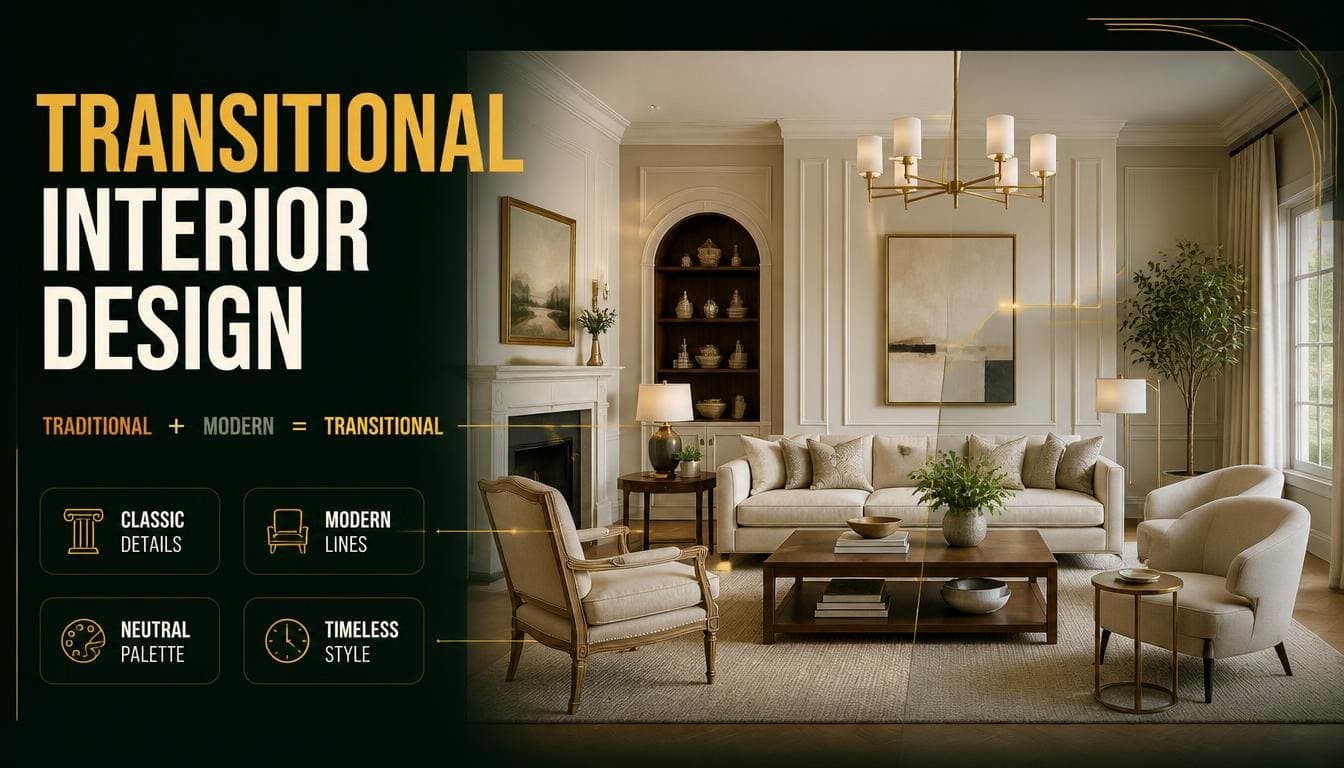
Transitional emerged as designers began mixing traditional and contemporary elements rather than committing to either. It's less a movement than a working method, which is why definitions vary.
The consistent characteristics:
Traditional furniture shapes, simplified. A rolled-arm sofa without the tufting. A wooden dining table without the turned legs.
Neutral palettes rather than warm colour. Cream and greige rather than burgundy and forest green.
One pattern maximum per room. Traditional layers pattern; Transitional uses it once.
Mixed wood tones. Traditional matches; Transitional deliberately doesn't.
Simplified window treatments. Full-length plain curtains rather than swags, pelmets, and tassels.
Restrained ornament. One carved or detailed piece, not a room full of them.
Contemporary art in traditional frames. The most characteristic Transitional move — old form, current content.
Try DecoAI Free
3 free credits. No credit card needed. Stage any room in 30 seconds.
Get 3 Free CreditsTransitional vs Traditional vs Contemporary
| Factor | Traditional | Transitional | Contemporary |
|---|---|---|---|
| Furniture shapes | Classic, ornate | Classic, simplified | Current, curved |
| Palette | Warm colour | Warm neutral | Warm neutral |
| Pattern | Multiple, layered | One per room | Texture over pattern |
| Wood tones | Matched, darker | Mixed, mid-tone | Light to mid |
| Window treatments | Elaborate | Simple full-length | Simple or none |
| Ornament | Throughout | One or two pieces | Minimal |
| Feel | Formal, period | Comfortable, timeless | Current, soft |
The distinction that matters: Traditional commits to a period. Contemporary commits to now. Transitional avoids committing to either, which is why it dates more slowly than both.
The Transitional Palette
Base Colours
- Warm white and cream — the most common wall colour
- Greige — the contemporary influence
- Soft mushroom and taupe
- Warm sand
Accent Colours
- Sage and soft green
- Dusty blue
- Muted terracotta
- Soft navy — used sparingly
Transitional accents are more muted than Traditional's burgundy and forest green, but warmer than Contemporary's cooler palette.
Wood Tones
Mid-tone oak, walnut, and ash — deliberately mixed rather than matched.
The characteristic move: an oak dining table with walnut chairs, or a walnut sideboard against oak flooring. Traditional would match them; Transitional doesn't.
Metals
Brushed brass, antique bronze, and matte black. Avoid chrome and high polish.
Transitional by Room
Living Room
Furniture: Rolled-arm or track-arm sofa in a neutral fabric, two armchairs that don't match each other exactly, wooden coffee table with simple lines
Palette: Cream or greige walls, neutral upholstery, one muted accent
Textiles: One patterned element — either the rug or the cushions, not both. Full-length plain curtains.
Lighting: Table lamps with fabric shades, one floor lamp
Art: Contemporary pieces in wooden or brass frames
The characteristic detail: symmetry in the arrangement, but not in the individual pieces. Two chairs flanking a fireplace, but chairs that complement rather than match.
Bedroom
Furniture: Upholstered headboard with a simple profile, mid-tone wood bedside tables, a bench at the foot
Palette: Cream or soft greige walls, neutral bedding
Textiles: Layered bedding in neutrals, one textured throw, full-length curtains
Lighting: Matching bedside lamps with fabric shades
Avoid: Heavily carved bed frames, patterned bedding, elaborate window treatments
Dining Room
Furniture: Solid wood table with simple legs, upholstered chairs in a neutral fabric
Palette: Warm neutral walls, wood as the tone source
Lighting: A pendant or simplified chandelier — the fixture can be traditional in form but shouldn't be ornate
Detail: A sideboard in a complementary but not matching wood
Kitchen
Cabinets: Shaker-style in cream, greige, or sage — traditional form, current colour
Worktops: Quartz or stone with subtle veining
Hardware: Brushed brass or matte black
Detail: Open shelving with a few pieces, rather than a full dresser
Shaker cabinets in a contemporary colour are the definitive Transitional kitchen.
Home Office
Furniture: Wooden desk with clean lines, upholstered chair
Palette: Neutral walls, or a deeper tone — navy or olive works here
Detail: Bookcase in a mid-tone wood, one traditional element like a brass desk lamp
Try DecoAI Free
3 free credits. No credit card needed. Stage any room in 30 seconds.
Get 3 Free CreditsWhere Transitional Wins
Family and Suburban Markets
The clearest case. Transitional has Traditional's warmth — which family buyers respond to — without the dated signals that make Traditional risky.
Properties with Some Period Character
A property with original fireplaces or cornicing but otherwise updated interiors. Transitional respects the architecture without committing fully to period furnishing.
When You're Unsure Between Traditional and Contemporary
If the market suggests Traditional but you're worried about looking dated, Transitional is the correct answer.
Mid-Market Properties
Broad appeal, warm without being fussy, current without being fashionable.
Longer Listing Periods
Because it avoids both period and trend signals, Transitional dates more slowly than either parent style. On a property that might be listed for several months, that matters.
Larger Rooms
Transitional's fuller furnishing suits generous proportions better than Scandinavian or Minimalist restraint.
Where Transitional Falls Short
Very Small Rooms
Transitional furniture is fuller than Scandinavian equivalents. In compact spaces, the slimmer profile of Scandinavian shows more floor.
Urban Apartments
City markets skew toward Modern and Contemporary. Transitional's warmth can read as suburban in an urban context.
New Builds
Clean-lined contemporary architecture doesn't provide the traditional reference Transitional half-depends on. Contemporary suits new builds better.
Premium and Luxury Properties
Transitional reads as comfortable rather than impressive. At high price points, Luxury or Modern signal the tier more clearly.
Character Properties with Strong Architecture
A warehouse conversion or a strongly period property is better served by Industrial or full Traditional respectively.
Common Transitional Mistakes
1. Drifting Into Traditional
Adding a second pattern, matching all the wood tones, or introducing elaborate window treatments. Each step moves it back toward the dated version.
2. Drifting Into Contemporary
Removing all traditional forms leaves you with Contemporary, which loses the warmth that made Transitional useful.
3. Matching Everything
The mixed wood tones and complementary-not-matching furniture are characteristic. A fully matched set reads as Traditional.
4. Using Colour as a Base
Transitional uses warm neutrals with muted accents. Deep colour on walls pushes it toward Traditional.
5. Elaborate Window Treatments
Swags, pelmets, and tassels are the fastest route back to dated. Full-length plain curtains achieve the same warmth.
6. Using It in Small Rooms
Fuller furniture in compact spaces. Scandinavian shows more floor.
The Practical Test
If you're unsure whether an arrangement is Transitional or has drifted:
Count the patterns. More than one per room and you're in Traditional territory.
Check the wood tones. All matching means Traditional. All light and matching means Scandinavian. Mixed mid-tones means Transitional.
Look at the window treatments. Anything more than a full-length plain curtain is Traditional.
Check the walls. Deep colour is Traditional. Warm neutral is Transitional.
Look at the art. Contemporary pieces in traditional frames is the definitive Transitional signal.
Frequently Asked Questions
What is transitional interior design?
A blend of traditional furniture forms with contemporary restraint — classic shapes simplified, warm neutral palettes, one pattern per room, mixed wood tones, and simple window treatments.
How is transitional different from traditional?
Traditional layers pattern, matches wood tones, uses deeper colours, and includes elaborate window treatments. Transitional simplifies all four while keeping the furniture forms.
How is transitional different from contemporary?
Contemporary uses current curved forms and prioritizes texture. Transitional uses classic forms simplified. Transitional is warmer; Contemporary is more current.
Is transitional good for staging?
Very. It has Traditional's warmth without the dated signals, which makes it strong in family and suburban markets where Contemporary can read as cold.
What colours are used in transitional design?
Warm white, cream, greige, and taupe as bases. Sage, dusty blue, muted terracotta, and soft navy as accents.
Should wood tones match in transitional design?
No — mixed mid-tones are characteristic. Matched wood reads as Traditional.
Does transitional work in small rooms?
Less well than Scandinavian. Transitional furniture is fuller and shows less floor.
What's the defining transitional detail?
Contemporary art in traditional frames. Old form, current content — it captures the whole approach in one element.
When should I choose transitional over contemporary?
Family and suburban markets, properties with some period character, larger rooms, and longer listing periods where dating matters.
Summary
What it is: Traditional furniture forms with contemporary restraint. Warm without being dated, classic without being period.
Use it for: Family and suburban properties, homes with some period character, mid-market listings, larger rooms, and longer listing periods.
Skip it for: Very small rooms, urban apartments, new builds, premium properties, and buildings with strong architectural character.
The four things that keep it Transitional rather than Traditional: one pattern per room, mixed wood tones, warm neutral walls, and simple full-length curtains.
The defining move: contemporary art in traditional frames.
Compare it against the alternatives. DecoAI gives 3 free credits with no card required — enough to test Transitional against Contemporary and Traditional in the same room.