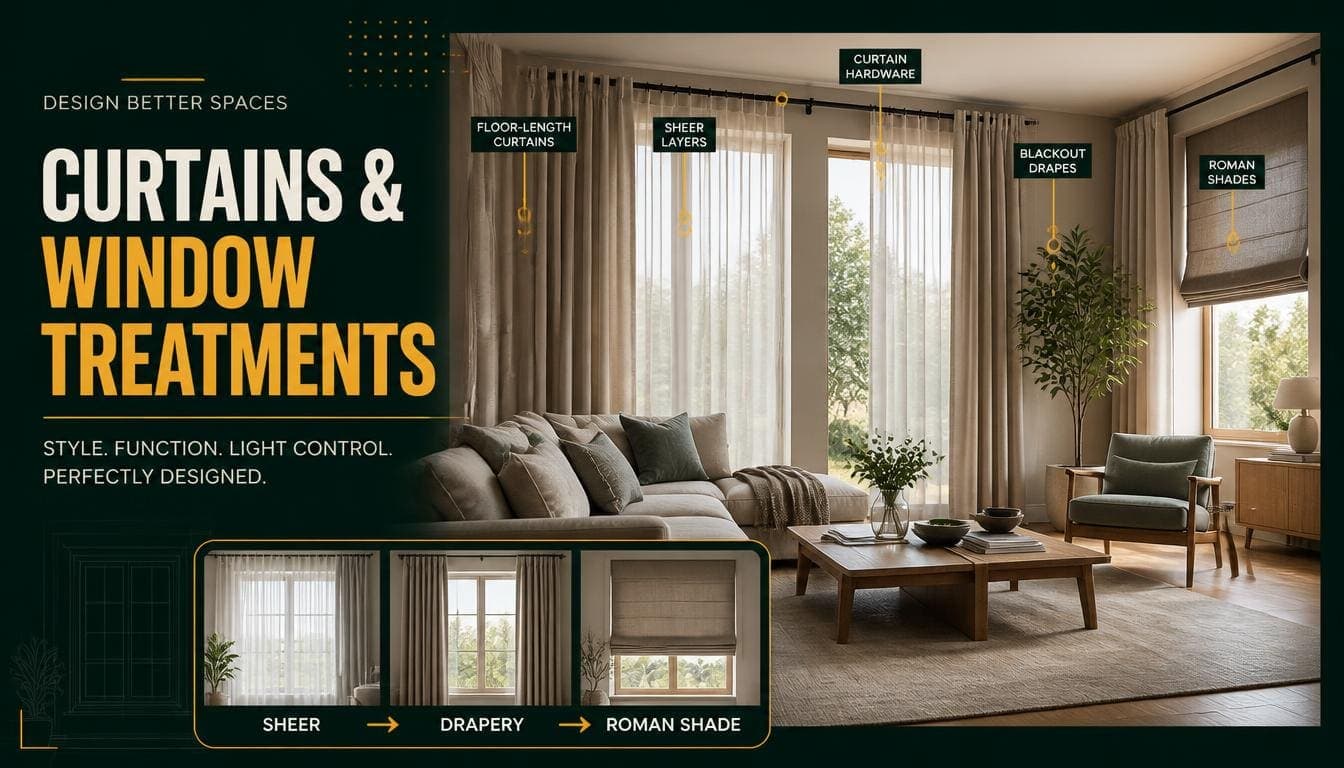
Curtains hung badly make windows look smaller, ceilings look lower, and rooms look less finished than they are. Curtains hung well do the opposite, using the same window and often the same fabric.
The difference is almost entirely in the measurements — where the rail goes, how wide it extends, and how long the fabric falls.
This covers those measurements, how to choose between curtains and blinds, and what works in each room.
The Three Measurements That Matter
1. Rail Height: Higher Than the Window
Standard: 10–15cm above the window frame.
Better in most rooms: as close to the ceiling as practical, or 5–10cm below the ceiling line.
Why: the eye reads the top of the curtain as the top of the window. Hanging high makes the window appear taller and the ceiling higher.
The common error: rail fixed directly to the window frame. This makes the window look exactly its actual size, which is the smallest it can look.
The exception: rooms with cornicing worth showing, or where a picture rail creates a natural line to work with.
2. Rail Width: Wider Than the Window
Extend 15–25cm beyond the frame on each side.
Why two reasons:
Light. When open, the curtains stack against the wall rather than over the glass, so the full window is exposed.
Proportion. The window appears wider than it is.
The common error: rail the same width as the window. When open, the curtains cover 20–30% of the glass, reducing both light and apparent window size.
3. Length: To the Floor
Standard: 1cm above the floor. Close enough to read as touching, high enough to avoid dragging.
Break: 2–5cm of fabric resting on the floor. More relaxed, slightly more formal in effect, but collects dust and needs adjusting.
Puddle: 10–20cm on the floor. Traditional and Luxury registers only. Impractical in daily use.
What to avoid: curtains ending at the windowsill or partway down the wall. This is the most dated-looking option and makes rooms feel smaller.
The exception: sill-length curtains are acceptable where a radiator, furniture, or a kitchen worktop sits directly below the window.
Try DecoAI Free
3 free credits. No credit card needed. Stage any room in 30 seconds.
Get 3 Free CreditsFabric Width
Curtains need more fabric than the window is wide, or they hang flat rather than in folds.
The Fullness Ratio
| Ratio | Effect | Best for |
|---|---|---|
| 1.5× window width | Minimal folds | Sheers, budget |
| 2× | Standard fullness | Most rooms |
| 2.5× | Generous | Formal rooms, heavy fabric |
| 3× | Very full | Luxury, silk, statement windows |
Standard recommendation: 2× the rail width, split between two panels.
Example: a 200cm rail needs 400cm of total fabric width, so two panels of 200cm each.
The common error: buying panels sized to the window width. The result hangs flat and reads as cheap regardless of fabric quality.
Curtains vs Blinds vs Both
Curtains
Best for: living rooms, bedrooms, dining rooms — anywhere warmth and softness matter.
Advantages: insulation, sound absorption, softness against hard surfaces, the ability to make windows look larger.
Disadvantages: take wall space when open, collect dust, more expensive for a given window.
Blinds
Best for: kitchens, bathrooms, home offices, and any window where curtains would be impractical.
Types:
Roller — Simplest and cheapest. Clean lines. Suits Modern and Minimalist.
Roman — Fabric folds when raised. Softer than roller, more structured than curtains. Works in most styles.
Venetian — Slatted, adjustable light control. Aluminium reads as functional; timber reads as warmer.
Vertical — Largely dated in residential contexts. Still used for large sliding doors.
Shutters — Most expensive, most architectural. Reads as permanent and adds perceived value.
Advantages: no wall space needed, precise light control, practical near worktops and baths.
Disadvantages: less warmth, no insulation benefit to speak of, can read as functional rather than finished.
Both Together
Blind for practical light control, curtains for warmth and proportion.
Where it works: living rooms and bedrooms where you want both blackout capability and the softness of fabric.
The caution: it's the most expensive option, and in a small room it can read as heavy.
Headings
The way the curtain attaches to the rail affects how it hangs and what register it reads as.
| Heading | Look | Best for |
|---|---|---|
| Wave / ripple fold | Uniform soft waves | Contemporary, Modern |
| Pencil pleat | Gathered, informal | Traditional, Country |
| Pinch pleat | Structured, formal | Traditional, Luxury |
| Eyelet | Casual, wide folds | Modern, Scandinavian |
| Tab top | Very casual | Country, Bohemian |
| Rod pocket | Fixed, doesn't slide well | Sheers only |
Practical note: eyelet and tab top don't stack as tightly when open, so they need more rail extension beyond the window.
Fabric and Weight
Sheers
Light-filtering, privacy without blocking daylight.
Best for: ground-floor rooms overlooked by the street, and layering under heavier curtains.
Note: sheers alone provide privacy during the day and none at night when interior lights are on.
Medium-Weight
Cotton, linen blends, lined cotton.
Best for: most rooms. Enough weight to hang well without dominating.
Heavy
Velvet, wool, heavily lined fabrics.
Best for: bedrooms needing blackout, formal rooms, and cold rooms where insulation matters.
Caution: heavy curtains in small rooms read as oppressive.
Lining
Standard lining: improves how curtains hang, protects the face fabric, adds modest insulation.
Blackout lining: for bedrooms. Worth it.
Interlining: an additional layer between face fabric and lining. Substantially better insulation and drape, substantially more expensive.
Try DecoAI Free
3 free credits. No credit card needed. Stage any room in 30 seconds.
Get 3 Free CreditsBy Room
Living Room
Recommended: floor-length curtains, rail near ceiling, 2× fullness, medium-weight lined fabric.
Colour: either matching the walls for a seamless effect, or one tone darker. Strongly contrasting curtains draw the eye to the window frame rather than the view.
Bedroom
Recommended: floor-length curtains with blackout lining, or a blackout blind with curtains over.
The practical requirement: actual darkness. Light leaking around the edges of a blackout blind defeats the purpose — curtains extending well beyond the frame solve it.
Kitchen
Recommended: blinds. Roller or Roman.
Why: fabric near cooking absorbs grease and odour. Curtains near a worktop or sink are impractical.
Length: to the sill or just below.
Bathroom
Recommended: blinds, in a moisture-tolerant material. Or shutters.
Avoid: fabric curtains, which hold moisture and develop mould.
Home Office
Recommended: blinds for glare control, particularly Venetian or Roman.
Why: screen glare is the practical concern, and adjustable slats handle it better than curtains.
Dining Room
Recommended: floor-length curtains. The room tolerates more formality than most.
Common Mistakes
1. Rail Fixed to the Window Frame
Makes the window look its smallest possible size. Hang high — near the ceiling where practical.
2. Rail the Same Width as the Window
Curtains cover the glass when open, reducing light and apparent window width. Extend 15–25cm each side.
3. Curtains Ending at the Sill
The most dated-looking option in most rooms. Floor length reads better in almost every case.
4. Insufficient Fabric Width
Panels sized to the window hang flat. 2× the rail width is standard.
5. Curtains Too Short
Ending 5–15cm above the floor reads as an error rather than a choice. Either 1cm above the floor or resting on it.
6. Heavy Fabric in Small Rooms
Reads as oppressive and reduces light.
7. Strong Contrast Against the Wall
Draws the eye to the window frame rather than through it. Matching or one tone darker works better.
8. Fabric Curtains in Kitchens and Bathrooms
Absorbs grease, odour, and moisture. Blinds are the practical answer.
For Property Presentation
Before Photographing
Open everything fully. Curtains pulled back completely, blinds raised entirely. Natural light does more for a photograph than anything else.
Check the stack. If curtains cover part of the window when open, that's visible in photographs and reduces apparent window size.
Iron or steam. Creased curtains are visible in photographs.
Remove anything dated. Swagged pelmets, tie-backs with tassels, and net curtains all read as dated and are cheap to remove.
Worth Doing Before Selling
Replacing dated curtains with simple floor-length panels in a neutral is one of the cheaper high-impact changes.
Cost: $60–$200 per window for ready-made.
Moving the rail higher costs almost nothing and makes windows look taller.
The Staging Note
AI staging tools generate window treatments inconsistently — sometimes adding curtains, sometimes leaving windows bare.
What to check: whether generated curtains sit at a plausible height and don't obscure the window. If they cover a substantial part of the glass, regenerate.
Practical approach: photograph with existing curtains fully open, or removed entirely if they're dated. Bare windows stage more predictably than dressed ones.
Frequently Asked Questions
How high should curtains be hung?
10–15cm above the window frame as a minimum, or as close to the ceiling as practical. Higher makes windows look taller and ceilings higher.
How wide should a curtain rail be?
Extending 15–25cm beyond the window frame on each side, so curtains stack against the wall rather than over the glass when open.
How long should curtains be?
Floor length in almost all cases — 1cm above the floor. Sill length reads as dated except where a radiator or worktop sits below the window.
How much fabric width do I need?
2× the rail width as standard, split between two panels. A 200cm rail needs two 200cm panels.
Should I use curtains or blinds?
Curtains for living rooms, bedrooms, and dining rooms. Blinds for kitchens, bathrooms, and home offices where fabric is impractical or glare control matters.
What colour should curtains be?
Matching the wall colour or one tone darker. Strong contrast draws the eye to the window frame rather than through it.
Do I need lining?
Standard lining improves how curtains hang and protects the fabric. Blackout lining is worth it in bedrooms.
Are sill-length curtains ever right?
Where a radiator, worktop, or furniture sits directly below the window. Otherwise floor length reads better.
What should I do with curtains before photographing a property?
Open them fully, check they don't cover the glass when open, steam out creases, and remove anything dated like pelmets or net curtains.
Summary
The three measurements: rail 10–15cm above the frame or near the ceiling, extending 15–25cm each side, with curtains to 1cm above the floor.
Fabric width: 2× the rail width, split between two panels. Less and they hang flat.
Curtains vs blinds: curtains for living rooms and bedrooms, blinds for kitchens, bathrooms, and offices.
Colour: matching the walls or one tone darker. Contrast draws attention to the frame rather than the view.
The most common error: rail fixed to the window frame at the same width as the window. It makes the window look as small as it possibly can.
Photograph windows bare or fully open. DecoAI gives 3 free credits with no card required — bare windows stage more predictably than dressed ones.