Children's rooms have a design problem other rooms don't: the occupant changes substantially every few years, and the room usually doesn't.
A nursery becomes a toddler's room, then a child's, then a teenager's. Each stage has different requirements for storage, furniture, and use of floor space. A room designed precisely for one stage needs redoing for the next.
The alternative is designing for adaptability — which mostly means putting the money into things that don't change and keeping the things that do change cheap and replaceable.
Design for the Change
What Doesn't Change
- The room's dimensions and window positions
- Flooring
- Wall colour, if it's neutral
- Built-in storage, if it's designed generously
- Lighting positions
- Power socket positions
Spend here. These carry through every stage.
What Changes Every Few Years
- Bed size and style
- Toy storage versus book and clothing storage
- Desk requirement — none, then essential
- Decoration, colour preferences, and interests
- Floor space needs — play space, then study space
Keep these cheap and replaceable. Bedding, wall art, small furniture, and decorative items.
Try DecoAI Free
3 free credits. No credit card needed. Stage any room in 30 seconds.
Get 3 Free CreditsThe Stages
Nursery — 0 to 2
Furniture: cot, changing surface, storage for clothes and supplies, a chair for feeding.
Floor space: minimal requirement.
The practical note: the changing table is used intensively for eighteen months and then isn't. Either use a chest of drawers with a changing mat on top, or accept you'll be replacing it.
Blackout: genuinely important at this stage. Proper blackout blinds or lined curtains, extending well beyond the window frame.
Toddler and Young Child — 2 to 6
Furniture: small bed, low storage, floor play space.
The dominant requirement: floor space. This is the peak play years and the room needs clear floor more than it needs furniture.
Storage: low and accessible so the child can put things away themselves. Storage above their reach is storage you're responsible for.
Practical: open boxes or baskets they can drop things into. Anything requiring a lid or a latch doesn't get used.
School Age — 6 to 11
Furniture: full-size bed, more book and clothing storage, a desk becomes useful.
The shift: from floor play to surface-based activity. The desk appears, and floor space matters slightly less.
Storage: more shelving, less toy storage. Books, projects, and collections.
Teenage — 12+
Furniture: full or double bed, desk, adequate wardrobe, seating.
The dominant requirement: the room becomes a bedroom, study, and social space simultaneously.
Storage: wardrobe capacity increases substantially. Books and technology.
Practical: the room needs to feel like theirs. Autonomy over decoration matters at this stage in a way it doesn't earlier.
Layout Principles
Bed Position
Against the longest uninterrupted wall, as with any bedroom.
Not under a window if avoidable — draughts, light, and blind cords.
In shared rooms, beds on opposite walls or bunked, with each child having a defined side.
Floor Space
For under-sixes: prioritize clear floor above almost everything else. Reduce furniture rather than reducing play space.
Practical minimum: roughly 2m × 1.5m of clear floor for meaningful play.
The Desk
When it's needed: typically from age seven or eight.
Position: beside the window if possible, perpendicular so light falls across the surface.
Size: 1000–1200mm wide is enough. Larger desks in small rooms take space that's needed elsewhere.
Storage Position
Low for young children. Anything above roughly 1200mm is out of reach and becomes adult-managed.
Higher storage for infrequent items — seasonal clothes, keepsakes — is fine at any age.
Storage That Works
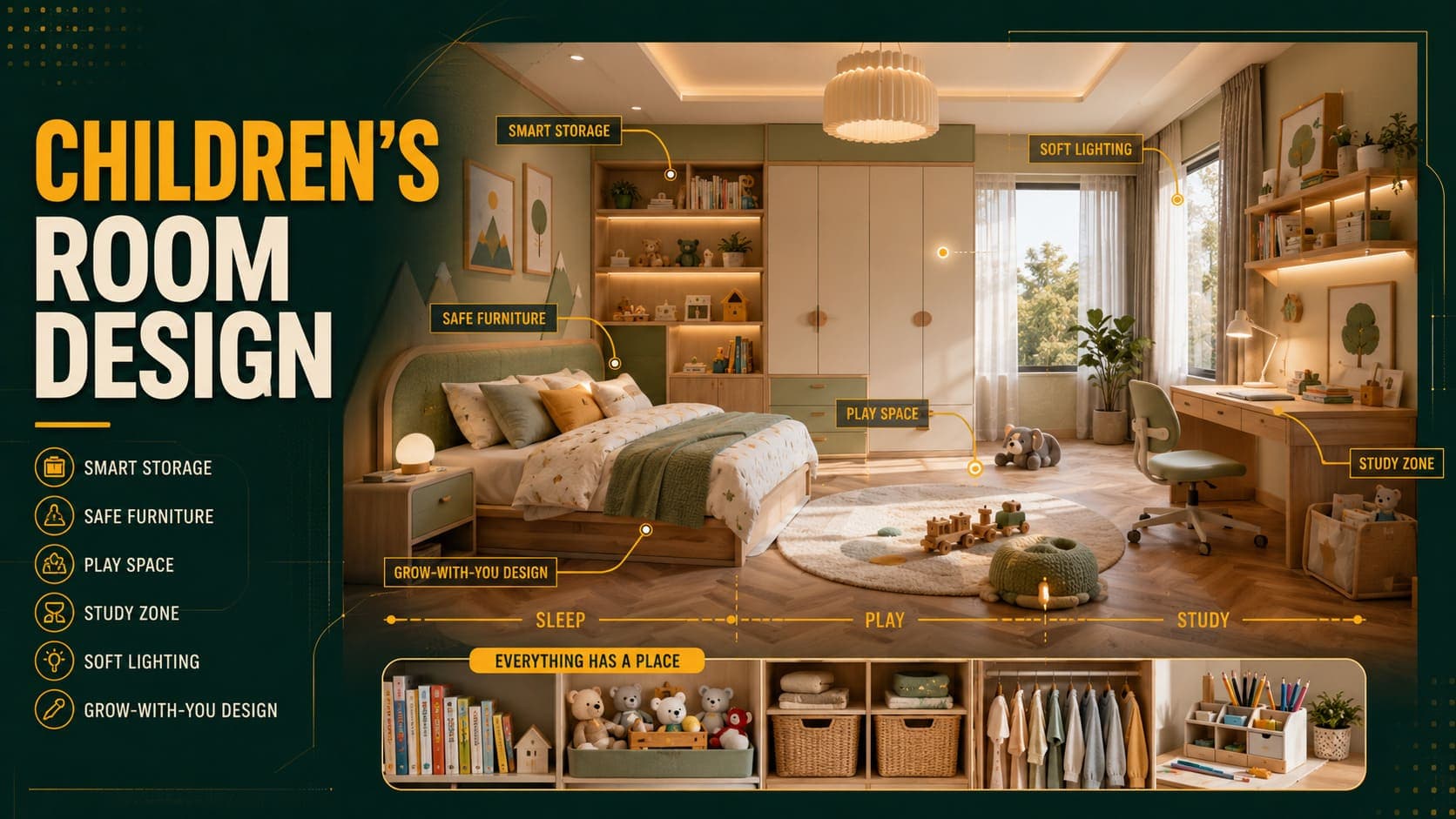
Children generate more possessions per square metre than adults, and the storage requirement is genuinely high.
Under-Bed Storage
The most efficient option in a child's room. Deep drawers or a lifting frame.
Holds: toys, spare bedding, out-of-season clothes, larger items that don't fit elsewhere.
Open Boxes and Baskets
Why open: young children don't reliably use storage with lids or latches. Anything requiring an extra action doesn't get used.
Practical: consistent boxes in a consistent colour read as tidy even when the contents aren't.
Low Shelving
Accessible shelving up to roughly 1200mm for books and things in current use.
Built-In Wardrobe
Worth the investment because it's the storage element that carries through every stage.
Sizing: children need less hanging space and more shelving than adults. A wardrobe with half hanging and half shelving works better than full-height hanging.
Wall-Mounted Storage
Frees floor space, which matters most in the young-child stage.
Practical: picture ledges for books hold surprisingly many and let children see covers, which is more useful than spines at that age.
What Doesn't Work
Toy boxes with heavy lids. Fingers, and children don't use them.
Storage requiring adult assistance. Becomes your job.
Themed storage furniture. Outgrown fast and expensive to replace.
Try DecoAI Free
3 free credits. No credit card needed. Stage any room in 30 seconds.
Get 3 Free CreditsThe Theming Question
The Case Against Heavy Theming
Children's interests change faster than furniture. A dinosaur-themed room for a four-year-old is a problem for a seven-year-old.
Cost: themed wallpaper, bedding, storage, and furniture is expensive to replace when the interest shifts.
Resale: if you're selling, a heavily themed room narrows appeal to buyers with a child of exactly that age and interest.
The Workable Compromise
Neutral fixed elements: walls, flooring, storage, and furniture in colours and forms that work at any age.
Themed removable elements: bedding, wall stickers, posters, cushions, and a few decorative objects.
Cost of a theme change: $50–$150 rather than a redecoration.
Where Theming Is Fine
One wall. A single feature wall in a bold colour or pattern is easily repainted.
Removable wall stickers. The best value theming available.
Textiles. Bedding, curtains, and cushions carry a theme and cost little to change.
Shared Bedrooms
Two children in one room is common and specific challenges follow.
Defining Personal Space
Each child needs a defined area, however small.
Practical tools:
- Beds on opposite walls
- Their own bedside surface, however small
- Their own storage, clearly theirs
- Their own wall space for pictures
Bunk Beds
Advantages: frees substantial floor space, which is the scarce resource in a shared room.
Considerations: age-appropriate for the top bunk, ceiling height for sitting up, and access to the top bunk at night.
Ceiling height: roughly 2.4m minimum for a standard bunk with comfortable headroom on the top.
Storage in Shared Rooms
Double the requirement, not the same amount split. Two children in a room need roughly twice the storage of one, and shared rooms are usually the smaller bedrooms.
Practical: built-in storage becomes more important, since freestanding wastes space you can't afford to waste.
Small Children's Rooms
Frequently the smallest bedroom in the property.
Priorities
1. Bed — fits, with access. 2. Storage — mostly under-bed and wall-mounted. 3. Clear floor — whatever remains.
What to Sacrifice
The desk — a child can work at the dining table until the room genuinely can't accommodate one.
Freestanding storage — built-in or under-bed instead.
Decorative furniture — chairs, tables, anything that isn't structural.
Space-Saving Options
Cabin bed — bed raised with storage or a desk beneath. Effective, though ceiling height matters.
Wall-mounted desk — folds down, or a simple shelf at desk height.
Bed with built-in drawers — no separate storage furniture needed.
Colour and Light
Colour
Neutral base with removable colour is the practical approach.
What works: warm white, soft grey, pale sage, muted blue. All read as calm and work at any age.
What to reconsider: strong colours on all four walls. It's harder to live with than it looks in the shop, and children's colour preferences change.
Blackout
Genuinely important, particularly for younger children.
Proper blackout means: lined blinds or curtains extending well beyond the window frame. Light leaking around the edges of a blind defeats the purpose.
Night Lighting
A dim, warm light source for night waking. A plug-in nightlight, or a dimmable lamp.
Avoid: anything with a bright blue-white LED indicator. Small lights in a dark room are more disruptive than they seem.
For Property Presentation
Staging Children's Rooms
Keep the room reading as a bedroom. If bedroom count is a selling feature, a room staged as a playroom undermines your own headline.
Neutral rather than themed. Themed staging narrows the appeal to buyers with a child of that specific age.
Reduce toys substantially. Enough to signal a child's room, not enough to read as cluttered.
Don't strip it entirely. A child's room stripped to a bare bedroom loses the family-home impression, which is often part of what's being sold.
The Balance
Show: a bed, storage, a clear floor, and one or two age-signalling items — a small bookshelf, a soft toy on the bed.
Remove: the majority of toys, personal photographs, name signs, artwork with the child's name, and anything heavily themed.
Common Mistakes
1. Designing for the Current Stage Only
The occupant changes every few years. Neutral fixed elements, changeable soft elements.
2. Heavy Theming
Expensive to change, outgrown fast, and narrows resale appeal.
3. Storage Above Reach
Becomes adult-managed. Low and accessible for young children.
4. Storage With Lids and Latches
Requires an extra action, so it doesn't get used.
5. Too Much Furniture in the Young Years
Floor space matters more than furniture for under-sixes.
6. Inadequate Blackout
Light leaking around a blind defeats the purpose entirely.
7. Adding a Desk Too Early
Takes floor space that's needed for play. Age seven or eight is usually when it earns its place.
8. Staging a Bedroom as a Playroom
Undermines the bedroom count if that's part of the property's headline.
Frequently Asked Questions
How do I design a children's room that lasts?
Neutral fixed elements — walls, flooring, storage, furniture — with themed removable elements like bedding, stickers, and cushions. Changing a theme then costs $50–$150 rather than a redecoration.
What storage works best in a child's room?
Under-bed drawers, open boxes at low height, low shelving, and a built-in wardrobe with more shelving than hanging space.
Should storage have lids?
No, for young children. Anything requiring an extra action doesn't get used. Open boxes and baskets work better.
How much floor space does a child's room need?
Roughly 2m × 1.5m of clear floor for meaningful play in the under-six years. Reduce furniture rather than play space.
When does a child need a desk?
Typically age seven or eight. Before that it takes floor space that's needed for play, and homework can happen at the dining table.
How do I share a bedroom between two children?
Beds on opposite walls or bunked, each with their own bedside surface, storage, and wall space. Storage requirement roughly doubles.
What ceiling height do bunk beds need?
Roughly 2.4m minimum for comfortable headroom on the top bunk.
Should I theme a child's room?
Lightly and removably. Bedding, wall stickers, and textiles carry a theme cheaply. Themed wallpaper, furniture, and storage don't.
How should I stage a child's room for sale?
Keep it reading as a bedroom, reduce toys substantially, remove personal items and names, and keep the styling neutral. Don't strip it entirely — some family character helps.
Summary
The core problem: the occupant changes every few years and the room usually doesn't.
The solution: neutral fixed elements — walls, flooring, storage, furniture. Cheap changeable soft elements — bedding, stickers, cushions.
By stage: nursery needs blackout and changing space. Under-sixes need floor space. School age needs a desk and shelving. Teenagers need wardrobe capacity and autonomy.
Storage that works: under-bed drawers, open low boxes, wall-mounted shelving, and a built-in wardrobe with more shelving than hanging.
Theming: removable only. Bedding and stickers, not wallpaper and furniture.
For staging: keep it a bedroom, reduce the toys, remove names and personal items, stay neutral.
Stage it as a bedroom, not a playroom. DecoAI gives 3 free credits with no card required — bedroom count is usually part of a property's headline, and staging should support it.