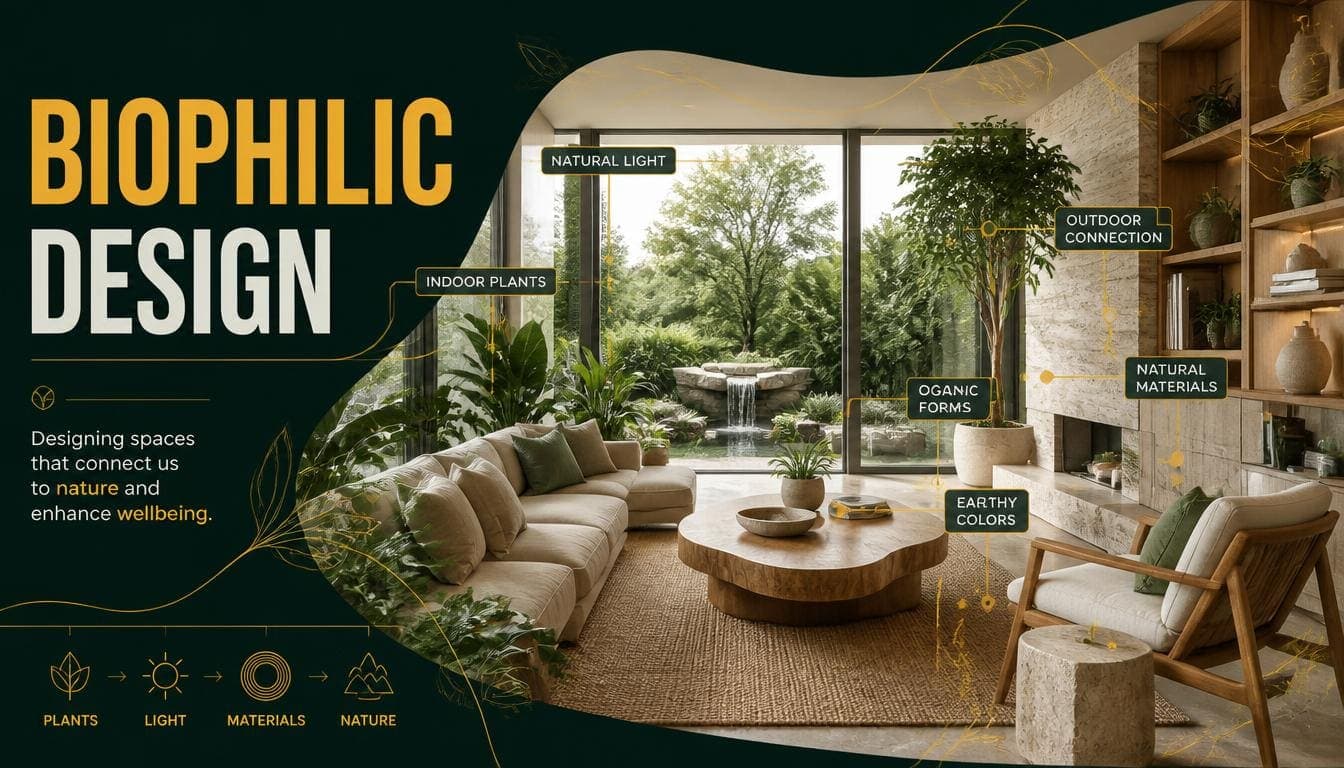
Biophilic design is the practice of bringing natural elements into interiors — light, plants, natural materials, views, and organic forms. The concept is genuinely useful. The claims made about it frequently aren't.
Marketing around biophilic design routinely cites precise wellbeing improvements, productivity gains, and health outcomes that don't hold up when you check the sources. That's unfortunate, because the underlying principles are sound and don't need overclaiming.
This covers what the evidence actually supports, what it doesn't, and how to apply the approach practically.
What Biophilic Design Means
The term comes from biophilia — the hypothesis, popularized by biologist E.O. Wilson, that humans have an innate affinity for nature.
Applied to interiors, it means designing spaces that incorporate natural elements rather than excluding them.
The Elements
Natural light — Maximizing daylight and managing it well.
Plants — Living greenery in the space.
Natural materials — Wood, stone, wool, linen, clay used honestly.
Views — Sightlines to gardens, trees, sky, or water.
Natural forms — Organic shapes rather than strict geometry.
Natural patterns — Grain, veining, and irregular textures.
Air and ventilation — Fresh air movement rather than sealed environments.
Water — Where practical, though rarely in residential settings.
Try DecoAI Free
3 free credits. No credit card needed. Stage any room in 30 seconds.
Get 3 Free CreditsWhat the Evidence Supports
Being specific about the confidence level of each claim.
Well Supported: Natural Light
Daylight access is associated with better sleep patterns and mood. This is among the better-evidenced findings in environmental psychology.
The mechanism is understood: light exposure affects circadian rhythm, which affects sleep quality and daytime alertness.
Practical implication: maximizing daylight is the highest-confidence biophilic intervention available.
Confidence: high.
Well Supported: Air Quality and Ventilation
Poor ventilation measurably affects cognitive performance. This has been studied reasonably rigorously in office environments, with controlled conditions.
Practical implication: ventilation matters more than most decorative decisions.
Confidence: high.
Important caveat: the popular claim that houseplants meaningfully improve indoor air quality is not well supported. The frequently cited NASA study used sealed chambers with plant densities far beyond what any home contains. At realistic densities, the effect on air quality is negligible compared to opening a window.
Plants are worth having. Air purification isn't the reason.
Moderately Supported: Views of Nature
The most-cited study found hospital patients with a view of trees recovered somewhat faster than those facing a brick wall. It's a real finding from 1984 with a small sample, and it has been broadly replicated in direction if not magnitude.
Practical implication: views matter, and blocking them with furniture or heavy window treatments has a cost.
Confidence: moderate.
Moderately Supported: Plants and Mood
Several studies associate the presence of plants with modest improvements in reported mood and perceived stress. Effect sizes vary, sample sizes are often small, and self-selection is difficult to rule out.
The honest position: plants probably help somewhat. The size of the effect is uncertain and smaller than commonly claimed.
Confidence: moderate.
Weakly Supported: Specific Productivity Percentages
Claims like "biophilic design improves productivity by 15%" almost always trace to industry reports rather than controlled research.
Productivity in knowledge work is notoriously difficult to measure, and studies claiming precise improvements rarely control adequately for confounding variables.
Confidence: low.
Not Supported: Health Outcome Claims
Anything approaching a medical claim — that biophilic design reduces illness, improves immune function, or treats conditions — is not supported by the evidence.
Confidence: very low.
The Practical Version
Stripped of the overclaiming, biophilic design reduces to a set of sensible decisions.
1. Maximize Daylight
The highest-return biophilic intervention.
Practical actions:
- Open curtains and blinds fully
- Keep window sills clear
- Avoid blocking windows with tall furniture
- Use pale wall colours to reflect available light
- Consider whether window treatments obstruct when open
Cost: mostly free.
2. Improve Ventilation
Practical actions:
- Air rooms daily, even briefly
- Ensure extractors work and vent externally
- Don't seal trickle vents
- Consider air quality in rooms with poor natural ventilation
3. Add Plants — But Realistically
Two or three per room, chosen for the conditions rather than for a look.
What works in low light: snake plant, ZZ plant, pothos, cast iron plant.
What needs good light: fiddle leaf fig, monstera, most succulents, olive trees.
The most common failure: buying plants for a room they can't survive in, then replacing them repeatedly.
Practical guidance: one large plant reads better than five small ones, and is easier to keep alive.
4. Use Natural Materials Honestly
Wood with visible grain, stone with visible veining, wool and linen textiles.
The distinction: actual materials rather than printed imitations. Wood-effect vinyl doesn't deliver the same effect as timber, though it may be more practical.
5. Preserve Views
Don't block windows with furniture. Where a view exists — a garden, trees, sky — orient seating toward it.
6. Introduce Organic Forms
Curved furniture, irregular shapes, and asymmetric arrangements rather than strict geometry.
This is the softest of the principles and the one that shades into aesthetics rather than function.
Try DecoAI Free
3 free credits. No credit card needed. Stage any room in 30 seconds.
Get 3 Free CreditsPlants: A Practical Guide
Since plants are the element most associated with biophilic design.
How Many
Two or three per room is enough for the visual effect. More becomes a maintenance commitment.
One large plant generally reads better than several small ones, and survives better.
Placement
Near a window for anything that needs light, but not against a cold pane in winter.
Corners — a large plant fills an awkward corner better than furniture.
Not on every surface. Plants scattered across shelves and tables read as clutter.
Choosing for the Conditions
| Light level | Suitable plants |
|---|---|
| Bright, direct | Succulents, cacti, olive, rubber plant |
| Bright, indirect | Monstera, fiddle leaf fig, calathea |
| Moderate | Peace lily, philodendron, dracaena |
| Low | Snake plant, ZZ plant, pothos, aspidistra |
Assess honestly. A room that seems bright to you may be moderate by plant standards. North-facing rooms are low light regardless of how they feel.
Pots
The pot affects the room more than the plant does.
What works: ceramic, terracotta, or woven baskets in tones that match the room's palette.
What doesn't: plastic nursery pots, or a collection of mismatched containers.
For Property Photographs
Two or three plants total across the visible rooms. Enough to signal life without reading as a garden centre.
Healthy specimens only. A struggling plant in a photograph draws the eye and reads as neglect.
Real or artificial: high-quality artificial plants photograph acceptably and require nothing. For a property on the market for months, this is a reasonable choice.
Natural Materials in Practice
Where They Matter Most
Flooring — the largest surface, and where timber versus vinyl is most noticeable.
Worktops — stone versus laminate is highly visible.
Textiles — linen and wool versus synthetic, both visually and to the touch.
Where the Distinction Matters Less
Small decorative items — a synthetic-material object at small scale is rarely noticeable.
Anything hidden — cabinet interiors, structural elements.
The Practical Compromise
Natural materials on the surfaces you see and touch most, practical materials elsewhere.
Example: a timber floor in the living room and vinyl in the utility room is a sensible allocation rather than a compromise on principle.
Where Biophilic Design Is Overclaimed
Worth naming, because the overclaiming undermines the genuine case.
Air-Purifying Plants
The most persistent myth. At realistic household densities, plants have a negligible effect on indoor air quality. Ventilation does the work.
Precise Productivity Figures
"15% more productive," "8% faster recovery," "6% better wellbeing." These figures circulate widely and rarely trace to controlled research.
Health and Immune Claims
Anything suggesting biophilic design has medical benefits.
Green Walls as a Wellness Feature
Living walls are visually striking and require substantial maintenance, irrigation, and often replacement. The wellness case for them specifically is weak; the aesthetic case is fine.
Nature Imagery as Equivalent to Nature
Some claims treat photographs of forests as delivering similar benefits to actual views. The evidence for this is thin.
For Property Presentation
What's Worth Doing
Maximize visible light. Curtains fully open, sills clear, nothing blocking windows.
Add two or three healthy plants across the photographed rooms.
Show views where they exist. A window with a garden beyond is worth including in frame.
Emphasize natural materials where they're present — timber floors, stone worktops.
What's Not Worth Doing
Installing a green wall before selling. Expensive, high-maintenance, and the buyer may not want it.
Filling rooms with plants. Two or three reads as considered; ten reads as a commitment the buyer inherits.
Nature-themed decoration. Leaf-print wallpaper and forest photographs aren't biophilic design — they're theming.
The Staging Note
AI staging generates plants in most schemes, usually appropriately.
What to check: quantity. Some styles — particularly Bohemian and Coastal — generate more plants than a room needs.
Two or three per room reads well. More reads as overstyling.
Frequently Asked Questions
What is biophilic design?
Designing interiors to incorporate natural elements — daylight, plants, natural materials, views, organic forms, and ventilation.
Do plants improve indoor air quality?
Not meaningfully at household densities. The frequently cited NASA study used sealed chambers with plant densities far beyond any home. Ventilation does the work.
Does biophilic design improve wellbeing?
Some elements are reasonably well evidenced — daylight access and ventilation particularly. Precise percentage claims about productivity and wellbeing generally come from industry reports rather than controlled research.
How many plants should a room have?
Two or three for the visual effect. One large plant generally reads better than several small ones and survives better.
What plants work in low light?
Snake plant, ZZ plant, pothos, and aspidistra. North-facing rooms are low light regardless of how bright they feel.
Is a green wall worth it?
Visually striking, but expensive and maintenance-intensive. The wellness case specifically is weak; the aesthetic case is reasonable if you'll maintain it.
Are artificial plants acceptable?
For property presentation, yes — high-quality artificial plants photograph acceptably and require nothing. For daily living, real plants offer more.
What's the highest-return biophilic intervention?
Maximizing daylight. Open the curtains fully, clear the sills, don't block windows. It costs nothing and it's the best-evidenced element.
Is nature imagery the same as actual nature?
The evidence for photographs delivering similar benefits to real views is thin. Actual light, plants, and views are better supported.
Summary
What's well supported: daylight access and ventilation. Both affect measurable outcomes and both are largely free to improve.
What's moderately supported: views of nature and the presence of plants, with modest effects on mood.
What's overclaimed: air purification by houseplants, precise productivity percentages, and any health claim.
The practical version: maximize daylight, ventilate properly, add two or three plants suited to the light, use natural materials on surfaces you see and touch, and don't block views.
For presentation: open everything, two or three healthy plants, and show any view the property has.
Check plant quantity in staged images. DecoAI gives 3 free credits with no card required — some styles generate more plants than a room needs, and it's worth reviewing.