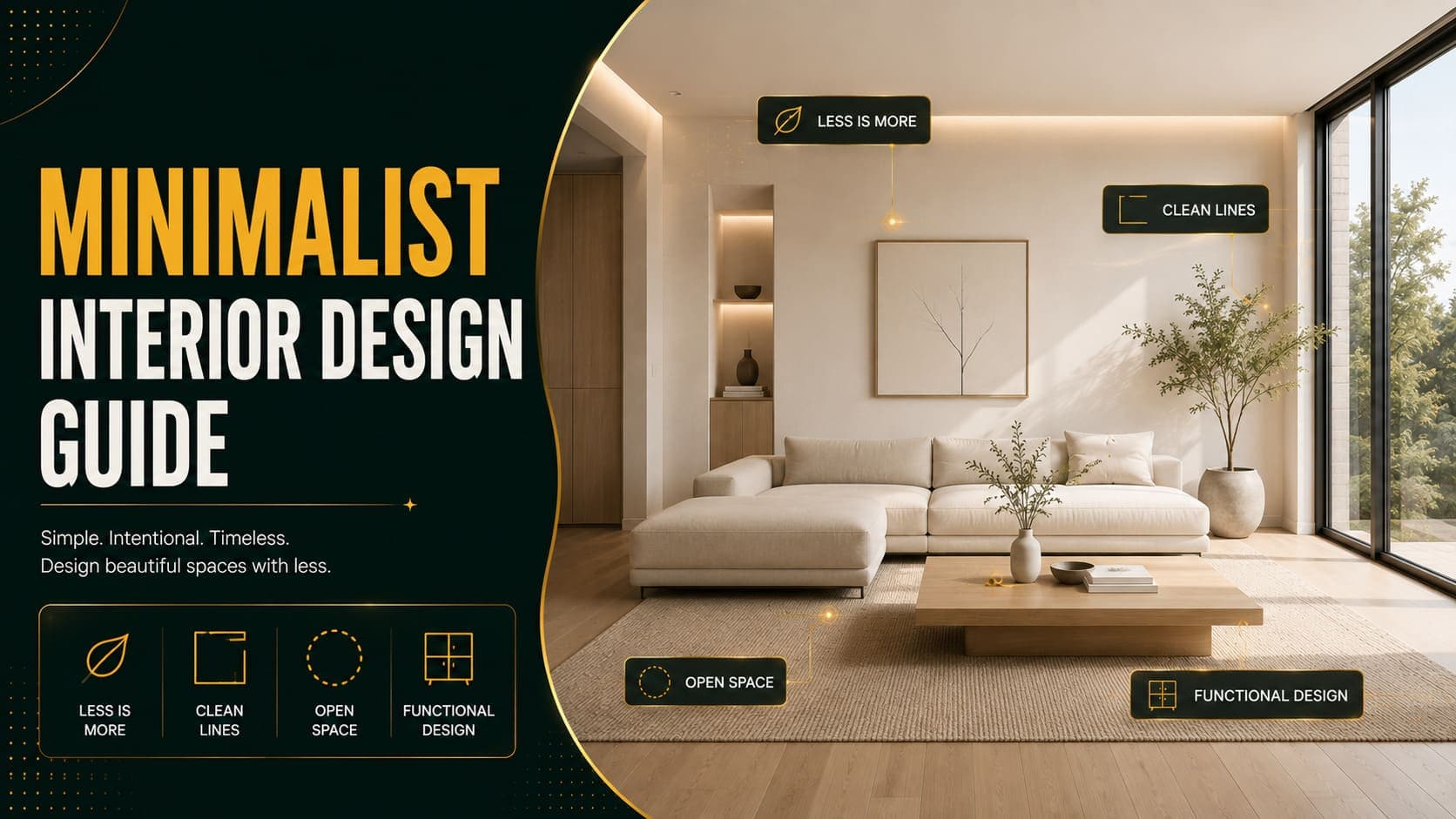
Minimalist design is the most misunderstood style in staging because people assume it means "not much furniture." It doesn't. It means every remaining item was chosen deliberately and everything else was removed.
That distinction shows in the result. A room with three carefully considered pieces reads as intentional. A room with three random pieces reads as unfurnished.
This guide covers what actually defines Minimalist, where it outperforms every other style, and the properties where it works against you.
What Minimalist Design Is
Minimalism as a design philosophy emerged from 1960s art and architecture, influenced heavily by Japanese aesthetics — particularly the concepts of ma (negative space as an active element) and kanso (simplicity through elimination).
Applied to interiors, the principle is subtraction: remove everything that isn't necessary, then make what remains excellent.
Core Characteristics
Absolute restraint in quantity — Only the pieces required for the room's function.
Monochrome or near-monochrome palette — Usually white and one other tone. Rarely more than two.
Clean geometry — Straight lines, simple forms, no ornamentation.
Hidden storage — Built-in and concealed rather than displayed. Visible storage implies possessions.
Negative space as a feature — Empty floor and blank wall are deliberate, not incidental.
Quality over quantity — With so few pieces, each one is scrutinized. Materials and proportions matter more than in styles with more visual noise.
No decorative objects — Or at most one, positioned deliberately.
Try DecoAI Free
3 free credits. No credit card needed. Stage any room in 30 seconds.
Get 3 Free CreditsThe Minimalist Palette
Base Colours
- White — the default wall and often floor colour
- Off-white and warm white — softer variants that avoid clinical coldness
- Black or charcoal — used for contrast in a single element
- Pale concrete grey — common in architectural minimalism
Accents
Minimalism typically uses no accent colour at all. Where one appears, it's a single element — one black chair in a white room, one wooden surface against concrete.
Materials
- Concrete
- Pale wood, used sparingly
- Steel and matte black metal
- Glass
- Plain natural textiles in white, grey, or oatmeal
What It Avoids
- Patterns of any kind
- Multiple colours
- Visible clutter, including books and ornaments
- Decorative moulding or detail
- Anything with visual busyness
Minimalist vs Scandinavian
These get conflated more than any other pair.
| Factor | Minimalist | Scandinavian |
|---|---|---|
| Palette | White, black, grey | White, pale wood, muted accents |
| Warmth | Deliberately low | Central to the style |
| Textiles | Minimal, plain | Layered — wool, linen, sheepskin |
| Wood | Occasional, restrained | Prominent — birch, ash, oak |
| Decorative objects | Essentially none | A few, curated |
| Plants | Rare, one at most | Common |
| Feeling | Austere, precise | Cosy, calm |
The simplest distinction: Scandinavian is warm minimalism. Minimalist is minimalism without the warmth — and that austerity is the point, not an oversight.
Which to choose for staging: Scandinavian in almost all cases, because warmth helps buyers imagine living there. Minimalist wins specifically where showing maximum floor matters more than showing comfort.
Minimalist by Room
Living Room
Furniture: One sofa, one low table. Possibly one chair. Palette: White walls, pale or concrete floor Textiles: One plain rug, no cushions or a maximum of two in the same tone Lighting: One floor lamp with a simple form Art: One piece, or none
Bedroom
Furniture: Platform bed, one or two matching bedside tables Palette: White walls, white bedding Textiles: Plain bedding, no layering, no throw Lighting: Wall-mounted reading lights rather than table lamps Storage: Built-in wardrobes only — no freestanding pieces
Minimalist bedrooms are the strongest application of the style. Bedrooms need less than any other room, and the restraint reads as restful rather than empty.
Kitchen
Cabinets: Handleless, flat-front, white or pale grey Worktops: Clear — completely Appliances: Integrated and hidden Detail: No open shelving, no visible utensils, nothing on the counter
Home Office
Furniture: Simple desk, one chair Palette: White walls, pale desk surface Storage: Wall-mounted shelf or nothing visible Lighting: One task lamp
Bathroom
Surfaces: Large-format tile or concrete, minimal grout lines Fixtures: Wall-mounted, matte black or brushed steel Detail: One folded towel, nothing else
Minimalist bathrooms photograph exceptionally well because bathrooms are naturally minimal when cleared.
Try DecoAI Free
3 free credits. No credit card needed. Stage any room in 30 seconds.
Get 3 Free CreditsWhere Minimalist Wins in Staging
Very Small Spaces
This is the strongest case. Studios, micro-apartments, and compact units under roughly 30 m².
With minimal furniture, the maximum possible floor area is visible, which directly drives perceived size.
Properties Where Square Footage Is the Selling Point
If the listing's main advantage is space, minimal furniture demonstrates it most clearly.
Architecturally Strong Properties
Where the building itself has interesting features — concrete, exposed structure, dramatic windows, unusual geometry — Minimalist staging lets the architecture speak instead of competing with it.
High-Ceilinged Spaces
Minimalism uses vertical emptiness effectively. A double-height living space staged Minimalist reads as generous.
Urban Investor Markets
Buyers purchasing for rental yield care about layout and square footage more than atmosphere. Minimalist presents both clearly.
Where Minimalist Falls Short
Family Markets
Family buyers frequently read Minimalist as impractical. The immediate reaction is often "where would everything go?"
Contemporary or Traditional performs better where storage and comfort are buying criteria.
Large Rooms
Three pieces of furniture in a 40 m² living room reads as unfurnished rather than spacious. The style's restraint needs a room small enough that restraint still fills it adequately.
Properties Needing Warmth
Older properties, rural markets, and anywhere buyers are looking for a home rather than an asset. Minimalist's austerity works against emotional connection.
Rooms with Poor Light
White-on-white in a dim room reads as grey and flat. Minimalism depends on light to look intentional rather than empty.
Period Properties
Ornate cornicing and panelling against minimalist furnishing creates an unresolved tension.
Common Minimalist Mistakes
1. Confusing Minimal with Empty
A room with three well-chosen pieces reads as designed. A room with three arbitrary pieces reads as unfinished. The difference is deliberateness.
2. All White with No Texture
Pure white with no material variation looks flat in photographs. Even Minimalist needs texture — concrete against wood, matte against gloss.
3. Using It in Large Rooms
Restraint that reads as intentional in a 15 m² room reads as sparse in a 40 m² one.
4. Applying It to Family Properties
The single most common mismatch. Family buyers want to see storage and comfort.
5. Ignoring the Light Requirement
Minimalism needs good natural light. In a dim room, choose Scandinavian instead — the warm tones handle low light far better.
6. Removing Too Much
A living room with only a sofa doesn't demonstrate function. There's a floor below which the room stops reading as usable.
Frequently Asked Questions
What is minimalist interior design?
A style based on subtraction — removing everything unnecessary and keeping only deliberately chosen essentials. Characterized by monochrome palettes, clean geometry, hidden storage, and negative space as a feature.
What's the difference between minimalist and Scandinavian?
Scandinavian is warm minimalism, using wood and textiles to create cosiness. Minimalist deliberately avoids that warmth in favour of austerity. Both are restrained; only Scandinavian is comfortable.
Does minimalist design make rooms look bigger?
Yes — more than any other style. Minimal furniture means maximum visible floor, which directly drives perceived size.
Is minimalist good for staging property?
For small spaces and architecturally strong properties, yes. For family markets and large rooms, Scandinavian or Contemporary usually performs better.
What colours are used in minimalist design?
White as the base, with black, charcoal, or pale grey for contrast. Usually no accent colour at all.
How much furniture should a minimalist room have?
Only what the room's function requires. A living room: one sofa, one table, possibly one chair. A bedroom: a bed and one or two bedside tables.
Why does my minimalist room look empty rather than spacious?
Usually one of two reasons: the room is too large for the amount of furniture, or the pieces don't read as deliberately chosen. Minimalism needs quality and intent to distinguish it from unfurnished.
Does minimalist work in family homes?
Poorly, in most cases. Family buyers look for storage and comfort signals that Minimalism deliberately removes.
What's a warmer alternative to minimalist?
Scandinavian. Similar restraint, similar space-maximizing effect, but with wood and textiles that make the room feel liveable.
Summary
Minimalist design maximizes visible floor and lets architecture speak. In small spaces and architecturally interesting properties, nothing else performs as well.
Use it for: Studios and micro-apartments, properties where square footage is the selling point, architecturally strong buildings, high-ceilinged spaces, and investor-focused markets.
Skip it for: Family properties, large rooms, dim spaces, period buildings, and anywhere buyers want warmth.
The most useful comparison: if you're considering Minimalist for a property that isn't tiny or architecturally exceptional, Scandinavian probably serves you better. Same space-maximizing effect, considerably more warmth.
Compare them yourself. DecoAI gives 3 free credits with no card required — enough to generate the same room in Minimalist and Scandinavian and see which reads better for your property.