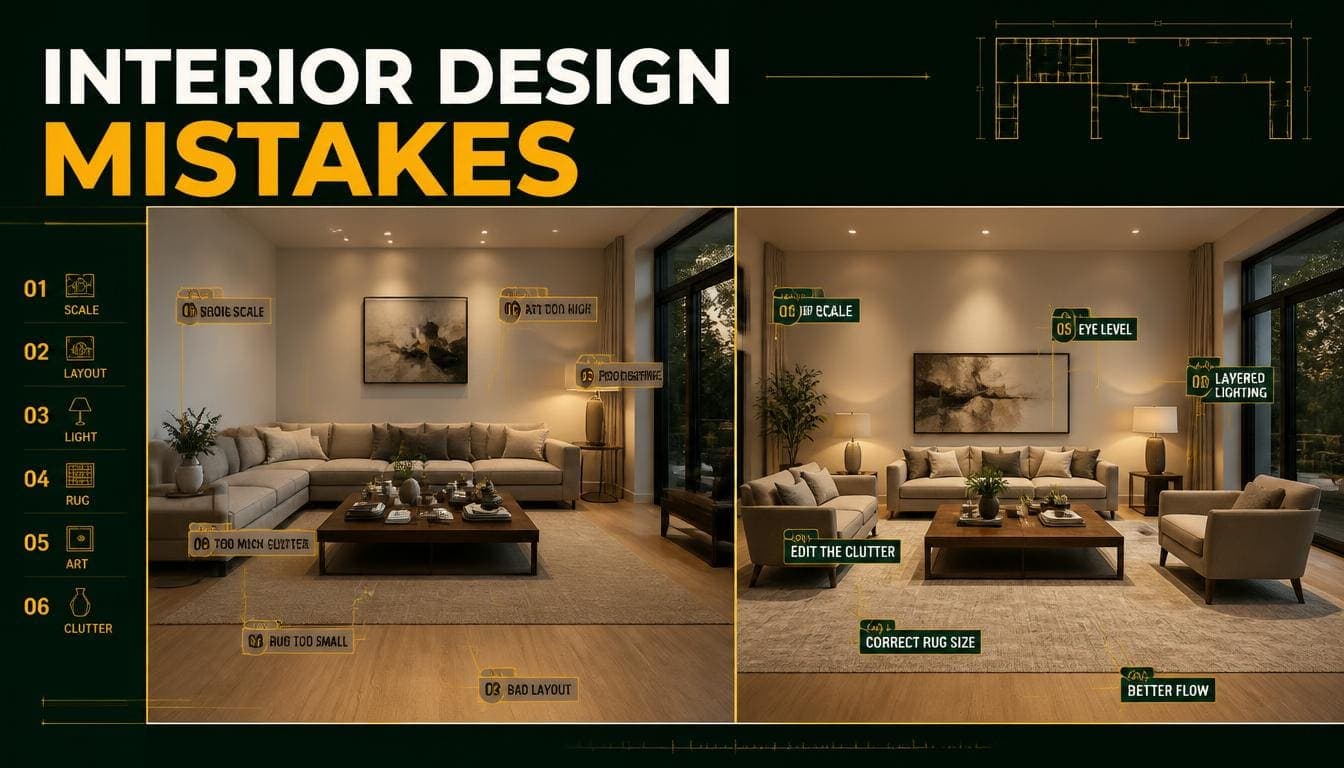
Rugs are bought too small more often than any other item in a room. It happens because larger rugs cost more, standard sizes don't always match room dimensions, and the consequence isn't obvious until the rug is down.
An undersized rug makes a room look smaller, makes furniture look disconnected, and reads as an afterthought — regardless of how good the rug itself is.
This covers the sizes that work, the placement rules for each room, and how rug choice affects how large a space feels.
The Core Principle
A rug should connect the furniture, not sit between it.
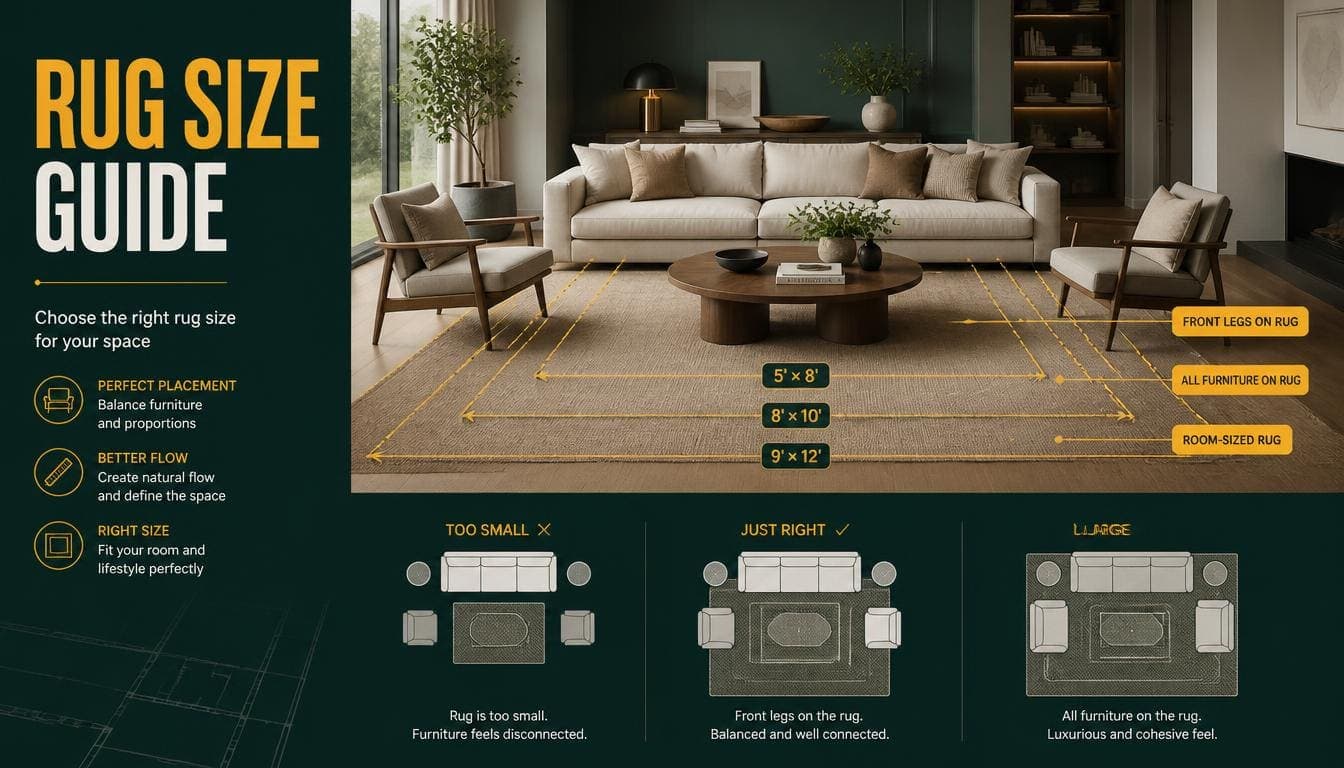
When a rug touches the seating, it defines a zone and the arrangement reads as intentional. When it floats in the middle with nothing on it, the furniture reads as scattered around an unrelated object.
That single distinction accounts for most rug errors.
Try DecoAI Free
3 free credits. No credit card needed. Stage any room in 30 seconds.
Get 3 Free CreditsLiving Room Rug Sizes
The Three Correct Approaches
1. All legs on — Every piece of furniture sits entirely on the rug.
Effect: the most generous and cohesive. Makes the seating area read as a single defined room within the room.
Requires: a large rug and a room that can take it.
2. Front legs on — The front legs of every seating piece rest on the rug; back legs are off.
Effect: the most common correct approach. Connects everything while using a smaller rug.
3. Floating with clearance — All furniture off the rug, but the rug is large enough that a consistent border of floor shows around it and the furniture sits close.
Effect: works in very large rooms. Requires discipline about the border being even.
The Wrong Approach
Rug only under the coffee table, touching nothing else.
This is the most common living room rug error. It reads as a placemat, and the furniture reads as unrelated to it.
Size Guidance
| Room size | Rug size | Approach |
|---|---|---|
| Under 15 m² | 160 × 230cm | Front legs on |
| 15–20 m² | 200 × 290cm | Front legs on |
| 20–28 m² | 240 × 340cm | Front legs or all legs |
| Over 28 m² | 300 × 400cm+ | All legs on |
The Wall Clearance Rule
Leave 30–60cm of bare floor between the rug edge and the walls.
Less than 30cm and the rug reads as attempted wall-to-wall carpet. More than 60cm in a standard room and it reads as undersized.
Dining Room Rug Sizes
The clearest rule of any room, and the one most often broken.
The Rule
The rug must extend at least 60cm beyond the table edge on all sides.
That's the space required for chairs to be pulled out and remain on the rug.
A rug where chairs come off the edge when in use is undersized, regardless of how it looks when the chairs are tucked in.
Size Guidance
| Table size | Minimum rug |
|---|---|
| 4-seat (120 × 80cm) | 240 × 200cm |
| 6-seat (180 × 90cm) | 300 × 210cm |
| 8-seat (220 × 100cm) | 340 × 220cm |
| Round, 120cm diameter | 240cm round or 240 × 240cm |
Shape
Match the table shape. Rectangular table, rectangular rug. Round table, round rug.
Mismatched shapes produce awkward corners where the rug extends past nothing.
Should a Dining Room Have a Rug at All?
Arguments against: food and drink, chairs dragging, and cleaning difficulty.
Arguments for: acoustic softening, zone definition in open-plan spaces, and warmth.
Practical position: in open-plan spaces where the dining zone needs defining, yes. In a separate dining room with hard flooring, it's optional and largely aesthetic. Choose a flat-weave or low-pile that cleans easily.
Try DecoAI Free
3 free credits. No credit card needed. Stage any room in 30 seconds.
Get 3 Free CreditsBedroom Rug Placement
Three approaches, depending on room size.
1. Large Rug Under the Bed
Rug extends 60cm beyond the bed on three sides — both sides and the foot.
Effect: the most generous. Warm underfoot on both sides.
Requires: a large room and a large rug.
| Bed size | Minimum rug |
|---|---|
| Double (135cm) | 240 × 300cm |
| Queen (150cm) | 270 × 340cm |
| King (180cm) | 300 × 360cm |
2. Rug Under the Lower Two-Thirds
The rug starts partway down the bed, extending past the sides and foot. Bedside tables sit off the rug.
Effect: achieves warmth where you step out, using a smaller rug.
The most practical option for most bedrooms.
3. Runners Either Side
Two runners, roughly 70 × 200cm, placed along each side of the bed.
Effect: warmth underfoot with maximum visible floor.
Best for: small bedrooms where a full rug would cover almost all the floor.
What Doesn't Work
A small rug at the foot of the bed only. It provides no benefit where you actually step out and reads as decoration.
Hallways and Runners
Width
Leave 10–15cm of bare floor on each side of the runner.
A runner the full width of the hallway reads as carpet. Too narrow and it looks lost.
Length
Leave 15–25cm at each end. A runner ending exactly at a doorway looks abrupt.
For long hallways: two runners with a gap is acceptable, though one long runner reads better if available.
Other Rooms
Kitchen
Usually better without. Rugs and mats break up the floor visually, make kitchens look smaller, and collect food.
The exception: a runner in a galley kitchen, in a washable flat weave.
Home Office
Approach: rug large enough that the desk and chair both sit on it, with the chair remaining on the rug when rolled back.
Practical note: low pile or flat weave. Chair casters don't work on thick pile.
Bathroom
Bath mats only, in a material that tolerates moisture.
Material and Pile
Flat Weave
Best for: dining rooms, kitchens, high-traffic areas, and under desk chairs.
Advantages: easy to clean, doesn't shed, works with casters.
Disadvantages: less warmth and softness underfoot.
Low Pile
Best for: most living rooms and general use.
A good default — enough softness to feel comfortable, practical enough for daily use.
High Pile and Shag
Best for: bedrooms and low-traffic living rooms.
Disadvantages: difficult to clean, shows footprints, unsuitable for dining areas or under furniture with legs that sink in.
Natural Fibres
Jute and sisal: excellent texture, good for layering, but rough underfoot and difficult to clean when stained.
Wool: the most practical natural fibre. Durable, naturally stain-resistant, warm.
Layering
A patterned or smaller rug layered over a larger jute or sisal base.
Where it works: Bohemian, Scandinavian, and Contemporary schemes.
The rule: the base rug should be at least 30cm larger than the top one on all sides, or it reads as accidental.
How Rugs Affect Perceived Room Size
Larger Rugs Make Rooms Look Bigger
Counter-intuitive but consistent. A large rug that reaches near the walls creates one continuous surface, which the eye reads as a single large space.
A small rug divides the floor into rug and not-rug, which reads as two smaller areas.
Except in Very Small Rooms
Below roughly 12 m², visible floor matters more than continuity. In a very small bedroom, runners beside the bed show more floor than a full rug and read as more spacious.
Colour Effect
Pale rugs reflect light and read as more open.
Dark rugs absorb light and ground the furniture, which suits larger rooms.
Patterned rugs draw the eye downward and can make ceilings feel lower. Use in rooms with adequate height.
Common Mistakes
1. Too Small
The defining error. If the rug touches no furniture, it's too small.
2. Chairs Coming Off the Dining Rug
60cm beyond the table edge is the minimum for chairs to stay on when pulled out.
3. Rug Too Close to the Walls
Leave 30–60cm of bare floor. Closer reads as failed wall-to-wall carpet.
4. Shape Mismatch
Round table with a rectangular rug produces awkward empty corners.
5. High Pile in Dining Areas
Impractical and difficult to clean.
6. Small Rug at the Foot of a Bed
Provides no benefit where you actually step out.
7. Layering With Insufficient Difference
The base rug needs to be at least 30cm larger on all sides, or the layering reads as accidental.
8. Heavily Patterned Rugs in Small Rooms
Draws the eye downward and makes the space feel more enclosed.
For Property Presentation
What Photographs Well
Solid neutral rugs in a texture — wool, low-pile, undyed. Adds warmth without drawing attention.
Correctly sized. Undersized rugs are visible in photographs and read as a furnishing error.
Simple geometrics if pattern is wanted. Busy patterns compete with the room.
What to Remove Before Photographing
Kitchen mats and runners. Break up the floor and make kitchens look smaller.
Bath mats. Should be removed for photography.
Multiple small rugs. Divides the floor and reads as clutter.
The Staging Note
AI staging generates rugs in most schemes, and sizing is one of the more common errors.
What to check: does the generated rug touch the front legs of the seating? Does a dining rug extend beyond the chairs? If not, regenerate — rug sizing varies noticeably between attempts.
Frequently Asked Questions
What size rug do I need for a living room?
Large enough that at least the front legs of all seating rest on it. For a 15–20 m² room, roughly 200 × 290cm.
What size rug for a dining table?
Extending at least 60cm beyond the table edge on all sides, so chairs stay on the rug when pulled out. A 6-seat table needs roughly 300 × 210cm.
How far should a rug be from the wall?
30–60cm of bare floor. Closer reads as failed wall-to-wall carpet; further and it looks undersized.
Should a rug go under the bed?
Either extending 60cm beyond it on three sides, or under the lower two-thirds. A small rug at the foot only provides no practical benefit.
Do rugs make rooms look bigger or smaller?
Larger rugs make rooms look bigger by creating one continuous surface. Small rugs divide the floor and make spaces read as smaller. The exception is very small rooms, where visible floor matters more.
What size runner for a hallway?
Leaving 10–15cm of bare floor each side and 15–25cm at each end.
Should kitchens have rugs?
Generally no. They break up the floor, make kitchens look smaller, and collect food. A washable flat-weave runner in a galley kitchen is the exception.
What rug pile is best?
Low pile for most rooms. Flat weave for dining rooms, kitchens, and under desk chairs. High pile for bedrooms and low-traffic areas only.
Can I layer rugs?
Yes, in Bohemian, Scandinavian, and Contemporary schemes. The base rug should be at least 30cm larger on all sides.
Summary
The core principle: a rug should connect the furniture, not sit between it. If it touches nothing, it's too small.
Living room: front legs of all seating on the rug, 30–60cm of bare floor to the walls.
Dining room: 60cm beyond the table edge on all sides, so chairs stay on when pulled out.
Bedroom: 60cm beyond on three sides, under the lower two-thirds, or runners either side in small rooms.
Effect on room size: larger rugs make rooms look bigger by creating a continuous surface. Except below about 12 m², where visible floor wins.
The most common error: undersizing. It's visible, it reads as a mistake, and it makes rooms look smaller.
Check rug sizing in staged images. DecoAI gives 3 free credits with no card required — rug scale varies between generations and is worth reviewing before you use an image.