Outdoor space is one of the most valued features in a property and one of the most poorly presented. Gardens get photographed from the back door in flat light, balconies get skipped entirely, and patios appear as an afterthought at photograph fourteen.
That's a missed opportunity, because outdoor space frequently drives buying decisions in a way an extra square metre of living room doesn't.
This covers what makes outdoor space usable, what buyers actually assess, and what's worth doing before selling.
What Buyers Assess
Usability, Not Size
A 40 m² garden that's entirely lawn on a slope is less usable than a 20 m² courtyard with a level patio and seating.
What makes space usable:
- A level area large enough to sit
- Access from the house that works
- Some privacy
- A reason to be there
Aspect
Which way the outdoor space faces determines when it's usable.
South-facing: sun most of the day. The most valued aspect in cooler climates.
West-facing: afternoon and evening sun. Often preferred for entertaining.
East-facing: morning sun. Good for breakfast, less good for evenings.
North-facing: shade most of the day. Less valued, though it's an advantage in hot climates.
Practical: state the aspect in the listing. Buyers ask.
Privacy
Overlooked gardens are consistently a concern.
What helps: planting, screening, a pergola, or a seating position that's less exposed.
Maintenance
Buyers assess how much work the space demands.
Low maintenance reads positively for most buyers. An elaborate garden with extensive planting reads as a commitment.
Try DecoAI Free
3 free credits. No credit card needed. Stage any room in 30 seconds.
Get 3 Free CreditsMaking Outdoor Space Usable
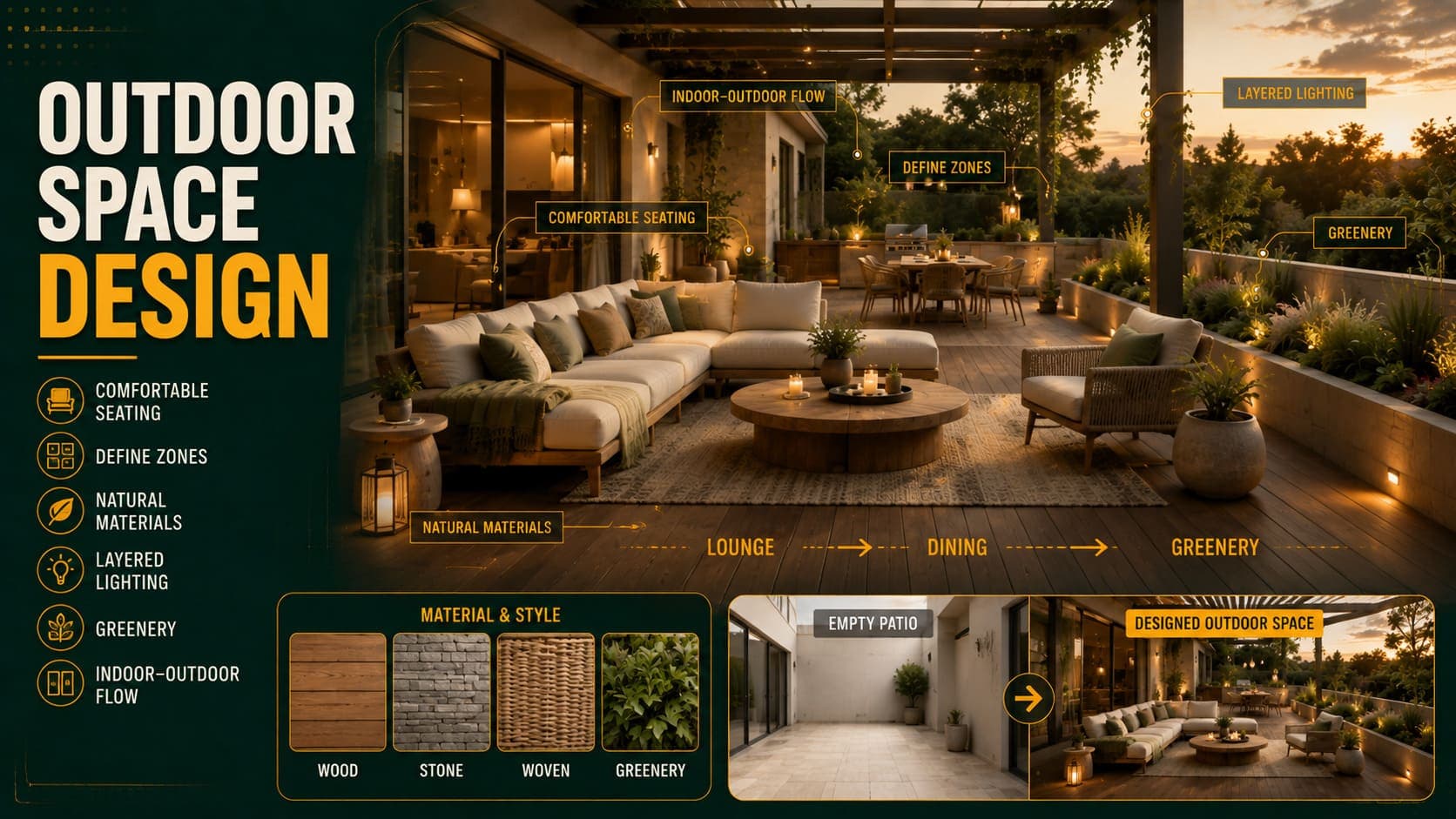
Create a Level Seating Area
The single highest-return outdoor intervention.
Minimum for a small table and two chairs: roughly 2 × 2m.
For a table seating six: roughly 3 × 3m.
Why it matters: an outdoor space with nowhere to sit is a view rather than a room. A level patio converts it into usable space.
Define Zones
Even a small garden benefits from having distinct areas.
Typical zones:
- Seating and dining
- Lawn or open space
- Planting
- Storage or utility
In a small garden: two zones is enough. A patio and a planted area.
Manage the Route From the House
The connection between inside and outside determines how much the space gets used.
What helps: level access, a clear path, and lighting so the route works after dark.
What doesn't: a step down onto grass, which means the space is unusable in wet weather.
Add Privacy Where It's Lacking
Planting — the softest option, takes time to establish.
Screening — trellis, slatted panels, or bamboo. Immediate effect.
A pergola — defines a seating area and provides overhead screening.
Practical: screening at seating level matters more than screening the whole boundary. Privacy where you sit is the actual requirement.
Outdoor Lighting
Transforms how much a space is used, and it's frequently absent.
What works:
- Lighting on the route from the house
- Low-level lighting around a seating area
- Uplighting on one or two plants or trees
- String lights for a simple, effective option
What doesn't: a single bright floodlight, which produces glare and harsh shadows.
Small Gardens and Courtyards
Under roughly 30 m².
The Approach
Prioritize the seating area. In a small garden, a usable patio matters more than lawn.
Go vertical. Wall planting, trellis, and climbers use space that's otherwise unavailable.
Fewer, larger elements. Several small features read as cluttered; one substantial planted area and one seating area reads as considered.
Continue the interior palette. Materials and colours that relate to the adjacent room make both feel larger.
What to Avoid
Small lawn areas. A 3 × 3m lawn is high-maintenance and barely usable. Paving or planting works better at that scale.
Too many pots. They multiply, need daily watering in summer, and read as clutter.
Full-boundary screening in a small space. It creates a box. Screen where you sit instead.
Balconies and Terraces
Disproportionately valuable in apartments and frequently neglected.
What Fits
| Depth | What's viable |
|---|---|
| Under 1000mm | Standing space, wall planting, a narrow shelf |
| 1000–1500mm | Two chairs, a small side table |
| 1500–2000mm | Small table and two chairs |
| Over 2000mm | Table seating four, planting |
What Works
Two chairs and a small table, even on a small balcony. It demonstrates the space is usable rather than decorative.
Wall or rail planting — uses no floor space.
Outdoor rug — defines the space and makes it read as an extension of the room.
Screening if overlooked — bamboo or slatted panels on the rail.
Lighting — string lights or a single lantern.
What to Avoid
Storage. Bikes, boxes, and drying racks on a balcony read as a utility space rather than an amenity.
Furniture too large. A full dining set on a 1500mm balcony leaves no room to move.
Patios and Paving
Material Options
| Material | Cost per m² | Notes |
|---|---|---|
| Concrete slabs | $20–$45 | Practical, budget |
| Porcelain paving | $50–$100 | Low maintenance, contemporary |
| Natural stone | $60–$150 | Best appearance, needs sealing |
| Decking, softwood | $30–$60 | Warm, needs maintenance |
| Decking, composite | $60–$120 | Low maintenance, no weathering |
| Gravel | $10–$25 | Cheapest, less comfortable underfoot |
Installation adds substantially, typically $40–$100 per m² depending on groundwork.
Practical Guidance
Porcelain paving has become the default for new patios — low maintenance, doesn't stain, and doesn't require sealing.
Timber decking looks warm and requires annual maintenance. Composite avoids that at higher cost.
Slip resistance matters in wet climates. Check the rating.
Size
A patio should be large enough for the furniture plus circulation. A table seating six needs roughly 3 × 3m to allow chairs to be pulled out.
Patios sized only to the furniture footprint end up unusable.
Try DecoAI Free
3 free credits. No credit card needed. Stage any room in 30 seconds.
Get 3 Free CreditsPlanting
The Practical Approach
Structure first, flowers second. Evergreen shrubs and small trees provide year-round form. Flowering plants provide seasonal interest.
A garden that relies entirely on flowers looks bare for half the year.
Low Maintenance Options
Evergreen shrubs — box, yew, pittosporum, viburnum.
Ornamental grasses — movement and texture, minimal work.
Perennials that spread — geranium, hardy salvia, hellebore.
Avoid if low maintenance matters: roses, bedding plants, and anything requiring regular deadheading or feeding.
For Small Spaces
Climbers — use vertical space. Clematis, jasmine, climbing hydrangea.
Larger pots rather than many small ones — retain water better, need less frequent watering, and read as more considered.
One substantial specimen — a small tree or large shrub — anchors a small garden better than several small plants.
Outdoor Storage
Frequently the thing that ruins a garden's appearance.
What Needs Storing
Bins, tools, garden furniture cushions, bikes, and children's equipment.
What Works
A dedicated store — even a small one — keeps things out of view.
Bin screening — a simple slatted enclosure. Bins in view are one of the most common issues in garden photographs.
Bench with storage — seating plus cushion storage in one.
Under-decking storage where a deck is raised.
For Property Presentation
Why It Matters More Than People Think
Outdoor space is a decision factor for a substantial proportion of buyers, and it's routinely buried at photograph twelve or later.
Practical: move outdoor space to position four or five in the gallery. Buyers who stop scrolling early still see it.
Before Photographing
Clear everything. Bins, tools, hoses, toys, bikes, drying racks, anything stored.
Cut back overgrowth, particularly anything blocking paths, windows, or the boundary.
Mow and edge the lawn. Edging matters more than mowing for photographs.
Sweep and pressure wash paving if it's stained or mossy.
Add seating if there isn't any. Two chairs and a small table demonstrate usability.
Add two or three pots with healthy plants.
Photographing
Golden hour — the hour before sunset. Outdoor spaces photograph substantially better in warm directional light than at midday.
From the house looking out, and from the far end looking back. The first shows the connection; the second shows the extent.
Include the house in one shot — it shows the relationship between inside and outside.
Overcast is acceptable for gardens; it produces even light without harsh shadows. Bright midday sun is the worst condition.
Worth Doing Before Selling
| Action | Cost | Return |
|---|---|---|
| Clear and tidy | Free | Very high |
| Mow and edge | Free | High |
| Pressure wash paving | $50–$250 | High |
| Screen the bins | $60–$200 | High |
| Add seating for photos | $100–$300 | High |
| Two or three planted pots | $60–$150 | Moderate |
| New fencing | $1,500–$4,000 | Low |
| Full landscaping | $5,000–$25,000 | Low |
The pattern is the same as indoors: tidying returns most, major work returns least.
Common Mistakes
1. No Seating Area
An outdoor space with nowhere to sit is a view rather than a room.
2. Patio Sized to the Furniture Only
Chairs need to pull out. Add circulation space.
3. Bins in View
One of the most common issues in garden photographs and cheap to solve.
4. Small Lawn Areas
A 3 × 3m lawn is high-maintenance and barely usable. Paving or planting works better.
5. Photographing at Midday
Harsh shadows and flat light. Golden hour or overcast.
6. Skipping the Balcony
Disproportionately valuable in apartments and frequently not photographed at all.
7. Full Landscaping Before Selling
Buyers often have their own plans. Tidy beats elaborate.
8. Placing Outdoor Photos Late in the Gallery
Move to position four or five.
Frequently Asked Questions
How big does a patio need to be?
Roughly 2 × 2m for a small table and two chairs, 3 × 3m for a table seating six. Size it to the furniture plus circulation, not to the furniture alone.
What's the best patio material?
Porcelain paving has become the default — low maintenance, doesn't stain, doesn't need sealing. Natural stone looks best but requires more care.
How do I make a small garden feel bigger?
Prioritize the seating area over lawn, use vertical planting, keep to fewer larger elements, and continue the interior palette outside.
What fits on a balcony?
Under 1000mm deep: standing space and wall planting. 1000–1500mm: two chairs. Over 1500mm: a small table and chairs.
Does outdoor space affect property value?
It's a decision factor for a substantial proportion of buyers, particularly families. Usability matters more than raw size.
When should I photograph a garden?
Golden hour — the hour before sunset. Overcast is acceptable; bright midday sun is the worst condition.
Should I landscape before selling?
Tidying returns well. Full landscaping rarely does — buyers frequently have their own plans for outdoor space.
Where should garden photos go in a listing?
Position four or five, not twelve. Buyers who stop scrolling early should still see the outdoor space.
What's the highest-return outdoor improvement?
Clearing and tidying, which costs nothing. After that, pressure washing paving and screening the bins.
Summary
What makes outdoor space usable: a level seating area, working access from the house, some privacy, and a reason to be there.
Minimum seating area: 2 × 2m for two people, 3 × 3m for six.
Small gardens: prioritize the patio over lawn, plant vertically, use fewer larger elements.
Balconies: two chairs and a small table, even on a small one. It demonstrates usability.
Photography: golden hour, from the house looking out and from the far end looking back.
Before selling: clear, tidy, pressure wash, screen the bins, add seating. Not full landscaping.
Move outdoor photos earlier in the gallery. DecoAI gives 3 free credits with no card required — though outdoor spaces benefit more from clearing and good timing than from staging.