If you had to fix one thing in a room, it should be the layout. Not the colour, not the furniture, not the lighting — the arrangement of the space itself.
That's the short answer, and it's not the answer most design content gives. Colour and style get the attention because they're visible and easy to discuss. Layout gets less because it's harder to explain and invisible when it's right.
This covers the hierarchy — what matters most, what matters next, and why the things people spend most time on come lower down.
The Hierarchy
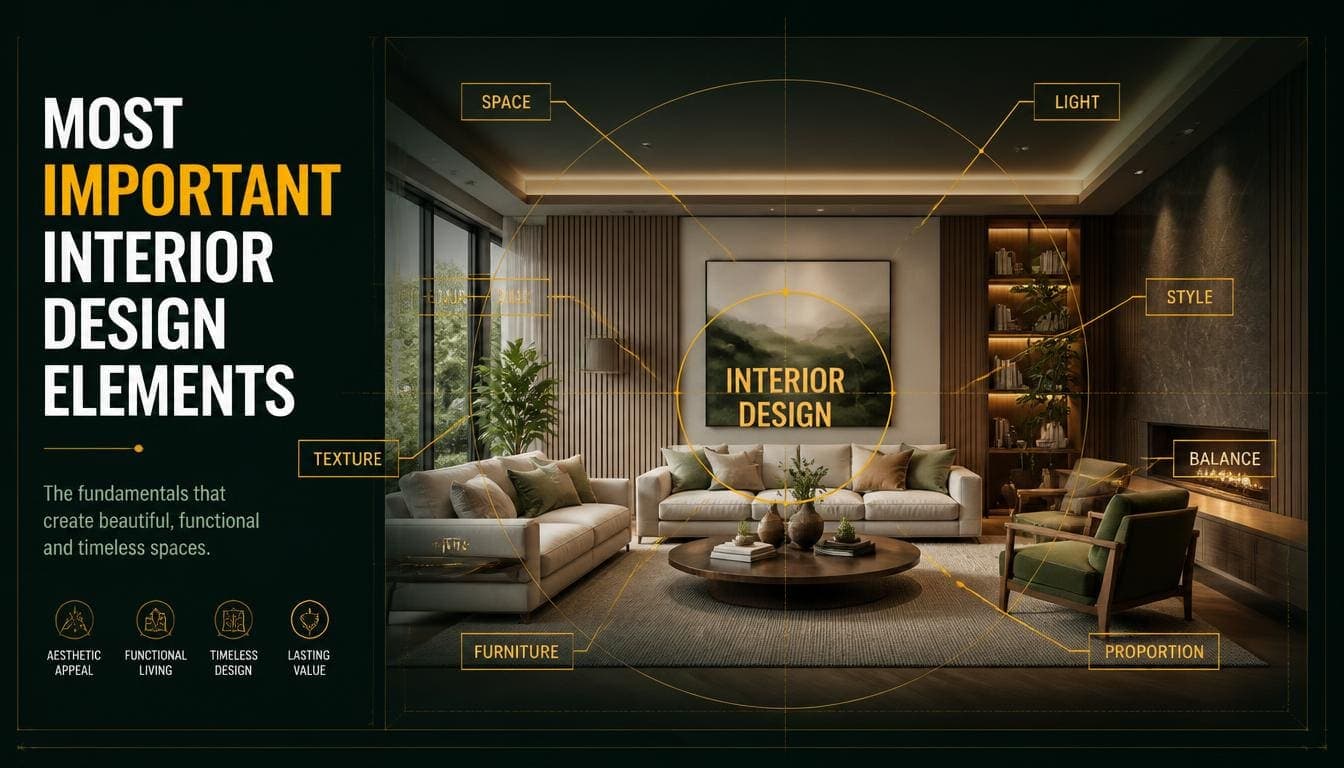
In order of how much each affects whether a room works:
- Layout — where things go
- Light — natural and artificial
- Scale — whether the furniture fits the room
- Colour and material — the visible layer
- Style — the aesthetic register
- Decoration — the final layer
Each level depends on the ones above it. Perfect colour applied to a bad layout produces a room that looks good in photographs and frustrates in use.
Try DecoAI Free
3 free credits. No credit card needed. Stage any room in 30 seconds.
Get 3 Free Credits1. Layout
Why It's First
Layout determines whether the room functions. Everything else determines how it looks.
What layout resolves:
- Whether you can move through the space comfortably
- Whether the furniture you need actually fits
- Where things get stored
- Whether the room serves what it's for
The test: live in a space for a week and note where the friction is. Doors that clash. Routes that require turning sideways. Surfaces that accumulate objects because there's nowhere else. Corners nobody uses.
Those are layout problems, and no amount of decoration addresses them.
What Good Layout Looks Like
Clear circulation. An unobstructed route from the entrance to every other doorway. 75cm minimum, 90cm comfortable.
Furniture facing inward. Seating arranged toward a shared focal point rather than pushed against every wall.
A defined focal point. Every room has one — a fireplace, a window, a feature wall. The arrangement should acknowledge it.
Adequate clearance. 40–45cm from sofa to coffee table. 60–75cm around a bed. 90cm around a dining table.
Storage where it's needed. Not in a distant cupboard, but near where the things get used.
The Most Common Layout Error
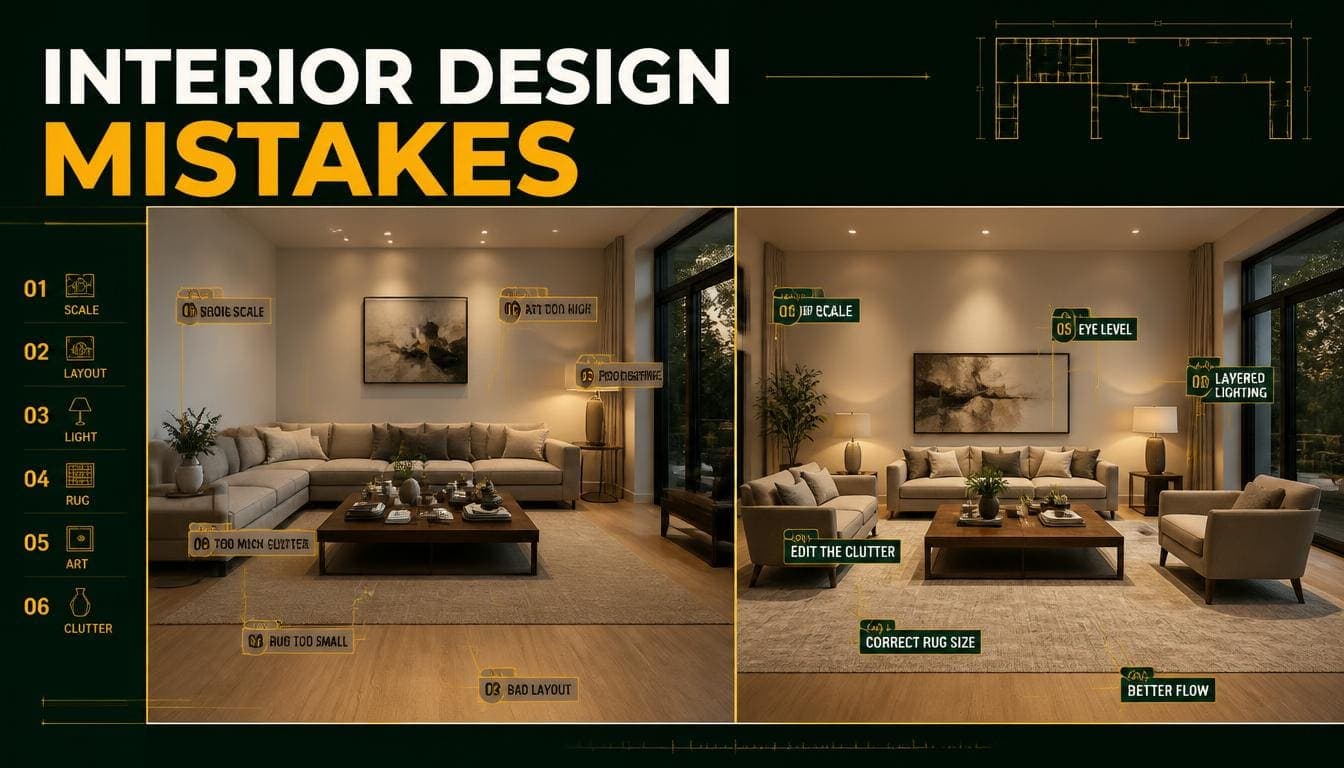
Furniture pushed flat against every wall. It's the instinctive arrangement and it's usually wrong — it produces a hollow centre and a room that reads as a waiting area.
Pulling seating inward, even 15–20cm, creates a defined zone and makes rooms look larger.
Why It Gets Skipped
Layout is hard to photograph and hard to discuss. "Move the sofa 40cm and turn it 30 degrees" doesn't produce content the way "paint it sage green" does.
It also frequently costs nothing, which means nobody has a commercial reason to promote it.
2. Light
Why It's Second
Light determines how a room feels more directly than any other single factor, and it's the environmental variable with the best evidence behind it.
Natural light affects perceived room size, mood, and how colours read.
Artificial light determines whether a room works in the evening and whether it photographs well.
What Matters Most
Maximize the natural light available. Unobstructed windows, no furniture blocking them, light surfaces to reflect it.
Layer the artificial light. Three types doing different jobs — ambient, task, and accent. Most rooms have only ambient, which is why they look flat.
Get the colour temperature right. 2700K for living spaces and bedrooms, 3000K for kitchens and bathrooms. Above 3500K reads as commercial in a home.
The Single Highest-Value Fix
Add two lamps at different heights to your main living space.
Cost: $60–$150. Effect: larger than any purchase at that price.
A floor lamp in a corner and a table lamp on a side table fills the dark corners a ceiling light doesn't reach and adds the shadow gradient that gives rooms depth.
Why Light Beats Colour
Colour only exists as reflected light. The same paint reads completely differently under 2700K and 4000K bulbs, and differently again in north-facing and south-facing rooms.
Fixing the light before choosing the colour is the right order. Most people do it the other way round.
3. Scale
Why It's Third
Scale errors are immediately obvious even to people with no interest in design, and they can't be fixed by anything else.
Oversized furniture in a small room fills the frame, hides the floor, and makes the space read as cramped.
Undersized furniture in a large room looks lost and makes the space read as unfinished.
The Practical Rules
| Room size | Sofa | Rug |
|---|---|---|
| Under 15 m² | Loveseat | 120×170cm |
| 15–25 m² | Three-seat | 160×230cm |
| Over 25 m² | Sectional or two sofas | 200×300cm+ |
Rugs specifically are the most commonly undersized element. A rug should sit under at least the front legs of all seating. One that only reaches the coffee table reads as a placemat.
The Detail Most People Miss
Furniture with visible legs shows floor. A sofa on slim legs and a sofa with a solid base can occupy identical footprints, and the first will make the room look larger.
Visible floor is what the eye reads as space.
Try DecoAI Free
3 free credits. No credit card needed. Stage any room in 30 seconds.
Get 3 Free Credits4. Colour and Material
Why It's Fourth
Colour matters — but it matters within a working layout, adequate light, and correct scale. Applied on top of problems in those three, it doesn't fix them.
What Actually Matters in Colour
Structure over specific hues. The 60-30-10 split — 60% dominant neutral, 30% secondary, 10% accent — matters more than which colours you choose.
Temperature consistency. Warm or cool, not both. Mixing produces a result that looks unintentional even when nothing is individually wrong.
Reading the fixed elements. Flooring, worktops, tiles, and brickwork aren't changing. Build the palette around them.
Texture over pattern. Texture adds depth without the divisiveness of print. In neutral schemes it's what prevents flatness.
What Matters Less Than Claimed
Colour psychology. The idea that specific colours reliably produce specific emotions is widely cited and poorly supported. Cultural variation is substantial and studies don't replicate consistently.
What does hold: brightness and saturation affect perceived room size and light levels. That's physics rather than psychology.
5. Style
Why It's Fifth
Style is a coherence device. It gives you a consistent basis for decisions so a room reads as intentional rather than assembled.
It matters that you have one. It matters less which one, provided it suits the property and the use.
The Practical Guidance
Contemporary for suburban properties and family homes. Modern for urban properties and clean-lined architecture. Scandinavian for small rooms and limited natural light.
These three cover the majority of situations. Everything else is situational.
The Rule That Matters
Pick one and hold it across the property. A Modern living room next to a Traditional bedroom reads as disjointed even to people who can't articulate why.
Consistency matters more than the choice.
6. Decoration
Why It's Last
Decoration is the layer everyone starts with and the one that matters least to whether a room works.
Cushions, artwork, ornaments, and accessories add character to a room that's already functioning. They don't compensate for one that isn't.
What Still Matters Here
Restraint. Three well-chosen objects read as considered. Twelve read as clutter.
Grouping. Objects grouped together read as a collection. The same objects distributed around a room read as scatter.
Negative space. Somewhere for the eye to rest. Even densely decorated rooms need this.
Testing the Hierarchy
A practical way to check where a room's problems actually sit.
Ask, in order:
- Can I move through this room comfortably? — Layout
- Are the corners dark at any time of day? — Light
- Does the furniture look right for the room's size? — Scale
- Do the colours work with the floor and fixed elements? — Colour
- Does everything belong to the same aesthetic? — Style
- Is there too much on the surfaces? — Decoration
The first "no" is where to start. Working further down the list before fixing that one produces a room that still doesn't work.
What This Means Practically
If You Have No Budget
Rearrange the furniture. Declutter. Both cost nothing and address the two levels that matter most after light.
If You Have $200
Two lamps ($60–$150) plus paint for the trim to match the walls ($40–$80). Layout and light addressed.
If You Have $2,000
Add a correctly sized rug, one or two furniture pieces at the right scale, and improved lighting throughout. Layout, light, and scale all addressed.
If You Have $20,000
Now colour, material, and finish decisions have somewhere to sit. Structural change becomes worth considering if the layout genuinely can't be resolved otherwise.
The Consistent Pattern
Money spent lower in the hierarchy returns less than money spent higher in it. A $4,000 sofa in a badly laid out room is a less effective purchase than $200 of lamps and an afternoon rearranging.
Frequently Asked Questions
What is the most important thing in interior design?
Layout. It determines whether the room functions. Everything else determines how it looks.
Is colour or layout more important?
Layout, substantially. Colour applied to a bad layout produces a room that photographs well and frustrates in use.
What's the cheapest way to improve a room?
Rearrange the furniture and declutter. Both cost nothing and address the highest-priority levels.
Why does my room feel wrong even though it looks fine?
Usually layout or scale. A room can be well decorated and still have poor circulation or furniture at the wrong size, and both produce a sense of wrongness that's hard to name.
Does colour psychology work?
Broadly overclaimed. Brightness and saturation affect perceived room size and light levels, which is physical. The claim that specific colours reliably produce specific emotions doesn't replicate consistently.
How much does lighting matter?
Second only to layout. A single ceiling light produces flat, shadowed, dark-cornered rooms regardless of how well everything else is done.
What's the most common design mistake?
Pushing all furniture against the walls. It's instinctive and usually wrong — pulling seating inward creates a defined zone and makes rooms look larger.
Should I choose a style before or after fixing the layout?
After. Style is a coherence device that governs how things look. It doesn't affect whether the room works.
What order should I do things in?
Layout, light, scale, colour and material, style, decoration. Each level depends on the ones above it.
Summary
The hierarchy: layout, light, scale, colour and material, style, decoration. In that order.
Layout is first because it determines whether the room functions. Everything else determines how it looks.
Light is second because it's the environmental factor with the strongest effect and the best evidence behind it.
Scale is third because errors here are immediately obvious and can't be fixed by anything below.
Colour is fourth, not first, despite receiving most of the attention.
The practical test: ask the six questions in order. The first "no" is where to start, and fixing anything below it first won't work.
Test layouts before committing. DecoAI gives 3 free credits with no card required — useful for comparing furniture arrangements and scale before buying anything.