Maximalism gets described as the opposite of minimalism, which is true but unhelpful. Minimalism removes until only essentials remain. Maximalism adds — but adds according to rules.
The distinction that matters is between maximalism and clutter. A maximalist room has more objects, more colour, and more pattern than a conventional one, and it still reads as intentional. A cluttered room has the same quantity and reads as accumulated.
The difference is structure, and that's what this covers.
What Maximalism Actually Is
The Core Idea
Abundance with underlying discipline.
Maximalism isn't the absence of rules — it's a different set of rules. A well-executed maximalist room has a palette, a repeating logic, and a hierarchy. It just runs those things at higher density than other styles.
The Defining Characteristics
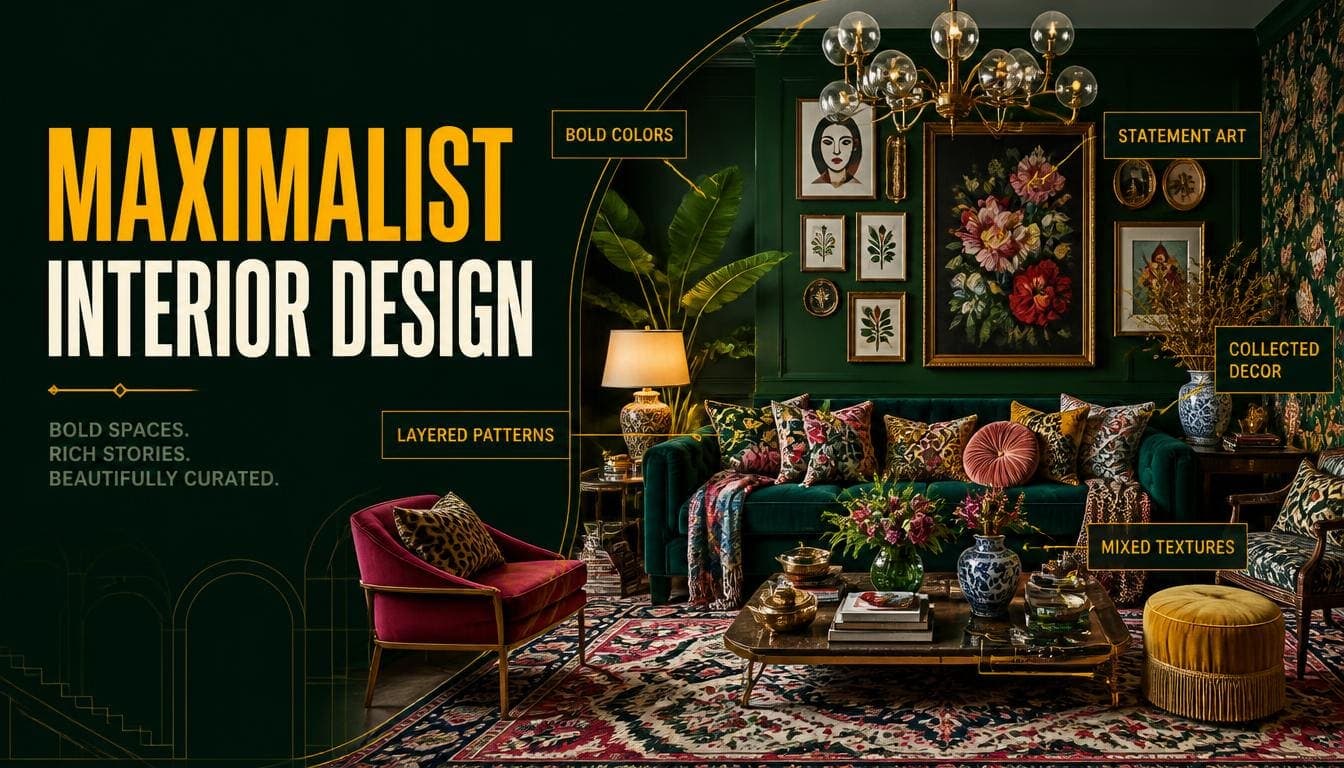
Layered pattern — Multiple patterns coexisting, usually three or more, deliberately combined.
Saturated colour — Deep, rich tones rather than neutrals. Colour as the base rather than as accent.
Dense display — Gallery walls, filled shelves, collections shown rather than stored.
Mixed periods and styles — Antique alongside contemporary, high alongside low.
Texture variety — Velvet, silk, wood, metal, ceramic, glass, all present.
Personality visible — The room clearly belongs to someone specific.
Nothing empty — Walls, surfaces, and corners all doing something.
Try DecoAI Free
3 free credits. No credit card needed. Stage any room in 30 seconds.
Get 3 Free CreditsThe Rules That Make It Work
This is where maximalism separates from clutter.
1. A Defined Palette
Maximalist rooms use more colour, not random colour.
The working method: choose three to five colours and use only those, in varying proportions, throughout the room. Every object that enters has to fit the palette.
Example palette: deep green, mustard, terracotta, cream, and brass.
What fails: every colour present. That's not maximalism, it's absence of decision.
2. Repetition Creates Coherence
Each colour should appear at least three times in the room, at different scales.
Example: deep green on the walls, in a cushion, and in a plant pot. The eye reads repetition as intentional and randomness as accidental.
3. Vary the Pattern Scale
The most technical rule and the one that separates good maximalism from visual noise.
Combine patterns of different scales:
- One large-scale pattern — a big floral, a bold geometric
- One medium — a stripe, a mid-size print
- One small — a fine check, a subtle texture
Why it works: patterns at similar scales compete. Patterns at different scales create hierarchy, and the eye can navigate.
4. One Dominant Element
Every maximalist room needs a focal point that wins — a patterned wallpaper, a large artwork, a statement sofa.
Everything else supports it.
What fails: five elements all competing for attention. Nothing wins, and the room reads as chaotic.
5. Group, Don't Scatter
Collections displayed together read as considered. The same objects distributed around the room read as clutter.
The practical rule: three, five, or seven objects grouped, rather than one object on each of seven surfaces.
6. Leave Some Negative Space
Counter-intuitive but essential. Even maximalist rooms need somewhere for the eye to rest.
Usually: one wall less dense than the others, or a clear surface, or a plain floor beneath a heavily patterned room.
7. Quality Over Quantity of Sources
Maximalism works when the objects are individually good. A room full of cheap decorative objects reads as clutter regardless of how well arranged.
The practical implication: maximalism done well is often more expensive than minimalism, not less.
The Maximalist Palette
How It Differs From Other Styles
Most styles use neutrals as base with accents on top. Maximalism uses saturated colour as the base.
Common Palette Directions
Jewel tones: Emerald, sapphire, ruby, amethyst, gold Earth-rich: Terracotta, ochre, olive, deep brown, cream Dark and dramatic: Charcoal, deep green, oxblood, brass Bright and playful: Coral, teal, mustard, pink
Base Colours
Unlike other styles, walls are frequently a strong colour rather than neutral.
Common approaches:
- Deep painted walls — green, navy, oxblood
- Patterned wallpaper as the base layer
- Colour drenching — walls, trim, and ceiling in one deep tone
What Maximalism Avoids
Beige and greige as the dominant tone. It's the neutral register maximalism defines itself against.
Cool grey. Reads as flat against the style's warmth.
Absence of contrast. Maximalism needs tonal range.
Try DecoAI Free
3 free credits. No credit card needed. Stage any room in 30 seconds.
Get 3 Free CreditsMaximalism by Room
Living Room
The room where maximalism works best, because it has the most surfaces.
Walls: Deep colour or patterned wallpaper Furniture: Statement sofa — velvet, patterned, or in a saturated colour Textiles: Layered rugs, patterned cushions at varied scales, a throw Display: Gallery wall, filled bookshelves, grouped objects Lighting: Multiple sources — a statement pendant, table lamps, a floor lamp
Bedroom
Harder, because bedrooms benefit from calm.
The workable version: patterned wallpaper or a deep wall colour, layered bedding, one strong artwork, but keep the surfaces less dense than a living room.
What fails: full maximalism in a bedroom frequently reads as restless.
Dining Room
Excellent for maximalism. Dining rooms are used for occasion rather than relaxation, which suits drama.
Approach: deep walls, statement lighting, patterned chairs, a densely hung wall, layered table setting.
Kitchen
Limited scope — kitchens are dominated by fixed elements.
Where it works: coloured cabinets, patterned tile, open shelving with displayed ceramics.
Hallway
An underrated maximalist opportunity. Hallways are transitional, so drama works without needing to live with it.
Approach: bold wallpaper, a gallery wall, a statement light.
Maximalism vs Eclectic vs Bohemian
These overlap and get conflated.
| Factor | Maximalist | Eclectic | Bohemian |
|---|---|---|---|
| Colour | Saturated, deep | Varies | Warm earth tones |
| Pattern | Heavy, layered | Moderate | Moderate |
| Structure | Strict palette rules | Loose | Loose |
| Materials | Velvet, brass, lacquer | Mixed | Natural fibre |
| Register | Dramatic, rich | Personal, collected | Relaxed, artisanal |
| Density | Very high | Moderate | High |
The distinctions:
Maximalist is the most structured despite appearing least so. Strict palette, deliberate pattern scaling, defined focal point.
Eclectic simply means mixing styles and periods. No particular palette or density requirement.
Bohemian is warmer, more natural in material, and less formal. Rattan and jute rather than velvet and brass.
Where Maximalism Works
Period Properties
High ceilings, cornicing, and generous proportions all support density. A Victorian room can carry maximalism where a modern box can't.
Larger Rooms
The style needs space. Density in a large room reads as rich; the same density in a small one reads as cramped.
Homes People Are Staying In
Maximalism is personal by definition. It's a style for living in rather than for marketing.
Dining Rooms and Hallways
Rooms used briefly or for occasion suit drama better than rooms used for relaxation.
Creative and Design-Led Markets
Where distinctiveness is valued over broad appeal.
Where Maximalism Fails
Property Staging
The clearest case against. Staging works by helping buyers imagine their own life in a space. Maximalism fills that space with someone else's taste and objects.
For property marketing, maximalism is the wrong tool almost universally.
Small Rooms
Density in a compact space reads as cramped. The style needs room to breathe despite being about abundance.
Rooms With Poor Light
Deep colours and heavy pattern in a dark room produce something oppressive.
Modern Minimal Architecture
Clean-lined contemporary buildings fight the style. Maximalism needs architectural detail to sit against.
Rental Properties
Broad appeal matters more than personality. Neutral serves better.
When the Budget Is Tight
Maximalism done well needs individually good objects. Done cheaply it reads as clutter.
Common Maximalist Mistakes
1. No Palette
The defining error. Using every colour isn't maximalism, it's absence of decision.
2. Patterns at the Same Scale
Three medium-scale patterns compete. Vary the scale — large, medium, small.
3. No Dominant Element
Five things competing for attention means nothing wins.
4. Scattering Instead of Grouping
The same objects grouped read as a collection; distributed they read as clutter.
5. No Negative Space
Even maximalism needs somewhere for the eye to rest.
6. Cheap Objects in Quantity
Quantity of poor-quality items reads as clutter regardless of arrangement.
7. Using It in Small or Dark Rooms
The two conditions the style handles worst.
8. Using It for Staging
Maximalism is a style for living in, not for selling.
Frequently Asked Questions
What is maximalist interior design?
A style built on deliberate abundance — layered pattern, saturated colour, dense display, and mixed periods — held together by a defined palette and underlying structure.
What's the difference between maximalism and clutter?
Structure. Maximalism has a defined palette, varied pattern scales, a dominant focal point, and grouped rather than scattered objects. Clutter has the same density without those rules.
How many patterns can I use in a maximalist room?
Three or more, but at different scales — one large, one medium, one small. Patterns at similar scales compete and produce visual noise.
What colours work in maximalist design?
Saturated palettes: jewel tones, rich earth tones, or dark dramatic combinations. Choose three to five and use only those, repeating each at least three times.
Does maximalism work in small rooms?
Poorly. The style needs space to read as rich rather than cramped, despite being about abundance.
Is maximalism expensive?
Done well, often more expensive than minimalism. It depends on objects being individually good; quantity of cheap items reads as clutter.
What's the difference between maximalism and bohemian?
Maximalism is more structured, uses saturated jewel or earth tones, and favours velvet, brass, and lacquer. Bohemian is warmer, more relaxed, and uses natural fibres like rattan and jute.
Should I use maximalism for staging a property?
No. Staging works by helping buyers imagine their own life in a space, and maximalism fills that space with someone else's taste.
How do I stop a maximalist room looking chaotic?
Define a palette of three to five colours, vary pattern scales, choose one dominant element, group objects rather than scattering them, and leave one area less dense as visual rest.
Summary
What it is: deliberate abundance with underlying structure — layered pattern, saturated colour, dense display, mixed periods.
The rules that make it work: defined palette, repetition of each colour three times, varied pattern scales, one dominant element, grouped rather than scattered objects, and some negative space.
Where it works: period properties, larger rooms, dining rooms and hallways, homes people are staying in, and design-led markets.
Where it fails: property staging, small rooms, dark rooms, modern minimal architecture, rentals, and tight budgets.
The distinction that defines it: maximalism has more rules than minimalism, not fewer. It just runs them at higher density.
For staging, choose neutral. DecoAI gives 3 free credits with no card required — Contemporary and Scandinavian outperform maximalism substantially for property marketing.