Interior design gets defended in two unhelpful ways: as pure aesthetics, which makes it sound optional, and with overclaimed wellbeing benefits that don't survive scrutiny.
The honest case sits between those. Design demonstrably affects how spaces function, how they're used, and how they perform commercially. Its effects on mood and health are real but more modest and less well-evidenced than design marketing suggests.
This covers what design genuinely does, what the evidence supports, and where the claims run ahead of it.
1. It Determines How a Space Functions
The strongest and least disputed case.
Layout Decides Usability
A kitchen where the fridge, sink, and hob are badly positioned takes longer to cook in. An office where circulation routes cross work areas is more disruptive. A living room with no clear walkway feels obstructed.
These are measurable in time and observable in behaviour. They don't require any claim about feelings.
Storage Determines Clutter
Rooms without adequate storage accumulate visible clutter regardless of how tidy the occupants are. Design that provides enough of the right storage in the right places prevents it structurally rather than through discipline.
Circulation Determines Flow
Whether people can move through a space comfortably at the times it's busiest. In commercial settings this directly affects throughput; in homes it affects daily friction.
The Practical Test
Watch how a space is actually used for a week. The paths people take, the surfaces that accumulate objects, the doors that clash, the corners nobody goes to. Those patterns reveal what the design gets right and wrong more reliably than any opinion about it.
Try DecoAI Free
3 free credits. No credit card needed. Stage any room in 30 seconds.
Get 3 Free Credits2. It Affects How Spaces Feel
Real, but the evidence is softer than commonly claimed.
What's Reasonably Well Supported
Natural light. Access to daylight is associated with better sleep patterns and mood. This is among the better-evidenced findings in the area.
Noise. Excessive noise measurably increases stress and reduces concentration. Acoustic design in offices and restaurants has a demonstrable effect.
Air quality and ventilation. Poor ventilation affects cognitive performance in measurable ways. This is well studied in office environments.
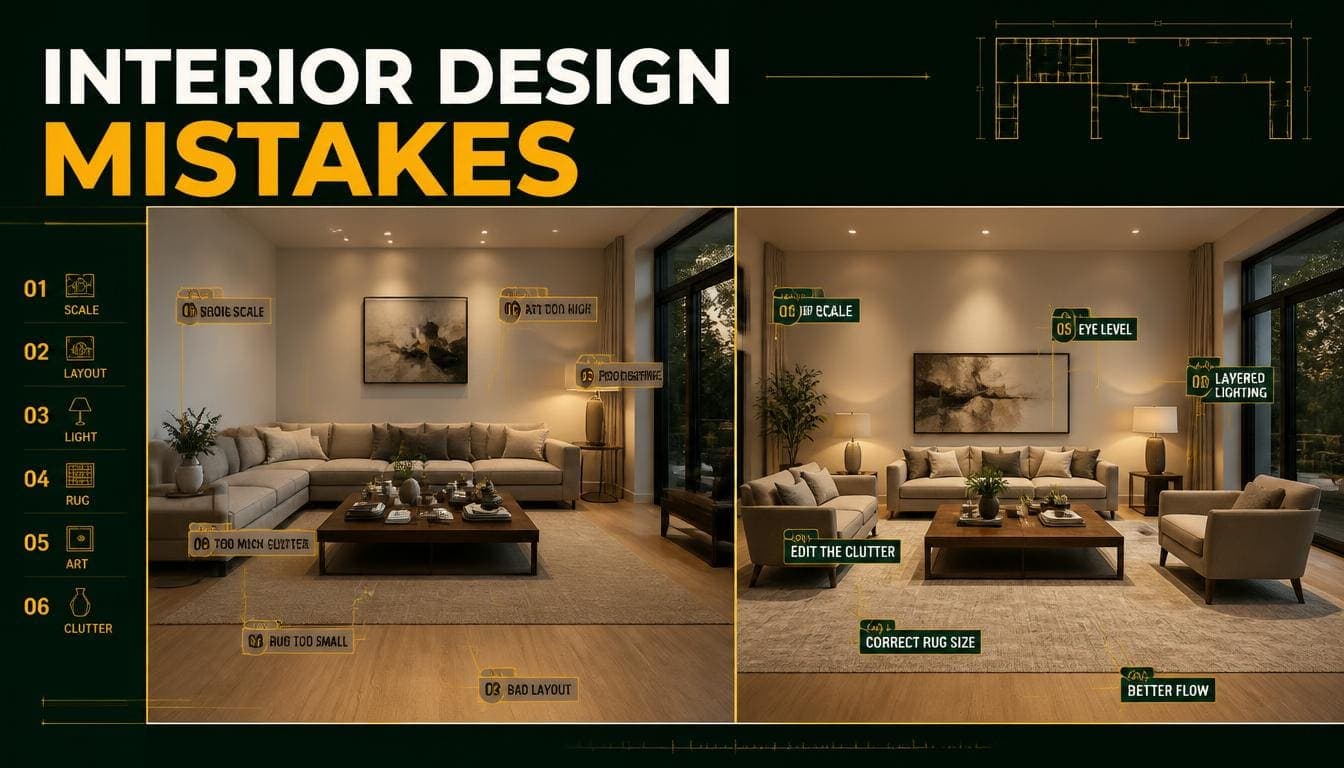
Clutter. Visual disorder is associated with increased stress in several studies, though effect sizes vary and self-selection is hard to rule out.
Temperature. Comfortable thermal conditions affect concentration and satisfaction. Well established.
What's Weaker Than Claimed
Specific colours causing specific emotions. Colour psychology is widely cited and poorly supported. The claim that blue makes people calm and red makes them energetic doesn't replicate consistently, and cultural variation is substantial.
What does hold: brightness and saturation affect perceived room size and light levels. That's a physical effect rather than a psychological one.
Precise wellbeing percentages. Figures like "good design improves productivity by 20%" typically trace to industry marketing rather than controlled research.
Biophilic design claims. Plants and natural materials are pleasant and there's some evidence for modest wellbeing effects. The stronger claims about measurable health outcomes are not well supported.
The Honest Position
Design affects how people feel in spaces. The mechanisms that are well evidenced — light, noise, air, temperature, clutter — are largely physical and environmental rather than aesthetic.
The aesthetic elements matter for satisfaction and preference. They matter less for measurable health outcomes than design marketing suggests.
3. It Affects Property Value and Sale Speed
The clearest commercial case, though the numbers require care.
What the Evidence Supports
Staged and well-presented properties sell faster. Multiple sources agree, including NAR's broad agent surveys which have no direct stake in staging services.
Presentation affects online engagement. Better photographs get more clicks and hold attention longer. This is mechanically obvious and consistently observed.
Condition affects offers. Buyers deduct for work needed, often more than the work would cost.
What's Less Certain
The size of any price premium. NAR 2025 found 29% of agents observed increases of 1–10% from staging — a minority of agents and a modest range. Industry sources claim considerably more, but those come from organizations selling staging.
The Practical Implication
Design and presentation reliably affect how quickly a property sells and how much attention it gets. Whether they materially increase the price is less certain than commonly stated, though the direction is positive.
4. It Affects Commercial Performance
Where the case is most measurable.
Retail
Layout, circulation, and lighting affect sales per square metre. These are tracked, tested, and iterated on continuously by large retailers — which is itself evidence that the effects are real enough to justify the investment.
What's measured: dwell time, penetration depth, conversion rate, sales per square metre.
Hospitality
Cover density determines revenue capacity. Acoustic design determines whether people stay. Layout determines staff efficiency.
What's measured: covers per hour, average spend, table turn time, repeat visits.
Offices
Design affects density (cost per employee), acoustics (concentration), and facilities (retention).
What's measured, with caveats: productivity is notoriously hard to measure in knowledge work, and claims about design improving it should be treated cautiously. Occupancy, satisfaction surveys, and retention are more reliable indicators.
Try DecoAI Free
3 free credits. No credit card needed. Stage any room in 30 seconds.
Get 3 Free Credits5. It Affects Longevity and Cost
Underrated and straightforwardly practical.
Material Choice Determines Replacement Cycles
Specifying appropriately durable materials means longer intervals between replacements. In commercial settings this is a substantial cost factor; in homes it's the difference between a floor lasting eight years and twenty.
Design for Maintenance
Surfaces that are easy to clean stay clean. Finishes that show every mark get replaced sooner. This is a design decision made at specification stage and lived with for years.
Flexibility Extends Usable Life
Spaces designed for one specific configuration become obsolete when needs change. Spaces designed with some flexibility adapt.
Example: a home office designed as a home office becomes a problem if the household needs a fourth bedroom. A room designed as a flexible space doesn't.
Energy Performance
Layout, glazing, insulation, and lighting design affect running costs over the whole life of a building. This is design work with a directly calculable return.
What Interior Design Cannot Do
Worth being explicit about, because overclaiming undermines the genuine case.
It doesn't fix a bad location. No amount of design compensates for a property somewhere people don't want to be.
It doesn't fix structural problems. Damp, subsidence, and poor construction are building problems, not design problems.
It doesn't guarantee a price premium. It affects perception and speed more reliably than it affects price.
It doesn't resolve fundamental layout constraints without structural work. You can improve how a badly laid out property works. You can't make it well laid out without moving walls.
It doesn't measurably cure anything. Wellbeing claims that verge on medical are not supported by the evidence.
Where Design Investment Returns Most
If you're deciding where to spend, rough guidance:
| Investment | Return | Why |
|---|---|---|
| Layout improvements | High | Affects daily function permanently |
| Lighting | High | Cheap relative to effect |
| Storage | High | Prevents clutter structurally |
| Decluttering and presentation | Very high | Costs almost nothing |
| Material durability | High long-term | Longer replacement cycles |
| Aesthetic refresh | Moderate | Real but the most subjective |
| High-spec finishes | Low if selling | Rarely recovered |
The consistent pattern: function returns more reliably than finish.
The Case in One Paragraph
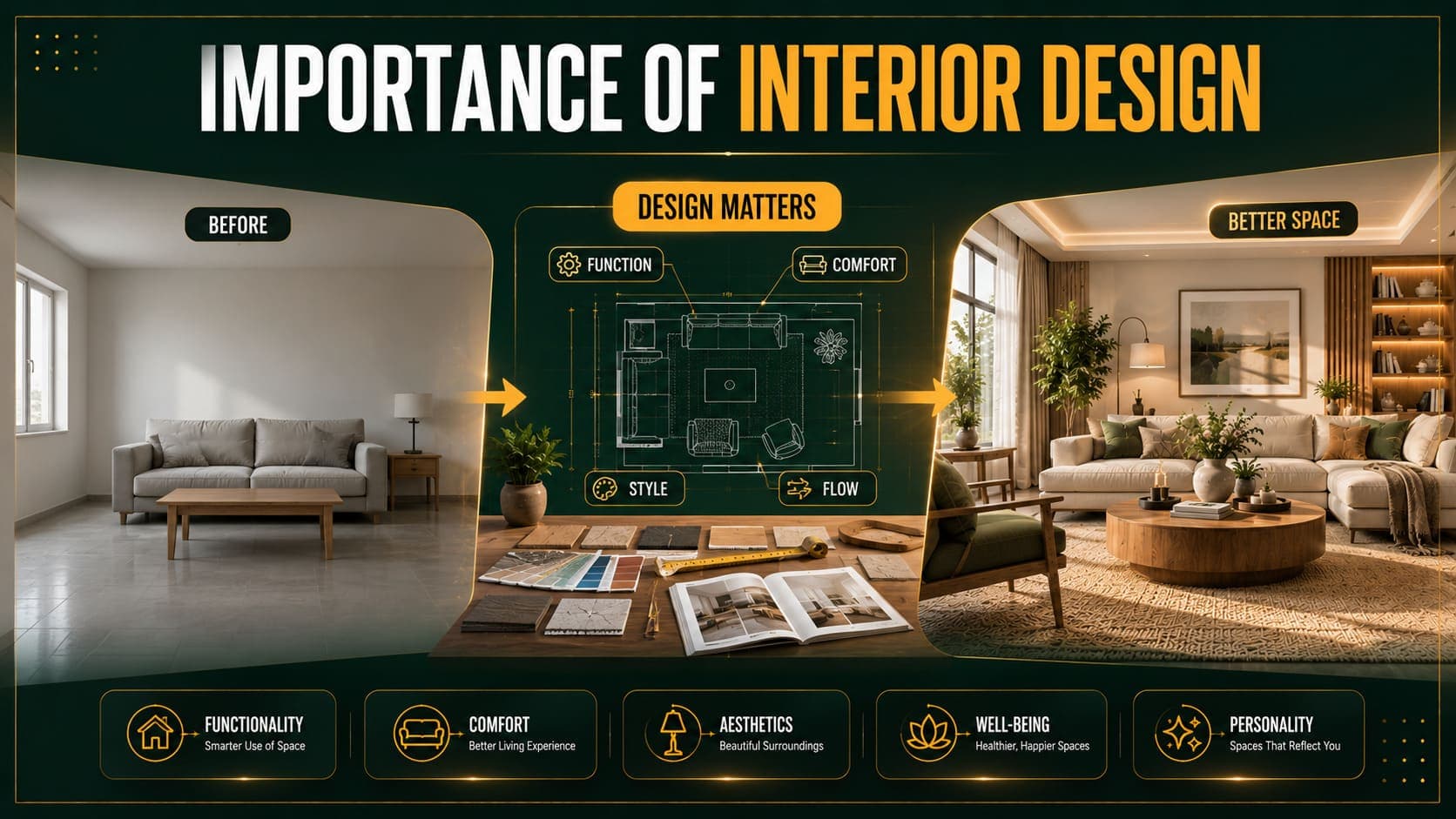
Interior design determines whether a space works — whether people can move through it, store things in it, and use it for what it's for. That's measurable and largely uncontroversial. It affects how spaces feel, through mechanisms that are mostly physical: light, noise, air, temperature, and visual order. It affects how properties perform commercially, reliably in terms of attention and speed, less certainly in terms of price. And it affects cost over time through material choice and flexibility.
What it doesn't do is compensate for location, fix structural problems, or produce the wellbeing outcomes that design marketing sometimes claims.
Frequently Asked Questions
Why is interior design important?
It determines how spaces function — circulation, storage, layout — which affects daily use permanently. It also affects how spaces feel, how properties perform commercially, and how much they cost to maintain over time.
Does interior design affect wellbeing?
Yes, through mechanisms that are largely physical: natural light, noise levels, air quality, temperature, and visual clutter. Claims about specific colours causing specific emotions are not well supported.
Does interior design increase property value?
It reliably affects how quickly a property sells and how much attention it gets online. Whether it materially increases price is less certain — NAR data suggests a modest effect observed by a minority of agents.
Is colour psychology real?
Broadly overclaimed. Brightness and saturation affect perceived room size and light levels, which is physical. The claim that specific colours cause specific emotions doesn't replicate consistently.
What's the highest-return design investment?
Decluttering and presentation, which cost almost nothing. Then layout improvements, lighting, and storage. High-spec finishes return least, particularly if you're selling.
Does design affect productivity?
Probably, but productivity in knowledge work is notoriously hard to measure, and specific percentage claims usually come from industry marketing. Better-evidenced effects are on concentration through noise and air quality.
What can't interior design fix?
Location, structural problems, and fundamental layout constraints without building work. It also can't guarantee a price premium.
Is professional design worth the cost?
Most clearly for layout problems, large budgets, and complex projects. Less clearly for single-room refreshes with modest budgets, where consultation-only input may deliver most of the value.
Does design matter more in commercial settings?
The effects are more measurable — retail sales per square metre, restaurant covers per hour, office density. That's why commercial design is more rigorously tested than residential.
Summary
What's well supported: design determines function, affects environmental conditions that influence how people feel, and affects how quickly properties sell and how much attention they attract.
What's less certain: the size of any price premium, productivity effects, and most wellbeing claims beyond the physical mechanisms.
What's overclaimed: colour psychology, precise percentage improvements, and anything approaching a health claim.
Where investment returns most: presentation, layout, lighting, and storage. Function over finish, consistently.
What it can't do: fix location, structure, or fundamental layout without building work.
Test presentation changes cheaply. DecoAI gives 3 free credits with no card required — presentation is the design investment with the highest return per unit of cost.