Interior design has a low barrier to entry and a high barrier to sustainability. Almost anyone can call themselves an interior designer; considerably fewer build a career that pays consistently.
That gap is worth understanding before committing time or money to training, because the training is rarely the constraint.
This covers the routes in, what they cost, what the work actually involves, and where the difficulty sits.
Interior Design vs Interior Decoration
The distinction matters practically, not just semantically.
Interior Decoration
Surfaces, furniture, colour, and styling. No structural or technical work.
Barrier to entry: essentially none. No formal qualification is required in most jurisdictions.
Typical work: furnishing schemes, colour consultation, styling, sourcing.
Interior Design
Includes decoration, plus space planning, technical drawing, building regulations, lighting design, and coordination with trades and other professionals.
Barrier to entry: higher. Formal training is effectively necessary to do the technical parts competently, and in some jurisdictions certain work requires registration.
Typical work: layout reconfiguration, specification, construction drawings, project coordination.
Which You're Aiming For
The routes differ substantially. Decoration can be self-taught and built through portfolio. Design generally requires structured training in the technical elements.
Practical note: many working professionals do both, and the boundary in practice is blurrier than the definition suggests.
Try DecoAI Free
3 free credits. No credit card needed. Stage any room in 30 seconds.
Get 3 Free CreditsThe Routes In
1. Degree
Duration: 3–4 years Cost: Varies enormously by country and institution Outcome: The most complete grounding, and the most direct route into established practices.
What you get: technical drawing, space planning, building construction, materials, history, CAD, and a structured portfolio developed over years.
Best for: People starting from scratch who want to work in established firms, particularly in commercial design where technical competence is required.
The consideration: significant time and cost commitment. Worth it if you want the technical and commercial routes; less necessary for residential decoration work.
2. Diploma or Foundation Course
Duration: 6 months to 2 years Cost: Substantially less than a degree Outcome: Practical grounding without the full academic commitment.
What you get: the core practical skills — space planning, drawing, materials, presentation — with less theory and history.
Best for: Career changers who want structured training without a multi-year degree.
3. Short Courses and Online Learning
Duration: Weeks to months Cost: Low Outcome: Specific skills rather than a complete grounding.
What you get: useful for particular gaps — CAD software, colour theory, a specific style, business setup.
Best for: Supplementing existing skills, or testing whether the field suits you before committing further.
The limitation: a short course alone doesn't produce a portfolio or the technical competence for design work.
4. Self-Taught Plus Portfolio
Duration: Ongoing Cost: Low in money, high in time Outcome: Viable for decoration work, difficult for technical design.
How it works in practice: design your own space, then friends' and family's spaces, document everything professionally, and build from there.
Best for: Decoration-focused work, particularly if you have an existing audience or network.
The honest limitation: without technical training, certain work is genuinely beyond your competence, and misjudging that boundary causes problems for clients.
5. Working Your Way Up
Duration: Years Outcome: Practical experience alongside earning.
Entry roles: design assistant, junior designer, showroom consultant, procurement assistant, studio administrator.
Best for: People who learn better in practice than in classrooms, and who can get an entry position.
The reality: entry positions in design are competitive and often poorly paid initially.
What Actually Matters for Getting Work
Ranked by how much they affect outcomes.
1. Portfolio
The single most important factor. Clients and employers assess work, not qualifications.
What a strong portfolio shows:
- Range — different room types, budgets, and styles
- Before and after, so the contribution is visible
- Technical drawings alongside finished images, if you're targeting design rather than decoration
- Professional photography of completed work
- Clear explanation of the brief and how it was solved
The chicken-and-egg problem: you need work to build a portfolio and a portfolio to get work.
How people solve it:
- Design their own home properly and document it
- Work for friends and family at cost, in exchange for photography rights
- Take on one project below rate specifically to build the portfolio
- Create speculative schemes for real spaces and present them as concept work, clearly labelled as such
2. Network
Interior design work comes substantially through referral. Builders, architects, estate agents, and previous clients generate more work than advertising does.
Practical implication: relationships with trades and adjacent professionals matter as much as design skill for sustaining a business.
3. Business Skills
Most independent designers fail on business rather than on design.
What's needed: pricing, contracts, scope management, client communication, cash flow, and managing suppliers.
The common failure: underpricing, unclear scope, and no written agreement about what's included. These cause more problems than any design decision.
4. Technical Competence
Matters more for commercial and construction-adjacent work than for residential decoration.
Software: CAD is standard. SketchUp is common for quick modelling. Rendering software varies by practice.
Knowledge: building construction basics, regulations relevant to your market, lighting, materials performance.
5. Formal Qualifications
Matter most for employment in established practices and for commercial work. Matter least for independent residential decoration.
Try DecoAI Free
3 free credits. No credit card needed. Stage any room in 30 seconds.
Get 3 Free CreditsWhat the Work Actually Involves
An honest breakdown, because the perception and the reality differ substantially.
The Time Split
Roughly, for an independent residential designer:
| Activity | Share of time |
|---|---|
| Client communication | 25–30% |
| Sourcing and procurement | 20–25% |
| Drawing and specification | 15–20% |
| Site visits and coordination | 10–15% |
| Business admin | 10–15% |
| Actual design decisions | 10–15% |
The point: design decisions are a minority of the work. Most of the job is coordination, communication, and administration.
What People Underestimate
Procurement is relentless. Ordering, tracking, chasing, dealing with damaged deliveries, managing lead times, and handling discontinued items.
Client management is the hardest part. Managing expectations, handling changes of mind, delivering difficult news about budget or timeline, and maintaining relationships through problems.
Problems are constant. Wrong deliveries, delayed trades, discovered issues in the building, budget overruns. Solving these is most of the job.
Physical demands. Site visits, carrying samples, measuring, and being on-site during works.
What People Overestimate
Creative freedom. Most projects are constrained by budget, existing architecture, client preference, and practicality. Pure creative expression is rare.
Glamour. The published photographs represent the final day of a project that involved months of coordination.
What It Pays
Honest ranges, with substantial regional variation.
Employed
| Role | Typical range |
|---|---|
| Junior / assistant | $28,000–$40,000 |
| Mid-level designer | $40,000–$65,000 |
| Senior designer | $60,000–$90,000 |
| Design director | $85,000–$140,000+ |
Commercial and contract design generally pays better than residential.
Independent
Highly variable. Income depends on project volume, fee structure, and whether you handle procurement.
The first two to three years are typically difficult. Building a client base takes time, and early projects are often underpriced.
Established independents with a consistent referral network and appropriate pricing can earn substantially more than employed equivalents. Many don't reach that point.
A realistic caution: the distribution is wide and skewed. A visible minority earn very well; a substantial proportion earn less than the employed ranges above while working more hours.
A Practical Path for Career Changers
If you're moving into design from another field:
Year 1
Test the field before committing money. Take a short course. Redesign your own space properly. See whether the work interests you when it's actual work rather than an idea.
Learn one software package. SketchUp is the most accessible starting point.
Document everything. Photograph properly, write up the brief and the reasoning.
Year 2
Get structured training if you've confirmed the interest — diploma level is sufficient for residential work.
Take on two or three projects at cost or reduced rate, specifically to build a portfolio. Be explicit with those clients about the arrangement.
Build relationships with a builder, an electrician, and a joiner. These are the relationships that sustain the work later.
Year 3
Start charging properly. Underpricing early is normal; continuing to underprice is the most common cause of failure.
Define your scope in writing. What's included, how many revisions, what's charged separately.
Decide on positioning. Full service, e-design, consultation only, or a specific niche.
Ongoing
Photograph every completed project professionally. The portfolio is the business.
Ask for referrals explicitly. Most clients would refer if asked and don't think to otherwise.
Common Mistakes
1. Expecting the Qualification to Generate Work
It doesn't. The portfolio and the network do.
2. Underpricing
Nearly universal early on and the most common reason independent practices fail.
3. No Written Scope
Causes more disputes than any other business decision.
4. Taking Everything
Projects that are the wrong size, wrong budget, or with clients who won't work out cost more than they return.
5. Neglecting Business Skills
Design competence without business competence produces a practice that doesn't survive.
6. Not Photographing Work
Completed projects that aren't documented professionally don't build the portfolio, which means they don't generate future work.
7. Overreaching Technically
Taking on structural or regulatory work beyond your competence. This creates genuine problems for clients.
Frequently Asked Questions
Do I need a degree to be an interior designer?
For decoration work, generally no. For technical design involving space planning, construction, and regulations, formal training is effectively necessary, and in some jurisdictions certain work requires registration.
What's the difference between an interior designer and a decorator?
Decoration covers surfaces, furniture, colour, and styling. Design adds space planning, technical drawing, building regulations, and coordination with trades.
How long does it take to become an interior designer?
3–4 years for a degree, 6 months to 2 years for a diploma. Building a sustainable practice typically takes another 2–3 years beyond training.
What qualifications do I need?
Requirements vary by country. In many markets there's no legal requirement for residential decoration work. Commercial and construction-adjacent work generally requires formal qualification.
How do I build a portfolio with no clients?
Design your own space properly and document it, work for friends and family at cost in exchange for photography rights, and create clearly labelled speculative schemes for real spaces.
What software do interior designers use?
CAD is standard for technical work. SketchUp is common for modelling and the most accessible starting point. Rendering software varies by practice.
How much do interior designers earn?
Employed: roughly $28,000 for junior roles to $140,000+ for director level. Independent income is highly variable, with a wide and skewed distribution.
What's the hardest part of the job?
Client management and problem-solving. Design decisions are a minority of the work — most of it is coordination, communication, and handling things going wrong.
Can I become an interior designer without formal training?
For decoration work, yes, via portfolio and network. For technical design, the gap in competence is real and misjudging it creates problems for clients.
Summary
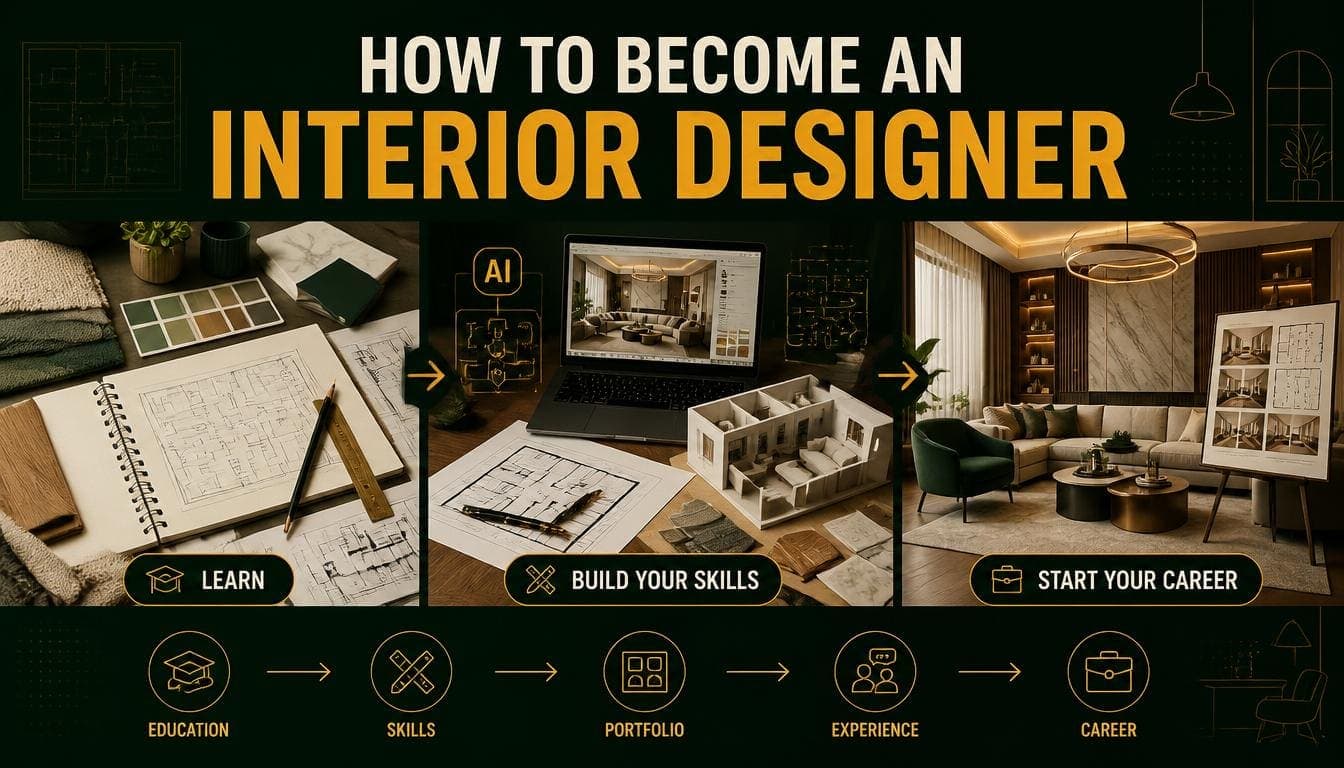
The routes: degree (3–4 years, most complete), diploma (6 months–2 years, practical), short courses (specific skills), self-taught plus portfolio (viable for decoration), or working up from an entry role.
What actually matters: portfolio first, network second, business skills third, technical competence fourth, formal qualifications fifth — with the caveat that qualifications rank higher for commercial work.
The reality of the work: design decisions are 10–15% of the time. The rest is client communication, procurement, coordination, and admin.
The most common failure: business, not design. Underpricing and unclear scope end more practices than poor design does.
Where the barrier actually sits: entry is easy; sustaining a practice is not.
Test style directions quickly. DecoAI gives 3 free credits with no card required — useful for exploring concepts before presenting them, and for building speculative portfolio work.