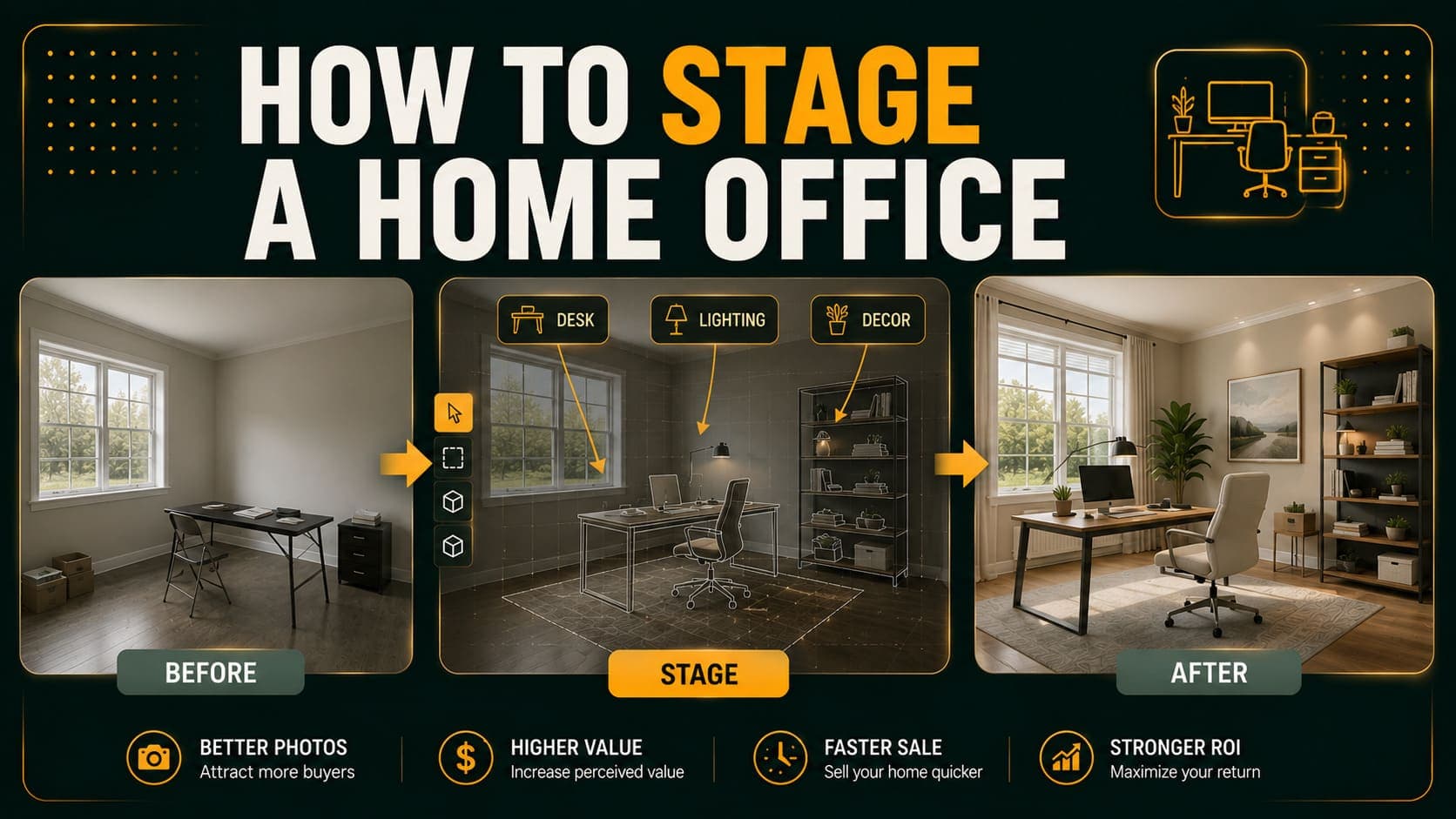
Before 2020, a spare room was a spare room. Now it's a buying criterion.
Remote and hybrid work turned "is there somewhere I can work?" into one of the questions buyers ask before booking a viewing. A property with an obvious, well-presented home office answers it. A property with an ambiguous empty room leaves the buyer guessing.
That makes home office staging one of the highest-leverage decisions available — you're not just presenting a room, you're defining what it's for.
The Strategic Question: Office or Bedroom?
Before staging, decide what the room should be.
Stage It as an Office When
- The property already has enough bedrooms for its target buyer
- The room is small — under about 8 m² and it makes a poor bedroom anyway
- The room has awkward proportions that suit a desk better than a bed
- Your market skews toward professionals or remote workers
- There's a window with good light
Stage It as a Bedroom When
- Bedroom count is a headline selling feature
- The property is family-oriented and bedroom count drives the price band
- The room comfortably fits a double bed with space around it
Stage It as Both
This is often the smartest option. Generate two versions of the same room — one as an office, one as a bedroom — and include both in the gallery.
You're showing flexibility rather than describing it. At $0.10 per image, showing both costs $0.20.
Try DecoAI Free
3 free credits. No credit card needed. Stage any room in 30 seconds.
Get 3 Free CreditsDesk Placement Rules
The desk is the anchor, and where it sits determines whether the room reads as a workable office.
1. Facing or Beside the Window
Natural light is the single most valued feature in a workspace. A desk positioned to use the window light signals a genuinely usable office.
Best: Desk perpendicular to the window, so light falls across the work surface from the side.
Also good: Desk facing the window, if the view isn't a distraction.
Avoid: Desk with its back to the window — this creates screen glare and looks like an afterthought.
2. Not Facing a Blank Wall in the Corner
A desk shoved into a corner facing plaster reads as a compromise. It's how people actually work sometimes, but it doesn't present well.
3. Leave Chair Clearance
There should be visible space behind the chair to pull it out and move around.
Minimum: about 70cm between the desk edge and the wall behind Better: 90cm or more
4. Show the Cable Situation
A desk with a visible power outlet nearby reads as practical. Buyers do think about where the router goes and whether they'll be running an extension lead across the room.
What to Include
The Essentials
Desk — Sized to the room. A large executive desk in a 7 m² room fills the frame; a small writing desk in a 15 m² room looks lost.
Chair — An actual office chair, not a dining chair. It signals the room is intended for real work.
Task lighting — A desk lamp. Even in a bright room, it communicates that the space works in the evening.
The Useful Additions
Shelving or a bookcase — Storage is a genuine consideration. A single bookcase against a wall shows where files, books, and equipment go.
A rug — Defines the workspace and adds warmth to what can otherwise be a sterile room.
A plant — One plant. It softens the space and photographs well.
A monitor or laptop on the desk — Optional but effective. It makes the room's purpose unambiguous.
What to Leave Out
- Filing cabinets — they read as corporate
- Multiple monitors and cable clutter
- Whiteboards
- Excessive decoration
- Anything that makes the room look busy
The office should read as calm and functional, not as a working environment mid-project.
Style Selection
Home offices suit a narrower range of styles than living spaces.
Modern
Clean desk, simple chair, uncluttered surfaces. Best for: Most properties, urban markets, professional buyers Effect: Focused and current
Minimalist
Desk, chair, one lamp. Nothing else. Best for: Small rooms where floor space is the story Effect: Maximum sense of space
Scandinavian
Light wood desk, white walls, soft textures. Best for: Small rooms with good light Effect: Calm and bright
Industrial
Metal-framed desk, dark tones, exposed shelving. Best for: Loft conversions and character properties Effect: Distinctive — needs architectural support
Contemporary
Mixed materials, upholstered chair, layered lighting. Best for: Family homes, suburban markets Effect: Comfortable and considered
Best Default
Modern or Scandinavian. Both read as professional without being cold, and both photograph well in the small rooms that typically become offices.
Try DecoAI Free
3 free credits. No credit card needed. Stage any room in 30 seconds.
Get 3 Free CreditsRoom-Size Approaches
Very Small Rooms (under 7 m²)
Style: Minimalist or Scandinavian Furniture: Slim desk, one chair, wall-mounted shelf Avoid: Bookcases, rugs, anything freestanding beyond the desk and chair
Key principle: a small office needs to look workable, not spacious. A slim desk against the window with visible floor around it reads as a genuine workspace.
Standard Rooms (7–12 m²)
Style: Modern, Scandinavian, or Contemporary Furniture: Desk, office chair, bookcase, desk lamp, small rug Consider: A second chair, if the room allows — it suggests the space can host a call or a colleague
Large Rooms (over 12 m²)
Style: Contemporary, Modern, or Industrial Furniture: Larger desk, office chair, bookcase, rug, and a seating element — an armchair or small sofa
Key principle: a large room with just a desk looks empty. A reading corner demonstrates the space's generosity and dual-purpose potential.
Corner or Alcove Offices
Some properties have a workspace nook rather than a dedicated room — under the stairs, in a hallway alcove, or in a corner of a bedroom.
Approach: Stage it minimally and honestly. A compact desk and chair in an alcove is a genuine feature worth showing, as long as it isn't presented as a full room.
Photography
Shoot from the Corner Showing the Window
Buyers assessing an office want to know about natural light. Position yourself so the window is visible in frame.
Camera at Chest Height
Roughly 1.2 meters, level. Same as every room.
Turn On the Desk Lamp
Even in daylight. A lit lamp adds a warm point of interest and signals evening usability.
Include the Doorway or a Second Wall
Small rooms photograph better when the composition shows depth. A corner shot capturing two walls does this.
Check for Cable Visibility
Real cables running across the floor look bad. In digital staging, check that generated furniture doesn't create implausible arrangements.
Common Mistakes
1. Desk Backing onto the Window
Creates glare and reads as poorly planned.
2. Dining Chair Instead of Office Chair
Immediately signals that the room isn't a real workspace.
3. Too Much Furniture
Filing cabinets, multiple bookcases, and a second desk make a small room look unusable.
4. Ignoring Storage
A desk alone doesn't answer "where does my stuff go?" One bookcase or shelf handles it.
5. Staging a Bedroom as an Office When Bedroom Count Matters
If the property is marketed as three-bedroom and you stage the third as an office, you've undermined your own headline.
6. Too Corporate
Grey filing cabinets and fluorescent-style lighting make a home office look like a call centre. Keep it residential.
7. No Natural Light Shown
If the room has a window, show it. If it doesn't, that's a genuine limitation buyers should know about.
Staging with AI
Step 1: Clear the Room Completely
Every object. Boxes and stored items are common in spare rooms and produce artifacts in staged output.
Step 2: Prepare Light
Curtains fully open, all lights on, shoot midday.
Step 3: Shoot from the Corner Showing the Window
This angle demonstrates both the room's dimensions and its light.
Step 4: Select Room Type
Room type: Home Office Style: Modern or Scandinavian for most properties
Step 5: Consider Generating Both Versions
Generate the same photo as Home Office and as Bedroom. Include both in the listing gallery to show flexibility.
Cost: $0.20 for both.
Step 6: Check the Result
- Is the desk positioned sensibly relative to the window?
- Is the chair an office chair?
- Is there visible floor around the desk?
- Does the room look workable rather than crowded?
Frequently Asked Questions
Should I stage a spare room as an office or a bedroom?
Depends on your bedroom count. If bedroom count is a headline feature, stage it as a bedroom. If the property already has enough bedrooms, or the room is small, an office adds more value. Showing both is often the best answer.
Where should the desk go in a home office?
Perpendicular to the window so light falls across the work surface. Avoid placing the desk with its back to the window.
What makes a home office look professional?
An actual office chair rather than a dining chair, a desk lamp, visible storage, and a calm, uncluttered arrangement.
How small can a home office be?
Around 5–6 m² is workable with a slim desk. Below that, an alcove or corner setup is more honest than presenting it as a room.
Should the desk have a computer on it?
Optional, but a laptop or monitor makes the room's purpose unambiguous. It helps buyers read the space instantly.
What style works best for a home office?
Modern or Scandinavian. Both read as professional and photograph well in the small rooms that typically become offices.
Can I show a room as both an office and a bedroom?
Yes, and it's often the strongest approach. Generate both versions and include both in the gallery. It demonstrates flexibility rather than claiming it.
Do home offices need a rug?
In rooms over about 8 m², a rug defines the workspace and adds warmth. In very small rooms, visible floor communicates space better.
How much does home office staging cost?
$0.10 per image with pay-per-image AI tools. Showing both office and bedroom versions costs $0.20.
Quick Checklist
Decide first
- Office, bedroom, or both?
- Does bedroom count matter to your headline?
Room prep
- Completely empty, including stored boxes
- Floors clean
- Curtains fully open
- All lights on
Photography
- Corner angle showing the window
- Chest height (~1.2m), level
- Desk lamp on if present
- Two or three angles
Staging choices
- Room type: Home Office
- Style: Modern or Scandinavian
- Consider generating a bedroom version too
Check in the result
- Desk beside or facing the window, not backing onto it
- Actual office chair
- Some visible storage
- Clear floor around the desk
- Calm rather than cluttered
Show the flexibility. DecoAI gives 3 free credits with no card required — enough to stage the same room as both an office and a bedroom and let buyers choose.