The bedroom is the second most important image in a listing after the living room — and it works differently. Nobody imagines entertaining guests in a bedroom. They imagine sleeping, waking up, and whether their own bed will actually fit.
That means bedroom staging answers a narrower set of questions: is it big enough, is it calm, and can I see myself here?
This guide covers bed placement, size-specific approaches, the mistakes that make bedrooms look smaller, and how to stage one digitally.
What Buyers Actually Look For
Three questions, in order:
1. Will my bed fit? Buyers are mentally placing a king or queen bed in the space. If the staging shows an undersized bed, the room reads as small — even if a king would genuinely fit.
2. Where does everything else go? Wardrobe, dresser, bedside tables. If there's no visible space for storage, the room feels impractical.
3. Does it feel calm? Bedrooms sell on restfulness. Cluttered or busy staging works against this.
Try DecoAI Free
3 free credits. No credit card needed. Stage any room in 30 seconds.
Get 3 Free CreditsBed Placement Rules
The bed is the anchor. Everything else follows from where it sits.
1. Against the Longest Uninterrupted Wall
Usually the wall opposite or perpendicular to the door, with no windows or doors interrupting it.
This creates the most balanced composition and leaves the maximum usable floor on either side.
2. Not Under the Window (Usually)
Placing the bed under a window blocks light, complicates curtain arrangement, and reads as a compromise.
Exception: In small rooms where it's the only wall long enough, it's better than an awkward alternative. Some rooms genuinely have no other option.
3. Not Directly Facing the Door
A bed positioned so you look straight down the length of it from the doorway produces an odd, corridor-like composition.
Perpendicular to the door usually photographs better.
4. Leave Space on Both Sides
A bed pushed into a corner with access on one side only reads as a compromise — practical for a child's room, awkward for a primary bedroom.
Ideal: 60–75cm of clear floor on both sides Minimum: 50cm on at least one side
5. Bedside Tables on Both Sides
Symmetry reads as intentional. A single bedside table looks like the room couldn't accommodate two.
If the room genuinely can't fit two, that's information the buyer needs — but if it can, show it.
Bed Size and Room Perception
This is where staging gets strategic.
| Room size | Bed to show | Effect |
|---|---|---|
| Under 9 m² | Double | Honest, avoids cramped look |
| 9–12 m² | Double or Queen | Queen if it genuinely fits |
| 12–16 m² | Queen | Standard expectation |
| Over 16 m² | King | Shows the room's generosity |
The principle: show the largest bed the room comfortably accommodates. Showing a double in a room that fits a king undersells the space; showing a king in a room that fits a double makes it look cramped and misleads.
Style Selection for Bedrooms
Bedrooms benefit from calmer styles than living rooms.
Scandinavian
Light wood, white linen, soft textures. Best for: Almost any bedroom, especially small ones Effect: Calm, bright, spacious
This is the highest-performing bedroom style across most markets.
Modern
Clean lines, neutral palette, low platform bed. Best for: Urban properties, professional buyers Effect: Uncluttered and current
Traditional
Wooden bed frame, warm neutrals, symmetrical arrangement. Best for: Family homes, period properties, older demographics Effect: Warm and familiar
Contemporary
Upholstered headboard, mixed textures, layered bedding. Best for: Suburban homes, mid-range price points Effect: Comfortable and inviting
Luxury
Premium fabrics, statement headboard, rich palette. Best for: Premium properties only Effect: Impressive — but must match the property tier
Minimalist
Bed, one side table, nothing else. Best for: Very small rooms where floor space is the story Effect: Maximum visible floor
What to Avoid in Bedrooms
Industrial rarely works in bedrooms — the hard materials and darker palette fight against restfulness.
Bohemian can work in vacation rentals but often reads as too busy for a primary bedroom in a standard listing.
Try DecoAI Free
3 free credits. No credit card needed. Stage any room in 30 seconds.
Get 3 Free CreditsRoom-Size Specific Approaches
Small Bedrooms (under 9 m²)
Style: Scandinavian or Minimalist Bed: Double Furniture: Bed, one or two slim bedside tables. Nothing else. Rug: Small or none — visible floor matters more Avoid: Wardrobes, benches, chairs, anything that fills floor
Key principle: show floor. A small bedroom with visible floor around the bed reads as workable. One filled edge to edge reads as unusable.
Standard Bedrooms (9–16 m²)
Style: Scandinavian, Modern, or Contemporary Bed: Queen Furniture: Bed, two bedside tables, one additional piece (dresser or chair) Rug: Runner on each side, or a large rug under the lower two-thirds of the bed
Large Bedrooms (over 16 m²)
Style: Contemporary, Traditional, or Luxury Bed: King Furniture: Bed, two bedside tables, dresser, and a seating element — a chair or bench Rug: Large, extending well beyond the bed's footprint
Key principle: a large bedroom with only a bed looks empty. Adding a reading chair or bench demonstrates the space's generosity.
Children's and Guest Bedrooms
Style: Scandinavian or Contemporary Bed: Single or double depending on size Approach: Keep it neutral. Heavily themed children's staging narrows the appeal to buyers with children of exactly that age.
Common Bedroom Staging Mistakes
1. Undersized Bed
Showing a double in a room that fits a queen makes the room look smaller than it is. Buyers judge size relative to familiar objects, and the bed is the reference point.
2. Bed Under the Window When Alternatives Exist
Blocks light, complicates the composition, reads as a compromise.
3. Single Bedside Table
Asymmetry looks like a constraint rather than a choice.
4. Too Much Furniture
A wardrobe, dresser, chair, bench, and desk in a 10 m² room leaves no visible floor. Less furniture makes rooms look larger.
5. Busy Bedding
Heavily patterned duvets and multiple clashing cushions create visual noise. Calm, simple bedding photographs better and reads as restful.
6. Heavy Dark Furniture in Small Rooms
Dark wood absorbs light and visually occupies more space than lighter pieces.
7. Ignoring Storage
If the room has a built-in wardrobe, show it. Storage is a genuine buying consideration.
8. Themed Children's Rooms
Cartoon-themed staging appeals to a narrow slice of buyers. Neutral staging lets everyone imagine their own use.
Staging a Bedroom with AI
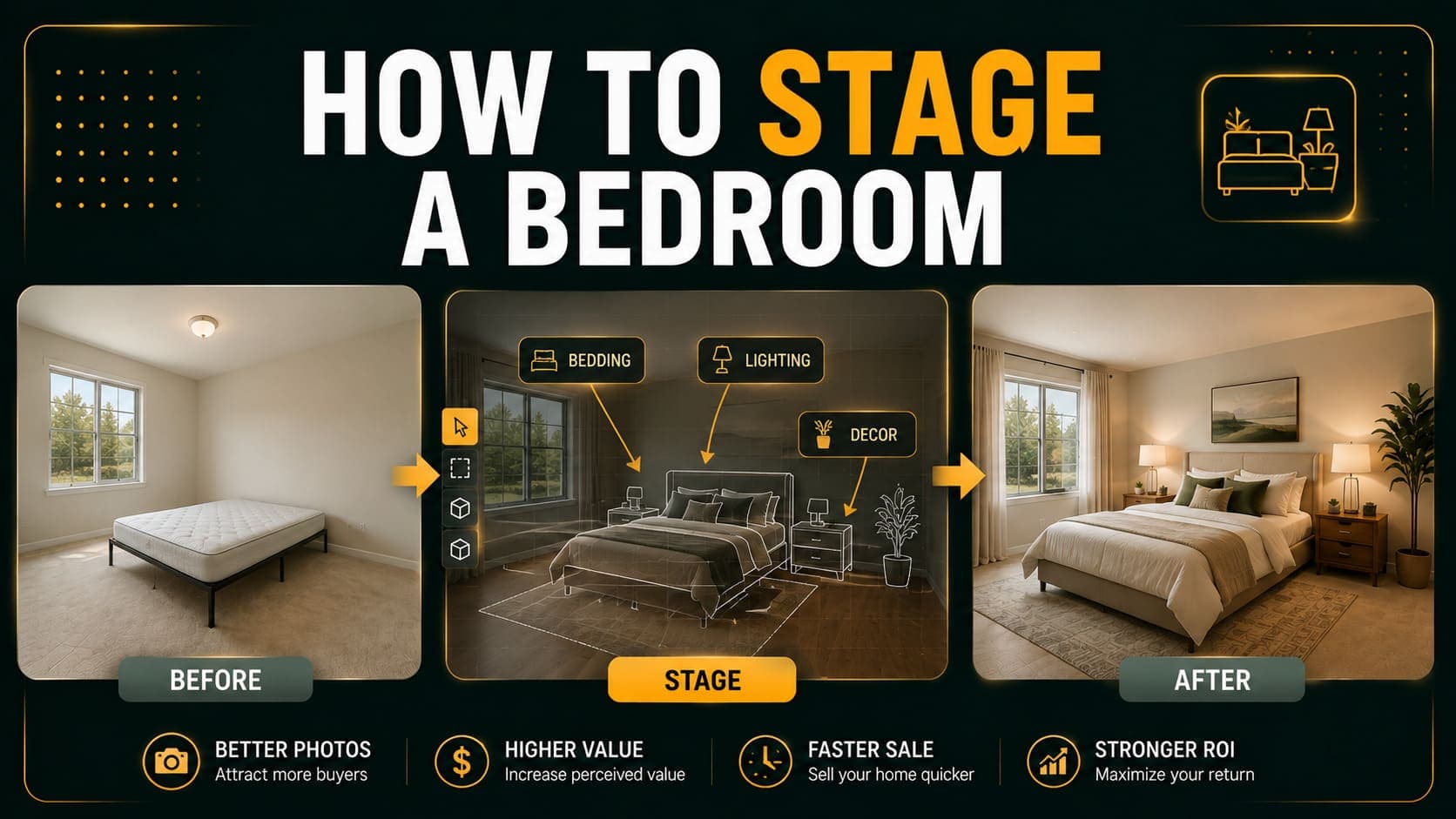
Step 1: Empty the Room Completely
Every object — including any existing bed frame or mattress. AI staging needs empty space to work from.
Step 2: Prepare the Light
Curtains fully open, all lights on, shoot between 10am and 2pm.
Step 3: Shoot from the Corner
Stand in the corner diagonally opposite the wall where the bed would naturally sit. Camera at chest height, level.
This angle shows the bed wall and the floor space around it — exactly what buyers are assessing.
Step 4: Upload and Select
Room type: Bedroom Style: Scandinavian is the safest default for most bedrooms
Step 5: Check the Result Carefully
Bedrooms have a specific failure mode: AI sometimes generates beds that are too large for the room. Check:
- Is there visible floor on both sides of the bed?
- Does the bed scale look plausible against the door and window?
- Are bedside tables present on both sides?
- Does the bed sit flat, not floating?
Step 6: Generate Variations
Three to five attempts. Bed placement and scale vary between generations, so picking the best from several meaningfully improves the result.
What Staging Communicates
An empty bedroom tells buyers:
- Approximate square footage
- Window position
- Wall condition
A staged bedroom tells buyers:
- Whether their bed will fit
- Where the wardrobe goes
- How much floor space remains around the bed
- Whether the room feels calm and liveable
That second list is what drives inquiries.
Frequently Asked Questions
Where should the bed go when staging a bedroom?
Against the longest uninterrupted wall, ideally not under a window and not directly facing the door.
What size bed should I show in staging?
The largest that comfortably fits with clear floor on both sides. Undersizing makes the room look small; oversizing makes it look cramped.
What is the best style for bedroom staging?
Scandinavian performs best across most markets — light, calm, and it makes small rooms feel larger.
How do I make a small bedroom look bigger?
Scandinavian or Minimalist staging, a double rather than a queen bed, minimal additional furniture, light palette, and maximum visible floor.
Should I stage children's bedrooms?
Yes, but keep them neutral. Heavily themed staging narrows appeal to buyers with children of a specific age.
How much furniture should a staged bedroom have?
Small room: bed and one or two bedside tables. Standard: add a dresser. Large: add a seating element to show the space's generosity.
Do bedrooms need a rug?
Not always. In small rooms, visible floor communicates space better than a rug. In larger rooms, a rug extending beyond the bed adds warmth.
How much does bedroom staging cost?
$0.10 per image with pay-per-image AI tools. Human designer services charge $16–$49 per image.
Should I stage every bedroom in the property?
Stage the primary bedroom always. Additional bedrooms are worth staging if the property has three or fewer — beyond that, one or two staged is usually sufficient.
Quick Checklist
Room prep
- Completely empty, including any existing bed
- Floors clean
- Curtains fully open
- All lights on
Photography
- Corner diagonally opposite the bed wall
- Chest height (~1.2m)
- Camera level
- Two or three angles
- Midday light
Style selection
- Scandinavian for small rooms and general use
- Contemporary or Traditional for family markets
- Luxury only if the property tier matches
- Avoid Industrial and heavy Bohemian
Check in the result
- Visible floor on both sides of the bed
- Bed scale plausible for the room
- Two bedside tables
- Nothing blocking the window
- Calm, uncluttered overall feel
Stage your bedroom now. DecoAI gives 3 free credits with no card required — enough to test three styles and see which makes the room look most spacious.