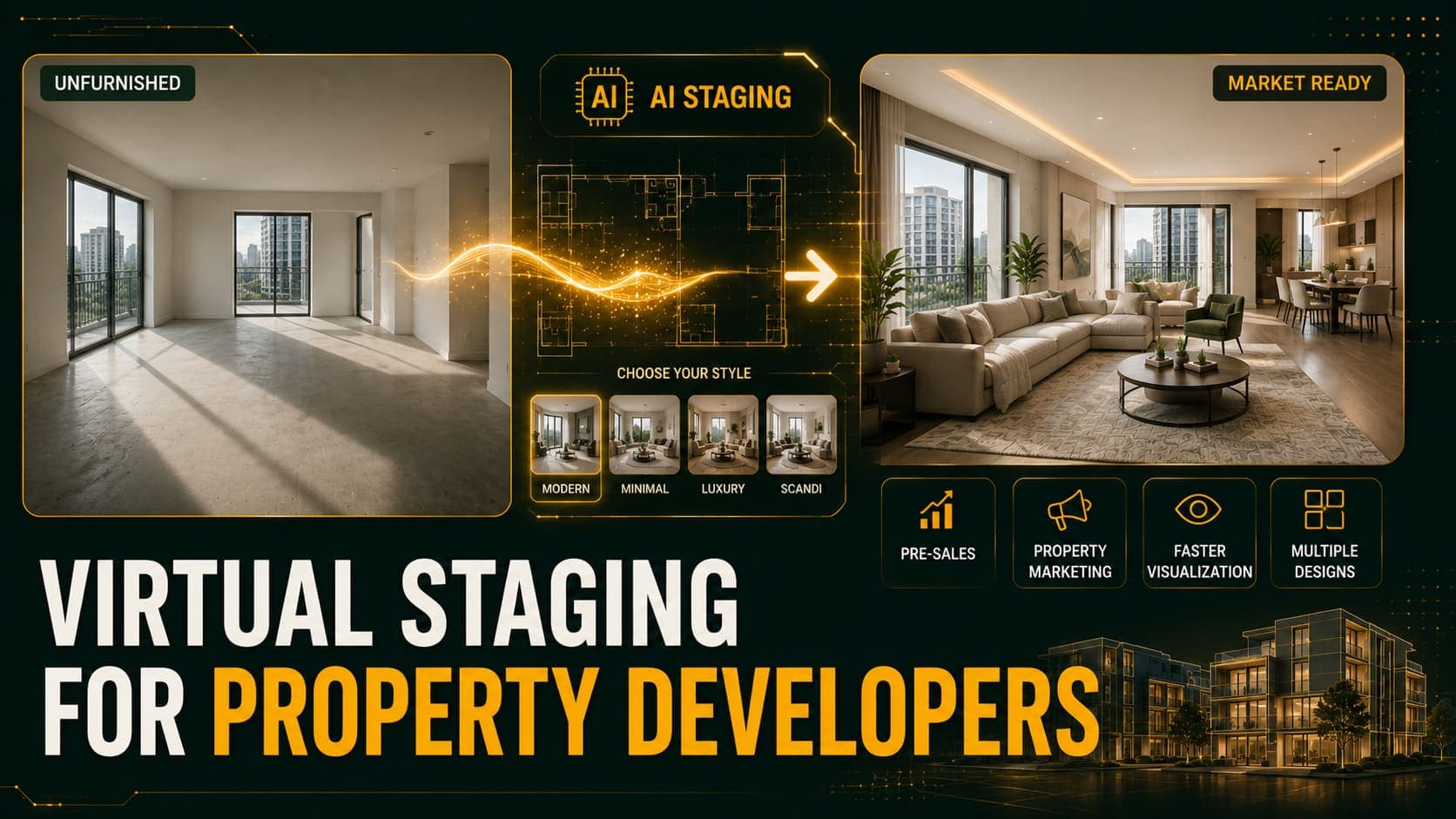
Property developers face a marketing problem that agents don't: you're often selling something that doesn't physically exist yet, or exists as a bare concrete shell.
The traditional answer is a show home — one unit fully fitted and furnished, costing £30,000–£100,000 or more, and only useful to buyers who visit in person.
Virtual staging doesn't replace a show home for serious buyers walking a site. But it does something a show home can't: present every unit type, in multiple configurations, before anything is built.
The Developer's Specific Problem
Selling What Doesn't Exist
Off-plan sales rely on floor plans and CGI renders. Floor plans require spatial imagination most buyers don't have. CGI renders cost £200–£2,000 per image and take weeks.
Multiple Unit Types
A development might have six unit types across four floor levels. A single show home represents one of them. The other five rely on the buyer extrapolating.
Phased Releases
Later phases launch months or years after the show home was fitted out. Design trends move, target demographics shift, and the show home no longer represents what's being sold.
Empty Completed Units
Between completion and sale, finished units sit empty. Photographs of bare rooms with new flooring and blank walls communicate very little about what living there would feel like.
Try DecoAI Free
3 free credits. No credit card needed. Stage any room in 30 seconds.
Get 3 Free CreditsWhere Virtual Staging Fits
Stage One Completed Unit as Every Unit Type
Once one unit of each type is finished, photograph it once and generate multiple staged versions.
Cost: $0.50 per unit type for a five-room configuration Versus: One show home fitted per type, at £30,000+ each
Show Multiple Configurations of the Same Unit
The most valuable application for developers.
A two-bedroom unit can be presented as:
- Two bedrooms — for families
- One bedroom plus a home office — for professionals
- One bedroom plus a nursery — for young families
Same photograph, three staged versions, $0.30 total. Each targets a different buyer segment with the same physical unit.
Bridge the Gap Between CGI and Reality
CGI renders are made before construction, from architectural drawings. They rarely match the finished unit exactly, and buyers who notice the difference lose confidence.
Photographing the actual finished unit and staging that photograph produces marketing material that matches what buyers will walk into.
Refresh Marketing for Later Phases
When phase three launches two years after phase one, restaging the same unit photographs in a current aesthetic costs $0.50 and takes twenty minutes. Refitting a show home costs tens of thousands.
The Show Home Question
Being honest about this: virtual staging doesn't replace a show home.
What a Show Home Does That Staging Can't
- Lets buyers experience actual scale, ceiling height, and flow
- Demonstrates finish quality — worktop materials, floor texture, joinery
- Creates the emotional moment that closes many sales
- Gives sales staff a space to conduct viewings
What Staging Does That a Show Home Can't
- Represents every unit type, not just one
- Presents multiple configurations of the same unit
- Reaches buyers who never visit the site
- Updates instantly as target demographics or design trends shift
- Costs approximately nothing per additional variation
The Practical Combination
One show home for the flagship unit type, giving site visitors the physical experience.
Virtual staging for every other unit type, every alternative configuration, and all online marketing.
This is substantially cheaper than fitting multiple show homes and covers more ground.
Try DecoAI Free
3 free credits. No credit card needed. Stage any room in 30 seconds.
Get 3 Free CreditsStaging Workflow for Developments
Phase 1: Photograph Each Unit Type Once
As soon as one unit of each type reaches practical completion — flooring in, walls painted, fittings installed — photograph every room.
What matters:
- Unit completely empty, including protective sheeting and site materials
- Every light working and switched on
- All windows unobstructed, blinds or coverings fitted if they're part of the spec
- Shot from a corner at chest height, camera level
- Midday light where possible
Time: About 20 minutes per unit.
Phase 2: Generate the Core Set
For each unit type, stage the rooms that drive decisions:
- Living area
- Primary bedroom
- Kitchen or kitchen-diner
- Second bedroom
- Bathroom if it's a selling feature
Cost: $0.50 per unit type.
Phase 3: Generate Configuration Variants
For units where the second bedroom could serve multiple purposes, generate alternatives.
Cost: $0.10 per additional configuration.
Phase 4: Generate Style Variants for Different Segments
If the development targets multiple buyer profiles, stage the same living area in two or three styles.
- Modern or Minimalist for young professionals
- Contemporary or Scandinavian for families
- Luxury for premium units
Cost: $0.10 per additional style.
Total for a Six-Unit-Type Development
| Item | Quantity | Cost |
|---|---|---|
| Core staging, 5 rooms per type | 30 images | $3.00 |
| Configuration variants | 12 images | $1.20 |
| Style variants | 12 images | $1.20 |
| Regenerations | 20 images | $2.00 |
| Total | 74 images | $7.40 |
Against CGI at £200–£2,000 per image, or additional show homes at £30,000+ each.
Style Selection by Development Type
City Centre Apartments
Buyer: Young professionals, investors, downsizers Styles: Modern, Minimalist, Scandinavian Emphasis: Show workspace potential, storage, and light
Suburban Family Housing
Buyer: Families, second-time buyers Styles: Contemporary, Traditional, Scandinavian Emphasis: Room count, garden connection, family living space
Premium and Penthouse Units
Buyer: High-net-worth, downsizers from large family homes Styles: Luxury, Modern Emphasis: Finish quality, views, entertaining space
Build-to-Rent Developments
Buyer: Institutional investors, tenants Styles: Modern, Scandinavian, Contemporary Emphasis: Durability, practicality, broad appeal rather than distinctiveness
Student and Co-Living Schemes
Buyer: Investors, operators Styles: Modern, Minimalist Emphasis: Efficient use of space, study areas, communal facilities
Common Developer Mistakes
1. Staging Before Completion
Photographing a unit with protective floor coverings, unfinished skirting, or site materials produces poor staging output and inaccurate marketing.
Wait for practical completion.
2. Using CGI Where Photography Is Available
Once a unit exists, photograph it. CGI renders made from drawings before construction rarely match the finished product, and the discrepancy costs credibility.
3. Staging Every Unit Individually
Unnecessary. Stage one unit per type, then reuse across all units of that type. The units are identical by design.
4. One Style for Every Buyer Segment
If a development targets both young professionals and families, one aesthetic underserves at least one of them. Generating a second style costs $0.10.
5. Ignoring Configuration Flexibility
A two-bedroom unit staged only as two bedrooms misses the professional buyer who wants a home office. Showing both costs $0.10 and doubles the addressable buyer profile.
6. Not Refreshing for Later Phases
A phase four launch marketed with phase one imagery signals that the development is dated before anyone moves in.
7. Mismatch Between Staging and Specification
Staging that shows a premium kitchen when the standard specification is basic creates a problem at the viewing. Match the staging to the actual spec.
Working with Marketing Teams
Standardize the Photography Brief
A one-page shooting guide ensures consistency across units, phases, and whoever holds the camera.
Corner position, chest height, level camera, all lights on, unit fully cleared, midday where possible.
Build a Reusable Asset Library
Stage once per unit type and store the outputs properly. Later phases, portal refreshes, and brochure updates draw from the same library.
Assign Ownership
The workflow requires no design skill. A marketing coordinator can handle staging for an entire development in a day after a single training session.
Decide the Pricing Model
| Volume | Model |
|---|---|
| Under 100 images per month | Pay per image |
| 100–290 images per month | Compare both |
| Over 290 images per month | Subscription |
Most developments fall well under 100 images per month, where pay-per-image is substantially cheaper.
Frequently Asked Questions
Can virtual staging replace a show home?
Not entirely. Show homes let buyers experience real scale and finish quality. Virtual staging covers every unit type and configuration, reaches online buyers, and costs almost nothing. Most developments benefit from one show home plus staging for everything else.
How much does it cost to stage a development?
A six-unit-type development with configuration and style variants runs around $7–$10 total using pay-per-image AI tools.
When should I photograph units for staging?
At practical completion — flooring in, painting done, fittings installed, all site materials removed. Photographing earlier produces poor results and inaccurate marketing.
Should I stage every unit or one per type?
One per type. Units of the same type are identical, so the staged images apply across all of them.
Can staging show different configurations of the same unit?
Yes, and this is one of its most valuable applications for developers. The same photograph can present a second bedroom as a bedroom, a home office, or a nursery for $0.10 per version.
Is virtual staging better than CGI for off-plan sales?
Different tools for different stages. Before construction, CGI is the only option. Once units exist, photographing and staging the real space produces marketing that matches what buyers will see.
How do I keep marketing consistent across phases?
Restage the same unit photographs in a current style when each phase launches. It costs about $0.50 per unit type and takes twenty minutes.
What style should a new development use?
Match the target buyer. City apartments suit Modern or Minimalist; suburban family housing suits Contemporary or Traditional; premium units suit Luxury.
Can virtual staging handle unit types beyond apartments?
Standard residential rooms stage well. Non-standard spaces — plant rooms, communal areas with unusual layouts, commercial units — produce less reliable results.
Summary
For developers, virtual staging solves a problem show homes structurally can't: presenting every unit type, in every configuration, to buyers who may never visit the site.
The cost difference isn't marginal. A full development's marketing imagery costs under $10 in staging against tens of thousands for additional show homes or CGI packages.
The practical approach is one show home for the flagship unit type, and virtual staging for everything else — every other unit type, every alternative configuration, and all online marketing.
Try it on one completed unit. DecoAI gives 3 free credits with no card required — enough to stage a living area in three styles and see which resonates with your target buyer.