Most buyers read the first two lines of a listing description and skim the rest. Some don't read it at all — they look at the photos, check the price and bedroom count, and decide from there.
That reality shapes how listing copy should work. You're not writing an essay. You're writing something that survives being skimmed.
What Buyers Actually Do
The typical sequence on a property portal:
- Thumbnail image — decides whether they click at all
- Price and bedroom count — immediate filter
- Photo gallery — the main assessment
- First two lines of description — a quick sanity check
- Rest of description — only if genuinely interested
By the time someone reads your third paragraph, they've already largely decided. The description's job is to confirm and add specifics, not to persuade from scratch.
Try DecoAI Free
3 free credits. No credit card needed. Stage any room in 30 seconds.
Get 3 Free CreditsStructure That Works
Line 1: The Single Strongest Feature
Lead with whatever most distinguishes this property. Not a generic opening.
Weak: "A wonderful opportunity to acquire this delightful family home." Strong: "South-facing garden backing onto woodland, with a converted loft adding a fourth bedroom."
The first line should give a buyer a reason to keep reading that they couldn't get from the photos.
Line 2: The Practical Frame
Type, size, and location context in one sentence.
Example: "A four-bedroom semi-detached house on a quiet residential road, ten minutes' walk from the station."
Between these two lines, a buyer knows whether this property is relevant to them.
Paragraph 2: The Layout Walk-Through
Describe the property in the order someone would walk through it. Entrance, main living spaces, kitchen, upstairs, outside.
Keep it factual. Room dimensions belong here if your portal doesn't display them separately.
Paragraph 3: The Specifics That Matter
Anything a buyer would want to know before booking a viewing:
- Heating type and age
- Recent work — new roof, rewiring, replacement windows
- Parking arrangement
- Garden orientation and approximate size
- Service charges and ground rent for leasehold
- Council tax or property tax band
Paragraph 4: Location
Schools, transport, amenities. Be specific rather than generic.
Weak: "Excellent local amenities and good transport links." Strong: "Two primary schools within half a mile, a Sainsbury's Local at the end of the road, and a 14-minute train to the city centre."
Closing: A Clear Next Step
"Viewings available from Saturday" or "Contact us to arrange a viewing." One line.
What to Leave Out
Generic Openers
"A rare opportunity." "We are delighted to offer." "Nestled in a sought-after location."
These appear in thousands of listings and communicate nothing. They also waste the two lines buyers actually read.
Adjective Stacking
"Stunning, beautifully presented, immaculate, spacious family home."
Four adjectives before the first noun. Buyers discount all of them because every listing uses them.
Better: describe what makes it those things. "Repainted throughout last year, with new oak flooring in the reception rooms."
Estate Agent Euphemisms
Buyers have learned to read these as warnings:
| Phrase | What buyers hear |
|---|---|
| Cosy / compact | Small |
| Deceptively spacious | Looks small |
| In need of modernisation | Needs substantial work |
| Full of character | Old, possibly problematic |
| Up-and-coming area | Not yet good |
| Would suit a first-time buyer | Cheap for a reason |
| Convenient for transport | Near a busy road or railway |
Using these doesn't hide the underlying issue — it just signals that you're trying to.
Better approach: state the actual situation. "Needs a new kitchen and bathroom, priced accordingly" performs better than "requires some modernisation" because it's specific and honest.
Excessive Length
A 600-word listing description doesn't get read. 200–300 words covers everything a buyer needs before viewing.
Repeating What the Photos Show
If the photos show a modern kitchen, "modern fitted kitchen" adds nothing. Use the description for what photos can't show — heating, work done, orientation, service charges.
Try DecoAI Free
3 free credits. No credit card needed. Stage any room in 30 seconds.
Get 3 Free CreditsWriting for Different Property Types
Family Homes
Lead with: School catchment, garden, bedroom count, storage Emphasize: Practicality, safety, space for growing Tone: Warm and reassuring
City Apartments
Lead with: Location specifics, transport times, building features Emphasize: Convenience, security, outdoor space if any Include: Service charge, lease length, parking situation
Period Properties
Lead with: The specific period features that matter — original fireplaces, sash windows, high ceilings Emphasize: Character supported by facts, not adjectives Be honest about: Condition, heating efficiency, any work needed
New Builds
Lead with: Specification, warranty, energy efficiency Emphasize: Move-in condition, running costs, guarantees Include: Developer, completion date, incentives
Properties Needing Work
Lead with: The potential and the price relationship Be specific: "Needs a new kitchen, bathroom, and rewiring" rather than "requires modernisation" Emphasize: What's already sound — roof, windows, structure
Buyers looking for projects want to know the scope. Vagueness makes them assume the worst.
Vacant Properties
Lead with: Move-in timing — vacant possession is genuinely valuable to some buyers Emphasize: No chain, immediate availability Note: If you've staged the photos, label them as virtually staged
Practical Techniques
Write the Second Line First
The opening line is the hardest. Write the practical description first, then go back and identify what's most distinctive to lead with.
Read It Out Loud
Anything that sounds like estate agent language when spoken aloud probably reads that way too.
Cut the First Sentence
Most drafts open with a throat-clearing sentence that adds nothing. Delete it and check whether the second sentence works as an opener. It usually does.
Use Specific Numbers
"Large garden" is weaker than "approximately 30 metres of garden." "Close to the station" is weaker than "an eight-minute walk to the station."
Specificity reads as honest. Vagueness reads as concealment.
Check Every Claim
Errors in listing descriptions cause problems at viewing and damage credibility. Verify bedroom counts, dimensions, tenure, and any factual claim before publishing.
Vary Openings Across Your Listings
If a buyer browses several of your listings and each opens with "A rare opportunity to acquire," it reads as templated. Vary the structure.
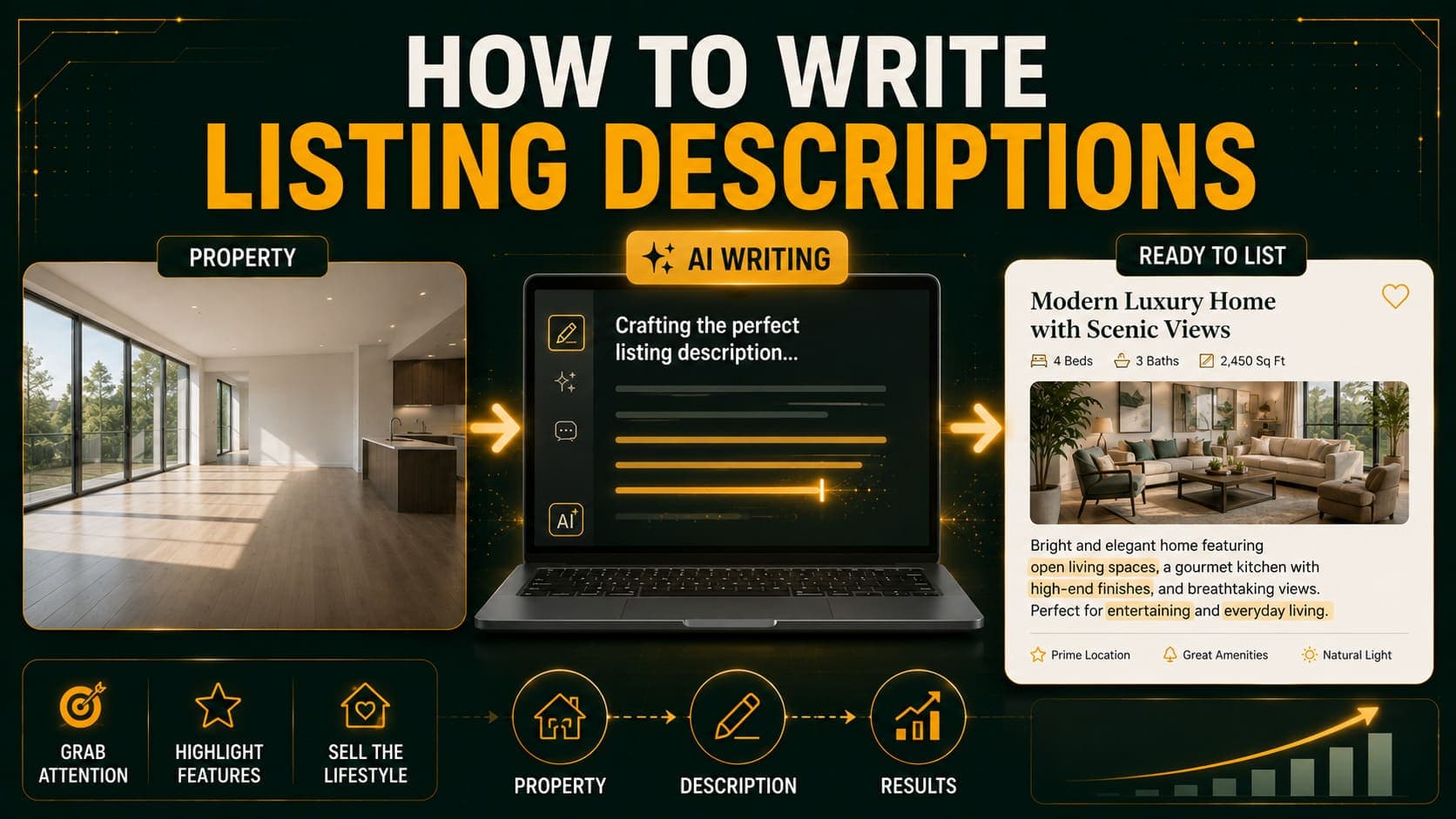
Using AI for Listing Copy
AI language models handle listing descriptions reasonably well, with caveats.
What Works
Structure and flow — Give it the property details and it produces well-organized copy. Consistency — Useful when writing many listings. Overcoming a blank page — A draft to edit is easier than starting from nothing.
What Doesn't
Factual accuracy — It will confidently reproduce any error in your input, and sometimes invent details. Local knowledge — It doesn't know which streets are quiet or which schools are oversubscribed. Distinctiveness — AI output has a recognizable sameness. Buyers browsing many listings notice.
Practical Approach
- Give it accurate property details, room dimensions, and key features
- Ask for 250 words in a specific structure
- Edit heavily — particularly the opening, which AI tends to make generic
- Verify every factual claim
- Add the local specifics AI can't know
Never publish unedited. The main risk isn't bad writing — it's factual errors that cause problems later.
A Worked Example
Before
"We are delighted to offer to the market this stunning and beautifully presented three-bedroom family home, nestled in a highly sought-after location and boasting a wealth of features throughout. This deceptively spacious property benefits from a modern fitted kitchen and would ideally suit a growing family. Early viewing is highly recommended to avoid disappointment."
Problems: Generic opener, adjective stacking, "deceptively spacious," describes what photos show, says nothing specific, 60 words with almost no information.
After
"A south-facing rear garden of roughly 25 metres, backing onto allotments rather than other houses.
Three-bedroom semi-detached house on a residential cul-de-sac, twelve minutes' walk from Northfield station.
The ground floor has a through lounge-diner opening to the garden, a separate kitchen fitted in 2023, and a downstairs cloakroom. Upstairs are two doubles and a single, plus a family bathroom.
Rewired in 2021, new combi boiler in 2024, and double glazing throughout. Driveway parking for two cars. Council tax band C.
Northfield Primary is a seven-minute walk. There's a Co-op and a pharmacy on the parade at the end of the road.
Vacant possession — no onward chain. Viewings from Saturday."
Why it works: Leads with a genuine differentiator, gives practical detail, uses specific numbers, mentions work done, and answers the questions a buyer would ask before viewing.
Frequently Asked Questions
How long should a property listing description be?
200–300 words. Longer descriptions don't get read; shorter ones miss information buyers need before viewing.
What should the first line of a listing say?
The single most distinctive feature of the property — something a buyer couldn't get from the photos alone.
What words should I avoid in listing descriptions?
Generic openers like "rare opportunity," stacked adjectives, and euphemisms like "cosy," "deceptively spacious," and "in need of modernisation." Buyers read these as warnings.
Should I describe what's already in the photos?
No. Use the description for what photos can't show — heating, work done, orientation, service charges, transport times.
Can AI write listing descriptions?
Reasonably well as a draft. The risks are factual errors and generic phrasing. Always edit heavily and verify every claim.
How do I describe a property that needs work?
Specifically. "Needs a new kitchen, bathroom, and rewiring" performs better than "requires modernisation" because buyers looking for projects want to know the scope.
Should I mention that photos are virtually staged?
Yes — it's standard practice, and it prevents any mismatch between listing expectations and the viewing.
What's the most common listing description mistake?
Wasting the opening on a generic phrase. Those first two lines are the only part many buyers read.
How do I make my listings sound different from competitors?
Lead with specifics rather than adjectives, use actual numbers, and vary your opening structure across listings.
Summary
Structure: Strongest feature, practical frame, layout walk-through, specifics, location, next step.
Length: 200–300 words.
Lead with: Something distinctive that photos can't show.
Leave out: Generic openers, stacked adjectives, euphemisms, and anything the photos already communicate.
The test: would a buyer scanning twelve listings stop at yours based on the first two lines? If not, rewrite the opening.
Pair good copy with good photos. DecoAI gives 3 free credits with no card required — staged photos and a specific, honest description do more together than either does alone.