Many buyers check the exterior before doing anything else. They see the front elevation on a property portal, then look at the street on a map, then decide whether the interior photos are worth their time.
That makes the frontage a filter. It doesn't sell the property, but it decides whether anyone gets far enough to be sold.
This covers what's worth fixing, what isn't, and how to photograph an exterior properly.
What Buyers Read from a Frontage
Condition Signals
Peeling paint, blocked gutters, and cracked paths read as deferred maintenance. Buyers extrapolate — if the visible things are neglected, what about the roof and the boiler?
Fair or not, that inference happens.
Street Context
The neighbouring properties, parked cars, and general upkeep of the street affect perception as much as your property does. You can't change this, but you can shoot around it.
Property Type Clarity
Buyers should be able to tell instantly whether it's detached, semi-detached, terraced, or an apartment. Ambiguity in the lead exterior image costs clicks.
Parking
Where cars go is a genuine question. If there's a driveway or garage, show it. If parking is on-street, don't attempt to obscure that.
Try DecoAI Free
3 free credits. No credit card needed. Stage any room in 30 seconds.
Get 3 Free CreditsThe High-Impact, Low-Cost Fixes
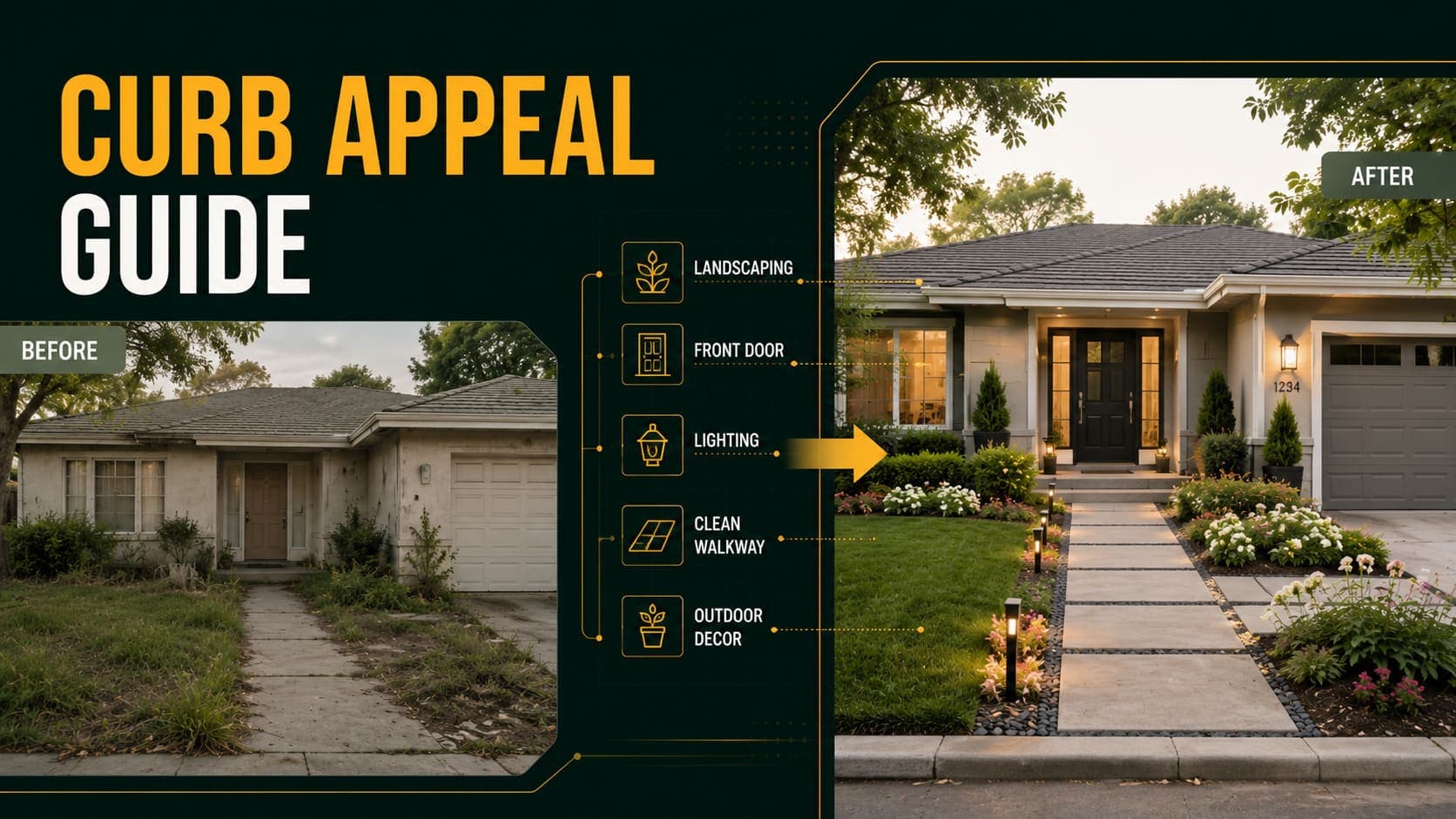
These are worth doing on almost any property. A weekend and under $200 covers most of them.
1. Clean the Front Door
The single most-looked-at element of a frontage. A wiped, clean door with polished hardware makes a disproportionate difference.
If the paint is tired: repainting a front door costs $30–$60 in materials and takes an afternoon. It's the highest-return cosmetic job available.
2. Replace the Doormat
$15–$30. Visible in every exterior photograph and at every viewing.
3. Clear the Gutters and Fascias
Visible debris and staining read as neglect. Clearing takes an hour with a ladder.
4. Clean the Windows
Inside and out. Affects both exterior appearance and interior light.
5. Remove or Screen the Bins
Bins in the frontage are one of the most common issues in exterior photographs. Move them for photography, and consider screening for viewings.
6. Cut Back Overgrowth
Anything obscuring the front elevation, path, or windows. Overgrown vegetation makes properties look neglected and darker inside.
7. Weed and Clear the Path
Weeds through paving and moss on paths are quick to remove and highly visible.
8. Mow and Edge the Lawn
Edging matters more than mowing for photographs — a defined edge reads as maintained.
9. Clear the Driveway
Remove cars, bins, tools, and stored items. An empty driveway also communicates that there is one.
10. Fix or Remove Broken Fixtures
A hanging light fitting, a broken gate latch, a cracked house number. Small, cheap, visible.
The Moderate-Cost Improvements
Worth considering depending on property value and condition.
Painting the Front Door and Frame
$50–$100 in materials. High return relative to cost.
Pressure Washing
Driveway, path, and patio. Hire cost $50–$80 for a day, or $150–$250 for a service. The difference on stained paving is substantial.
Planting
Two matching pots either side of the door, or a small planted bed. $50–$150.
Practical note: this reads as maintained rather than decorated. Keep it simple — overplanting looks fussy.
New House Numbers
$20–$50. Small detail, disproportionately visible.
Repainting Window Frames
$100–$200 in materials for a typical frontage. Worth it if they're visibly peeling.
Replacing the Front Door
$500–$1,500. Only worth it if the existing door is genuinely poor. Painting usually achieves most of the benefit.
What's Usually Not Worth It
Re-Rendering or Re-Cladding
$3,000–$15,000. Rarely returns its cost when done specifically to sell.
New Driveway
$3,000–$8,000. Buyers factor a tired driveway into their offer at roughly its replacement cost, so you're unlikely to gain.
Exception: if the driveway is genuinely unusable or dangerous.
Extensive Landscaping
Buyers often have their own plans for outdoor space. Tidy and clear beats elaborately landscaped.
New Windows
$5,000–$15,000. Buyers factor this in. Doing it to sell rarely returns the cost.
Roof Work Done Cosmetically
If the roof needs work, it needs work — and a survey will find it. Cosmetic patching to improve appearance is a poor use of money.
Try DecoAI Free
3 free credits. No credit card needed. Stage any room in 30 seconds.
Get 3 Free CreditsPhotographing the Exterior
Time of Day
Golden hour — the hour before sunset — is best for most properties. Warm directional light flatters brickwork, stonework, and planting.
Midday works if the frontage faces the sun. Avoid shooting into direct sun.
Check which way the property faces. A north-facing frontage is in shadow most of the day and photographs best on a bright overcast day.
Camera Position
Shoot from an angle, not straight on. A three-quarter view shows depth and gives the building form. A straight-on elevation looks flat and technical.
Get back far enough to include the full building plus some context — path, planting, sky.
Camera at chest height, as with interiors. Shooting from very low exaggerates the building; from very high diminishes it.
Keep verticals straight. Tilting up to fit the building in makes it lean backwards. Step back further instead.
What to Include
- The full front elevation
- The path or driveway approach
- Some sky
- Enough context to place the property
What to Exclude
- Cars, including yours
- Bins
- Neighbouring properties where possible
- Wheelie bins, cables, satellite dishes where the angle allows
- Overhead wires if you can shoot around them
Multiple Angles
Shoot from both sides and straight on. The best angle isn't always predictable, and some frontages have a clearly better side.
Property-Type Specifics
Detached Houses
The most photogenic. Show the full plot context — the space around the building is part of what's being sold.
Semi-Detached
Shoot at an angle that emphasizes your half. A straight-on shot showing both halves equally makes the property look smaller.
Terraced
Difficult to photograph well. Shoot at an angle down the terrace rather than straight on, which shows the street context and gives the image depth.
Consider whether the rear or garden makes a better lead exterior image.
Apartments
The building exterior is less relevant than for houses. Include one shot for context, but don't lead with it unless the building is distinctive.
Better lead: an interior or the balcony if there is one.
Rural Properties
Setting is often the selling point. Shoot wider than you would in town, and include the surroundings.
Consider a shot from further back showing the property in its landscape.
Common Mistakes
1. Cars in the Frame
Including your own car, the seller's car, or neighbours' cars. Move what you can and shoot around the rest.
2. Bins Visible
One of the most common issues, and entirely avoidable.
3. Shooting Straight On
Flat, technical, no depth. An angle almost always works better.
4. Tilting Up
Makes the building lean backwards. Step back further instead.
5. Shooting Into the Sun
Front elevation in shadow, blown-out sky. Check which way the property faces and time accordingly.
6. Overinvesting in Landscaping
Buyers have their own plans. Tidy and clear beats elaborate.
7. Ignoring the Front Door
The most-looked-at element and among the cheapest to improve.
Frequently Asked Questions
What is kerb appeal?
The impression a property makes from the street — its exterior condition, presentation, and immediate surroundings. It affects whether buyers click through to interior photos and book viewings.
What's the cheapest way to improve kerb appeal?
Clean the front door, replace the doormat, clear gutters, remove bins, cut back overgrowth, and weed the path. Under $100 and a weekend.
Is painting the front door worth it?
Yes — it's the highest-return cosmetic job available. $30–$60 in materials and an afternoon's work on the most-looked-at element of any frontage.
Should I replace the driveway before selling?
Usually not. Buyers factor a tired driveway into their offer at roughly its replacement cost. Pressure washing achieves most of the visual benefit for a fraction of the price.
When should I photograph the exterior?
Golden hour — the hour before sunset — for most properties. Check which way the frontage faces; north-facing elevations photograph best on bright overcast days.
Should the exterior be the first listing photo?
Only if it's genuinely distinctive. For most properties, the best interior image performs better as the lead.
How do I photograph a terraced house?
At an angle down the terrace rather than straight on. This shows context and gives the image depth. Consider whether the rear makes a better lead image.
Is landscaping worth doing before selling?
Tidying is. Extensive landscaping usually isn't — buyers often have their own plans for outdoor space.
What should I remove before photographing the exterior?
Cars, bins, tools, stored items, and anything on the driveway. Cut back anything obscuring the elevation.
Summary
The high-return fixes, under $200 total: Clean or repaint the front door, new doormat, clear gutters, remove bins, cut back overgrowth, weed the path, edge the lawn, clear the driveway.
Not worth it: Re-rendering, new driveway, extensive landscaping, new windows. Buyers factor these into offers regardless.
Photography: Golden hour, shoot from an angle, chest height, keep verticals straight, exclude cars and bins.
The thing most people skip: the front door. Most-looked-at element, cheapest to improve, highest return per dollar spent.
The interior still does the selling. DecoAI gives 3 free credits with no card required — the exterior gets buyers to click, but staged interiors are what generate enquiries.