How to Price a Property: Why Overpricing Costs More Than It Gains
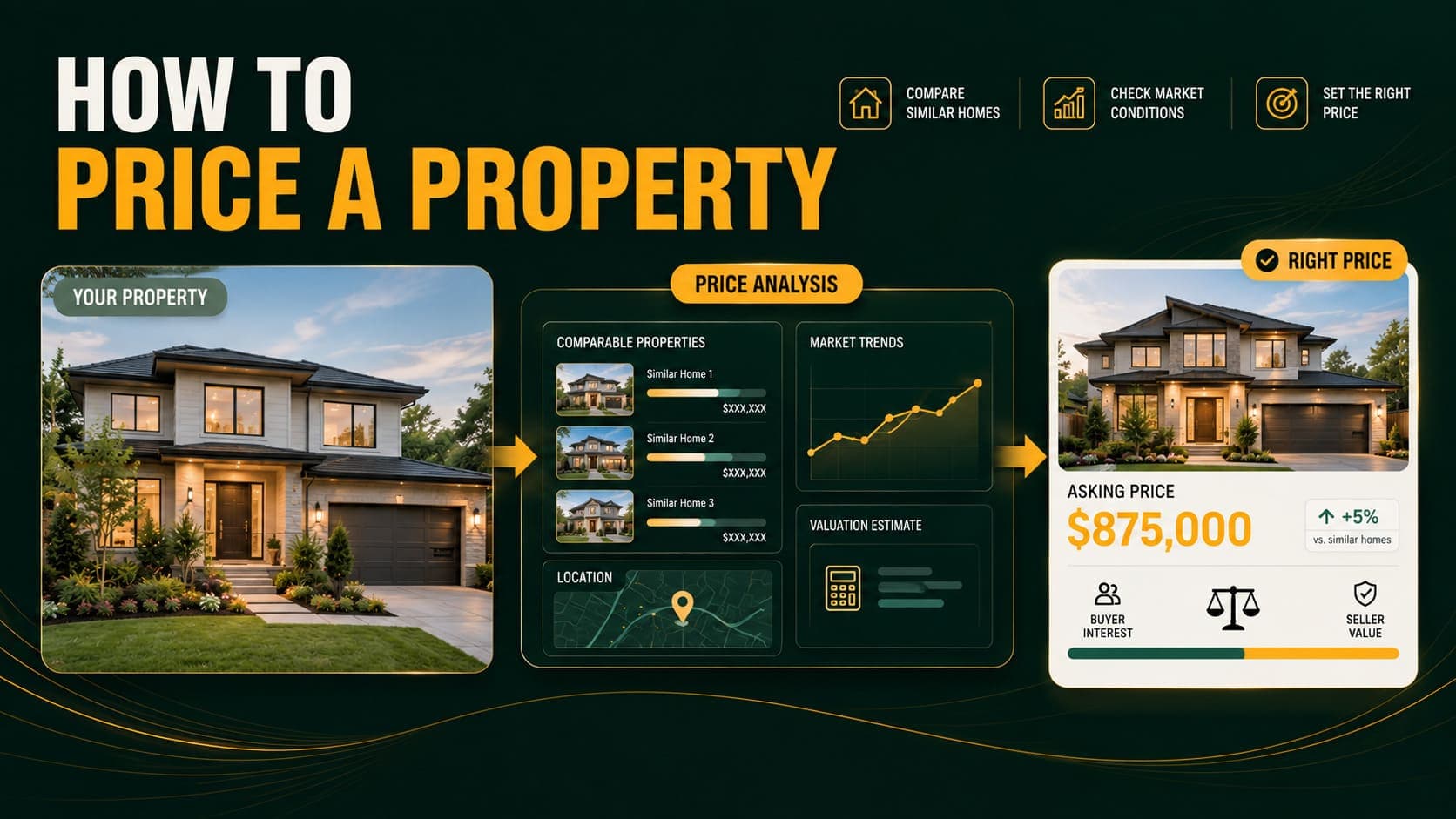
Overpricing is the most expensive mistake in property, and it's counter-intuitive: properties listed above market value frequently sell for less than properties priced accurately from the start.
The mechanism is straightforward once you see it. This covers how pricing actually works, what comparables can and can't tell you, and when adjustment makes sense.
Why Overpricing Costs Money
The First Two Weeks Are the Peak
When a property lists, it appears in every relevant saved search, email alert, and portal feed. Buyers who have been looking for months see it immediately.
That's your maximum exposure, and it happens once.
An overpriced property spends this window being seen by exactly the right buyers, who conclude it's too expensive and move on. When you reduce later, most of them have already dismissed it.
Listings Go Stale
Portals display days-on-market. Buyers read a long listing period as a signal — something's wrong, or the seller is unrealistic.
The practical effect: after roughly 60 days, enquiries drop sharply regardless of price changes.
Price Reductions Signal Weakness
A reduction tells buyers you were overpriced and that you're now motivated. That's an invitation to offer below the reduced price rather than at it.
The sequence that costs money:
- List at $450,000 (above market)
- No offers for six weeks
- Reduce to $425,000
- Buyers now offer $405,000, reading the reduction as motivation
- Property sells for $410,000
Versus listing accurately at $425,000:
- Multiple viewings in week one
- Offers around asking
- Sells for $422,000 in four weeks
Same property, $12,000 difference, and six weeks of additional carrying costs.
Try DecoAI Free
3 free credits. No credit card needed. Stage any room in 30 seconds.
Get 3 Free CreditsWhat Determines Value
Comparable Sales
Sold prices, not asking prices. Asking prices tell you what sellers hoped for. Sold prices tell you what buyers paid.
Recent — within three to six months in most markets. Older data is unreliable in moving markets.
Genuinely comparable — same property type, similar size, same area, similar condition.
Adjusted for differences — an extra bedroom, a larger plot, a renovated kitchen, off-street parking. Each has a value in your local market.
What Comparables Don't Capture
Condition variance. Two identical houses can differ by $30,000 in value based on internal condition, and sold price data doesn't show you the condition.
Specific location factors. Noise, aspect, neighbours, and view vary street by street and house by house.
Market movement since the sale. A comparable from six months ago reflects six-month-old conditions.
Unusual features. Extensions, conversions, and non-standard layouts have no clean comparable.
Automated Valuations
Portal estimates and AVM tools use comparable sales data algorithmically.
Useful for: A rough starting reference in areas with plenty of similar recent sales.
Unreliable for: Unusual properties, renovated properties, thin markets, and anything where condition differs substantially from the comparables.
Practical position: a starting point, not a valuation. Anyone relying on these without local knowledge gets caught out.
How Buyers Actually Assess Price
They Compare, They Don't Calculate
Buyers don't run valuation models. They look at what else is available at the same price and ask whether yours is better.
The implication: your price positions you against specific competing properties. If a better property is available at your price, you don't sell.
Search Bands Matter
Buyers search in bands — under $400,000, $400,000–$450,000, and so on.
Pricing at $405,000 excludes every buyer searching up to $400,000. Pricing at $399,950 includes them.
The practical effect: a $5,000 price difference can substantially change how many people see the listing.
They Discount for Work Needed
Buyers estimate renovation costs and deduct them, usually generously. A kitchen that needs replacing gets deducted at more than it would cost you to replace it.
The implication: doing the work yourself sometimes returns more than pricing for it. Sometimes it doesn't. It depends on the work and the market.
Setting the Price
Start with Sold Comparables
Find five to ten genuinely comparable recent sales. Note their sold prices, sizes, conditions, and any differences from your property.
Adjust for Differences
| Difference | Typical adjustment |
|---|---|
| Extra bedroom | Varies significantly by market |
| Off-street parking | Meaningful in urban areas, minimal in rural |
| Renovated kitchen | Partial recovery of cost |
| Larger plot | Diminishing returns above average size |
| Needs full renovation | Often more than the actual cost |
Local knowledge determines these. There are no universal numbers.
Check What's Currently Available
Your competition isn't the comparables that sold — it's what a buyer can choose instead of yours right now.
Look at every currently listed property a buyer at your price point would consider. Be honest about whether yours is better.
Position Within Search Bands
If your valuation lands at $402,000, pricing at $399,950 rather than $405,000 captures a substantially larger audience.
Decide Your Strategy
Price accurately: Most reliable. Generates viewings in week one when exposure peaks.
Price slightly under: Can generate competing offers in strong markets. Risky in weak ones.
Price above and reduce: Almost always costs money for the reasons above.
Try DecoAI Free
3 free credits. No credit card needed. Stage any room in 30 seconds.
Get 3 Free CreditsWhen the Property Isn't Selling
Work through these in order.
Week 1–2: Check Enquiry Volume
No enquiries at all → The listing isn't being seen or isn't appealing. Check photos, description, and price band positioning.
Enquiries but no viewings → Something in the listing is putting people off at the last step. Often price relative to what's shown.
Viewings but no offers → The property isn't matching expectations set by the listing, or price is above what viewers think it's worth.
Week 2–4: Improve Presentation First
If the photos are weak, fix them before touching price.
- Stage the vacant rooms
- Reshoot anything badly lit
- Rewrite a generic description
- Reorder the gallery to lead with your strongest image
Why first: presentation changes cost almost nothing and are reversible. Price reductions are permanent and signal weakness.
Week 4–6: Reassess Price
If presentation is good and you've had viewings without offers, price is the likely issue.
Feedback is useful here. Viewers who say "it's nice but overpriced" are telling you something specific.
Week 6+: Adjust Meaningfully
If you reduce, reduce enough to matter.
A $5,000 reduction on a $450,000 property changes nothing. It doesn't move you into a new search band and it doesn't change buyer perception.
Reduce into the next search band — $450,000 to $425,000 rather than to $445,000.
Beyond 90 Days
Consider withdrawing and relisting after a gap, particularly if presentation has been improved substantially. A stale listing carries a signal that a fresh one doesn't.
Portal rules on this vary, and some display previous listing history regardless.
Common Pricing Mistakes
1. Pricing on What You Need
The property is worth what buyers will pay, not what clears your mortgage or funds your next purchase.
2. Pricing on Asking Prices, Not Sold Prices
Asking prices reflect hope. Sold prices reflect transactions.
3. Pricing Above a Search Band Boundary
$405,000 excludes everyone searching to $400,000.
4. Small Reductions
$5,000 off $450,000 achieves nothing except signalling that more reductions may follow.
5. Reducing Before Improving Presentation
Presentation fixes are cheap and reversible. Price reductions aren't.
6. Ignoring Current Competition
The comparables that sold matter less than what a buyer can choose instead of yours today.
7. Believing an Overvaluation
Some agents win instructions by suggesting a high price. Properties listed on that basis reduce later, having lost the peak exposure window.
Frequently Asked Questions
Why do overpriced houses sell for less?
They waste the first two weeks, when exposure peaks and motivated buyers are watching. By the time the price reduces, those buyers have dismissed it, and the listing carries a stale signal that invites lower offers.
How do I know what my property is worth?
Recent sold prices of genuinely comparable properties, adjusted for differences, and checked against what's currently available at the same price.
Are portal valuation estimates accurate?
As a rough starting point in areas with plenty of comparable sales. Unreliable for unusual properties, renovated properties, and thin markets.
Should I price high and negotiate down?
Almost always a mistake. It wastes the peak exposure window and price reductions signal motivation, inviting lower offers.
When should I reduce the asking price?
After improving presentation and having viewings without offers, typically at four to six weeks. Reduce enough to move into a different search band.
How much should I reduce by?
Enough to matter. A reduction that doesn't move you into a new search band changes nothing except perception.
What if I get no enquiries at all?
The listing isn't being seen or isn't appealing. Check price band positioning, photo quality, and the first two lines of the description before assuming price is the issue.
Should I do renovation work before selling?
Depends on the work and market. Buyers deduct renovation costs generously, often more than the work would cost. Cosmetic work usually returns more than structural.
Does staging affect what I can price at?
It affects how the property is perceived relative to competing listings, which affects viewings and offers. It doesn't change the property's underlying value.
Summary
The core mechanism: overpriced properties waste the peak exposure window, go stale, and then sell below what accurate pricing would have achieved.
How to price: Recent sold comparables, adjusted for differences, checked against current competition, positioned within search bands.
When it isn't selling: Improve presentation first — it's cheap and reversible. Reduce price only after that, and reduce enough to matter.
The most expensive mistake: believing an overvaluation because it's what you hoped to hear.
Presentation before price. DecoAI gives 3 free credits with no card required — staging costs pennies and is reversible. A price reduction isn't.