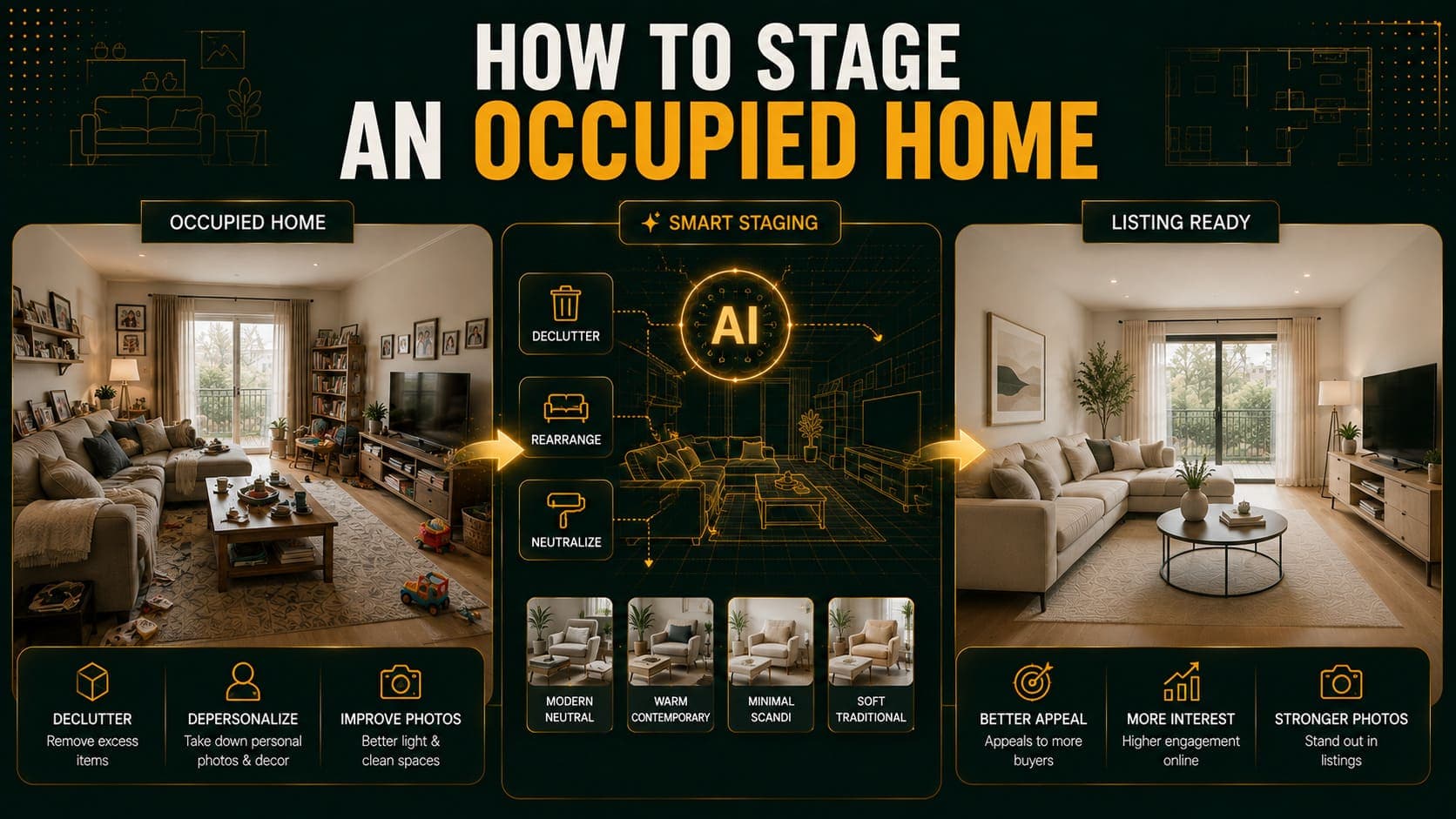
Most properties are sold while someone still lives in them. That makes occupied staging the more common scenario, and it's harder than staging a vacant property — not because it needs more work, but because the work is constrained by someone actually living there.
The good news: occupied properties start with an advantage. They're already furnished, which means scale is readable and rooms don't photograph as bare. The work is subtraction rather than addition.
Why Occupied Staging Is Different
You Can't Empty the Room
Virtual staging works on empty rooms. In an occupied property, that's usually impractical for anything beyond a single room at a time.
The implication: decluttering and photography do most of the work. Staging tools have a limited role.
Personal Items Are the Main Problem
Buyers need to imagine themselves living in the space. Family photographs, personal collections, and evidence of specific lives interrupt that.
Rooms Are Arranged for Living, Not Viewing
Furniture positioned for daily practicality is often not positioned for photographs or for showing space.
There's a Person to Consider
The seller has to live there through the process. Recommendations that ignore this — remove all furniture, stage every room, clear every surface permanently — don't survive contact with reality.
Try DecoAI Free
3 free credits. No credit card needed. Stage any room in 30 seconds.
Get 3 Free CreditsThe Decluttering Hierarchy
Work through these in order. Each step matters more than the one after it.
Level 1: Remove Roughly a Third of Everything
Not a specific list — a general reduction. Every room should have visibly less in it.
The test: if you removed a third of the objects in a room, would anyone notice something missing? Usually not. But the room will photograph noticeably better.
Level 2: Clear All Horizontal Surfaces
Kitchen counters, bathroom shelves, bedside tables, coffee tables, windowsills, mantelpieces.
Aim for one or two items maximum on each surface, not zero. Completely bare surfaces read as staged; two objects read as tidy.
Level 3: Remove Personal Items
- Family photographs
- Children's artwork on the fridge
- Certificates and diplomas
- Religious items
- Collections of anything
- Sports memorabilia
- Personal toiletries
This isn't about the items being unattractive. It's that buyers need mental room to imagine their own life in the space.
Level 4: Reduce Furniture
Most occupied rooms have more furniture than they need for photographs.
Common candidates for removal:
- Extra chairs and side tables
- Bookcases in rooms that aren't studies
- Exercise equipment
- Anything in a hallway
- Second desks or workstations
Moving furniture into a garage, storage unit, or a single designated room for the duration is worth doing.
Level 5: Depersonalize Colour
If any room has a strong or unusual paint colour, neutral repaint is worth considering.
Cost: $100–$200 in materials per room. When it's worth it: Rooms with colours that divide opinion. Not rooms that are simply a bit tired.
Room-by-Room
Living Room
Remove: Excess cushions, throws, magazines, remote controls, cables, children's toys, pet beds.
Reduce: Furniture to sofa, chairs, coffee table, one or two side tables. Remove extra seating.
Rearrange: Pull furniture away from walls into a conversation grouping if it isn't already. This makes the room look larger and more considered.
Keep: One or two decorative objects, a plant, artwork.
Kitchen
Remove: Everything from the counters. Toaster, kettle, coffee machine, knife block, utensil holder, dish rack, fruit bowl, bread bin.
Remove: All fridge magnets, photos, notes, and children's drawings.
Remove: Bins, mats, and anything on the floor.
Keep: One item on the counter — a bowl of fruit or a plant.
The kitchen benefits more from clearing than any other room.
Bedrooms
Remove: Clothes, laundry baskets, personal items on bedside tables, exercise equipment, anything stored under or beside the bed.
Make the bed properly. Wrinkles and rumpled bedding are highly visible in photographs.
Reduce: Furniture to bed, two bedside tables, and one other piece maximum.
Consider: Neutral bedding. Strongly patterned duvets photograph busily.
Bathrooms
Remove: All toiletries, toothbrushes, razors, medications, bath toys, cleaning products, laundry.
Remove: Bath mats and any towels in use.
Add: Fresh folded towels — white or a single neutral colour.
Close: The toilet lid.
Bathrooms are the easiest room to prepare and among the most scrutinized.
Home Office
Remove: Paperwork, cables, printers if possible, personal items, anything on the floor.
Keep: Desk, chair, one shelf of books, a lamp.
Cable management makes a visible difference here.
Children's Rooms
Remove: Most toys. Keep a small number, tidily arranged.
Consider: Whether the room reads as a bedroom or as a playroom. Buyers assessing bedroom count need to see a bedroom.
Don't: Strip it entirely of character — a child's room that looks like a spare room loses the sense of a family home.
Try DecoAI Free
3 free credits. No credit card needed. Stage any room in 30 seconds.
Get 3 Free CreditsWhere Staging Tools Fit
Rooms You Can Clear
If a room can be emptied — a spare bedroom, a study, a room that isn't in daily use — clearing and staging it digitally works normally.
Practical approach: clear one room at a time, photograph, restore.
Furniture Removal
Some tools can digitally remove furniture from occupied rooms. Results are unreliable above roughly 40% floor coverage.
Where it helps: Removing one or two awkward pieces from an otherwise acceptable room.
Where it doesn't: Heavily furnished rooms, which is most occupied rooms.
Renovation Visualization
More useful than staging for occupied properties. Showing a dated kitchen or bathroom with updated surfaces works regardless of whether furniture is present.
The Honest Position
For most occupied properties, decluttering and good photography do more than any staging tool. The property is already furnished; the problem is what else is in the frame.
Photography for Occupied Homes
Same Rules Apply
Shoot from corners at chest height, camera level, all lights on, curtains open, between 10am and 2pm.
Additional Considerations
Photograph after preparing, not before. Do the full declutter first.
Check the frame for personal items. Photographs on shelves, letters on tables, and toiletries in bathroom mirrors all appear in shots you thought were clear.
Watch reflections. Mirrors, TVs, and glass surfaces show the rest of the room — and sometimes you holding the camera.
Remove cars from the driveway. For exterior shots.
Shoot bedrooms with beds made. This should be obvious but frequently isn't.
Preparing for Viewings
Different from photography. Buyers are walking through and using more senses.
Before Every Viewing
- Open all curtains and blinds
- Turn on every light
- Air the property for twenty minutes, then close windows
- Empty bins
- Clear kitchen counters and sink
- Make all beds
- Close toilet lids
- Set the heating to a comfortable temperature
- Remove pets and pet items where possible
What Sellers Get Wrong
Air fresheners and baking smells. Buyers read strong scents as masking something. Neutral is better than pleasant.
Being present during the viewing. Buyers speak more freely and stay longer when the seller isn't there.
Following buyers around. Even if you stay, don't accompany them room to room.
Common Mistakes
1. Not Decluttering Enough
The most common issue by far. Sellers routinely underestimate how much needs to go.
2. Leaving Personal Photographs
They're the single clearest signal that the property belongs to someone else.
3. Cluttered Kitchen Counters
Appliances on counters reduce apparent workspace, which is what buyers assess.
4. Photographing Before Preparing
The declutter has to happen first.
5. Trying to Digitally Remove Heavy Furniture
Results are poor above roughly 40% floor coverage. Physical clearing or accepting the furnished photo both work better.
6. Strong Smells at Viewings
Air fresheners, cooking, pets. All read as concealment.
7. Being Present at Viewings
Buyers assess more thoroughly and speak more freely without the seller there.
Frequently Asked Questions
Can I stage my home while living in it?
Yes, though the work is mostly decluttering rather than adding. Digital staging tools require empty rooms, which is usually impractical in an occupied property.
How much should I declutter before selling?
Remove roughly a third of everything, clear all horizontal surfaces to one or two items, and remove all personal photographs and collections.
Should I remove furniture before photographing?
Reduce it. Most occupied rooms have more furniture than they need for photographs. Extra chairs, side tables, and anything in hallways are common candidates.
Can AI remove furniture from occupied room photos?
Sometimes, with unreliable results. It works when furniture covers under roughly 40% of the visible floor and fails above that.
Should I repaint before selling?
Worth it for strong colours that divide opinion. Not usually worth it for neutral rooms that are simply tired.
What should I do before a viewing?
Open curtains, turn on every light, air the property, empty bins, clear counters, make beds, and set a comfortable temperature. Then leave.
Should I be present during viewings?
No. Buyers speak more freely and stay longer without the seller there.
Do air fresheners help?
No. Buyers read strong scents as masking something. Air the property instead.
What's the highest-impact thing I can do?
Declutter properly. It costs nothing, takes a weekend, and does more than any tool or technique.
Summary
The order of operations:
- Remove roughly a third of everything
- Clear all horizontal surfaces to one or two items
- Remove all personal photographs and collections
- Reduce furniture in every room
- Consider neutral repaint for divisive colours
- Then photograph
Where staging tools fit: Rooms you can clear entirely, removing one or two awkward pieces, and renovation visualization for dated kitchens and bathrooms.
The honest position: for occupied properties, decluttering and good photography do more than any staging tool. The property is already furnished — the problem is everything else in the frame.
For rooms you can clear. DecoAI gives 3 free credits with no card required — useful for a spare room or study you can empty for an afternoon.