Mirrors get recommended reflexively — put one opposite the window, hang one in a small room, add one to a dark hallway. Most of that advice is directionally right and short on the detail that determines whether it works.
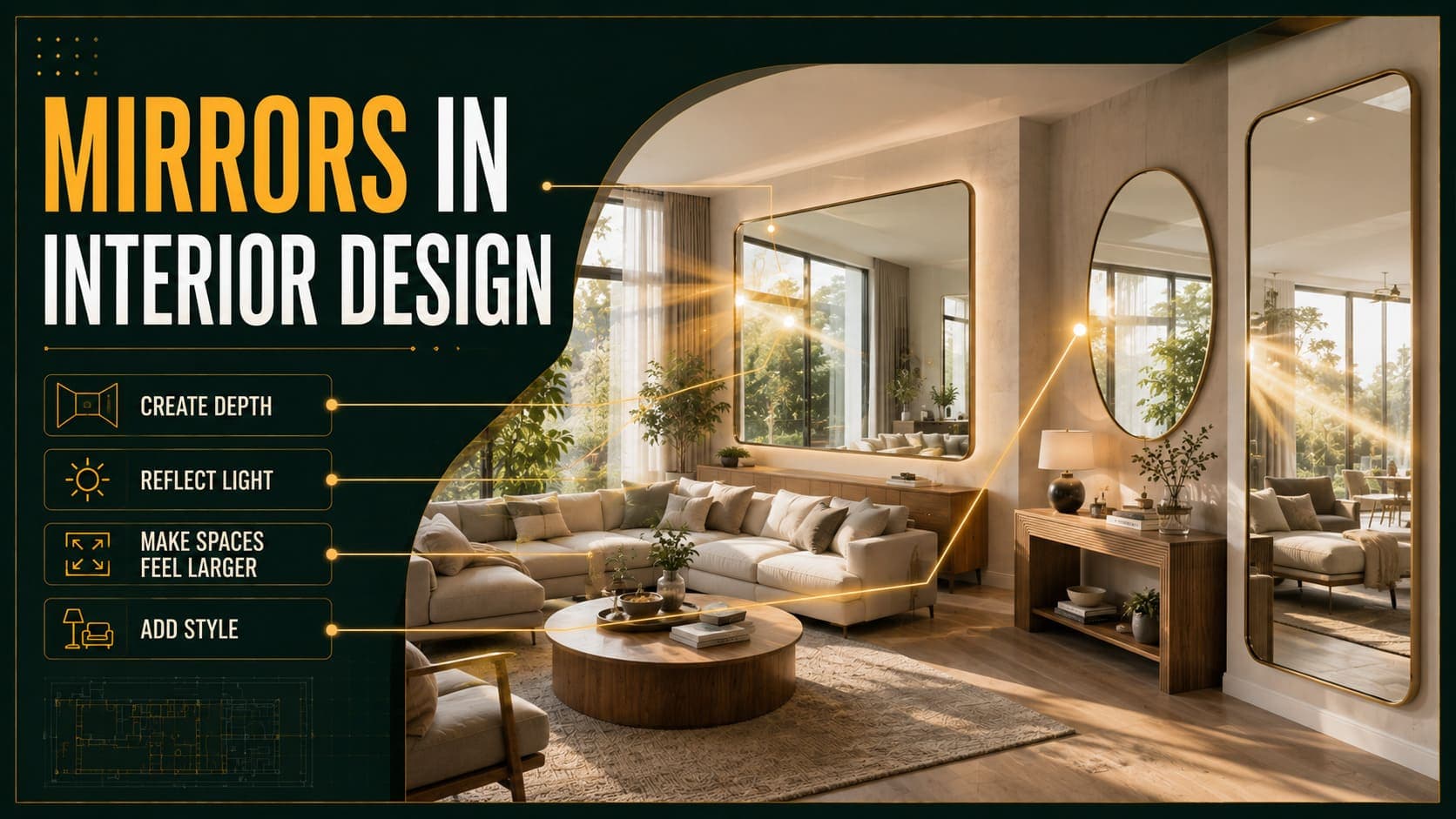
A mirror reflects whatever is in front of it. Placed well, that's light, depth, or a view worth doubling. Placed badly, it's a blank wall, a doorway, or the back of a sofa.
This covers where mirrors genuinely help, the sizing and height rules, and the placements that don't work despite being frequently recommended.
What Mirrors Actually Do
They Reflect Light, Not Create It
A mirror in a dark room with no light source stays dark. What it does is take existing light and redirect it, which fills areas the original source doesn't reach.
The practical implication: the mirror's usefulness depends entirely on what light is available to reflect.
They Suggest Depth
A mirror reads as an opening. The eye interprets the reflected space as continuing beyond the wall, which makes rooms feel less enclosed.
The requirement: the reflection needs to show something with depth. A mirror reflecting a blank wall two metres away creates no sense of space at all.
They Double Whatever Is Opposite
This is the rule that determines placement.
Before hanging a mirror, stand where it will go and look at what's directly opposite. That's what people will see. If it's not worth doubling, the mirror is in the wrong place.
Try DecoAI Free
3 free credits. No credit card needed. Stage any room in 30 seconds.
Get 3 Free CreditsPlacement That Works
Perpendicular to a Window
Better than opposite a window in most rooms.
Why: a mirror opposite a window reflects the window itself — a bright rectangle, and often a blown-out view. A mirror on the adjacent wall catches the light coming in and throws it across the room, reaching the corners that natural light doesn't.
The exception: if the view through the window is genuinely good, opposite works — you're doubling the view rather than just the light.
Reflecting Into the Room's Depth
Position the mirror so it reflects the longest sightline available — down a room, through a doorway into another space, or across a diagonal.
The effect: the strongest sense of extended space you can get from a mirror.
Above a Fireplace
The most conventional placement, and it works for a reason. It's usually the room's focal point, it's at a natural height, and it reflects the room rather than a wall.
Sizing: roughly two-thirds to three-quarters the width of the chimney breast or mantel.
In a Narrow Hallway
Hallways are usually the darkest and most enclosed part of a property.
Best approach: a tall mirror on one long wall, reflecting the opposite wall and any light from the entrance.
What to avoid: mirrors on both facing walls. The infinite reflection is disorienting rather than expansive.
Above a Console or Sideboard
Anchors the furniture and gives the arrangement a vertical element.
Sizing: roughly the same width as the furniture beneath, or slightly narrower. Never wider.
Behind a Dining Table
Doubles the perceived size of the room and reflects the lighting above the table.
Note: some people dislike watching themselves eat. In a home you're selling, this is a low concern; in one you're living in, worth considering.
In a Small Bedroom
A full-height mirror on a wardrobe door or a wall serves the practical function and adds depth.
Placement: not opposite the bed, if the occupant will notice it at night.
Placement That Doesn't Work
Opposite a Blank Wall
The most common mistake. The mirror reflects an empty surface and achieves nothing except adding an object.
Opposite a Doorway
Reflects a dark opening, which reads as a hole rather than as depth.
Facing Another Mirror
Produces an infinite tunnel effect that most people find unsettling in a home.
Reflecting Clutter
The mirror doubles whatever is opposite. If that's a cluttered surface, you've doubled the clutter.
Too High
The single most common error. More on this below.
Too Small
An undersized mirror on a large wall reads as an afterthought and achieves none of the depth effect.
In a Room With No Natural Light
A mirror in an internal room with only artificial light reflects the artificial light, which rarely improves anything.
Try DecoAI Free
3 free credits. No credit card needed. Stage any room in 30 seconds.
Get 3 Free CreditsSizing and Height
Height Rule
Centre the mirror at eye level — roughly 145–155cm from the floor to the centre of the mirror.
This is the single most broken rule in interior decoration. Mirrors are consistently hung too high, usually because people align them with the top of nearby furniture or hang from an existing hook.
Above furniture: leave 15–25cm between the top of the furniture and the bottom of the mirror.
Above a mantel: 10–20cm above the mantel shelf.
Full-height mirrors: floor to somewhere between 170cm and the ceiling. These follow different rules because they're architectural rather than decorative.
Width Rules
| Position | Mirror width |
|---|---|
| Above a console or sideboard | Same width or slightly narrower |
| Above a fireplace | Two-thirds to three-quarters of the mantel width |
| On a blank wall | Roughly half to two-thirds the wall width |
| In a hallway | As tall as practical, width less critical |
The general principle: a mirror should relate to something — furniture below it, the wall it sits on, or the architecture around it. A mirror sized arbitrarily reads as arbitrary.
Shape
Rectangular — the safest, reads as architectural, suits most styles.
Round — softens a room with a lot of straight lines. Currently prominent, which means it will date somewhat.
Arched — strongly of the current moment. Effective but will read as "2020s" within a few years.
Ornate framed — suits Traditional and Luxury schemes. Reads as dated in contemporary ones.
Frameless — cleanest and most seamless. Best for Minimalist and Modern.
Mirrors by Style
Modern and Contemporary
Frameless or slim metal frame. Rectangular or round. Matte black or brushed brass if framed.
Scandinavian
Slim pale wood frame, or frameless. Round is common. Understated.
Traditional
Ornate gilt or carved wood frame. Rectangular or arched. A statement piece above a fireplace.
Luxury
Large, statement, often with a decorative frame in brass or antique gold. Venetian mirrors suit this register.
Industrial
Metal frame, often black or raw steel. Sometimes with visible rivets or an aged finish.
Bohemian
Rattan or woven frame, or a distressed vintage piece. Often round.
Minimalist
Frameless, flush to the wall, rectangular. Nothing decorative.
Mirrors in Small Spaces
The most commonly cited use, and it works — with conditions.
What Actually Helps
One large mirror rather than several small ones. A single substantial mirror creates the depth effect. Three small ones read as decoration.
Positioned to reflect the longest sightline. Across a diagonal, or through a doorway.
Perpendicular to the light source rather than directly opposite it.
Full-height where possible. Floor-to-near-ceiling mirrors have the strongest effect because they read as an opening rather than as an object.
What Doesn't Help
Mirrored furniture. Popular for a period, now dates the room, and it reflects the floor rather than anything useful.
Mirror tiles or mirrored walls. Reads as dated and, in most contemporary schemes, as a 1980s reference.
Small mirrors scattered around. No depth effect, and they add visual clutter to a room that needs less of it.
For Property Presentation
Mirrors in Listing Photographs
The check nobody does: look at what the mirror reflects before photographing.
Common failures:
- The photographer, visible in the reflection
- A cluttered surface opposite
- Another room in a state you didn't intend to show
- A bathroom doorway
The fix: shoot from an angle where the reflection shows something acceptable, or accept a slightly different composition.
Adding a Mirror Before Selling
A large mirror in a dark hallway or a small living room is one of the cheaper ways to improve how a space photographs and shows.
Cost: $40–$150 for something suitable. Effect: most noticeable in narrow hallways and small rooms with one window.
The Staging Note
AI staging generates mirrors reasonably often, particularly in Contemporary and Luxury styles.
What to check: what the generated mirror reflects. Tools sometimes produce reflections that don't correspond to the actual room, which reads as wrong even if viewers can't identify why.
If a staged image includes a mirror with an implausible reflection, regenerate.
Frequently Asked Questions
Where should you put a mirror in a room?
Perpendicular to a window, reflecting the longest sightline in the room, or above a fireplace or console. Avoid opposite a blank wall or a doorway.
Do mirrors make a room look bigger?
Yes, if they reflect something with depth. A mirror reflecting a blank wall two metres away creates no sense of space at all.
Should a mirror be opposite a window?
Usually not. It reflects the window as a bright rectangle. A mirror on the adjacent wall catches the light and throws it across the room instead — more useful in most cases.
How high should a mirror be hung?
Centre at eye level, roughly 145–155cm from the floor to the centre of the mirror. Mirrors are consistently hung too high.
What size mirror above a console table?
The same width as the console or slightly narrower. Never wider.
Can you have two mirrors facing each other?
Technically yes, but the infinite reflection effect is disorienting rather than expansive. Most people find it unsettling in a home.
What shape mirror should I choose?
Rectangular is safest and suits most styles. Round softens rooms with many straight lines. Arched is strongly current and will date.
Is mirrored furniture a good idea?
It dates the room and mostly reflects the floor. A single large wall mirror achieves far more.
What should I check before photographing a room with a mirror?
What the mirror reflects. Photographers appearing in reflections is the most common failure, followed by cluttered surfaces opposite.
Summary
The rule that determines everything: a mirror doubles whatever is opposite it. Stand where it will go, look at what's there, and decide whether that's worth doubling.
Best placements: perpendicular to a window, reflecting the longest sightline, above a fireplace, along one wall of a narrow hallway.
Worst placements: opposite a blank wall, opposite a doorway, facing another mirror, or reflecting clutter.
Height: centre at 145–155cm. This is the most commonly broken rule in the whole subject.
In small rooms: one large mirror positioned to reflect depth, not several small ones scattered around.
Check reflections in staged images. DecoAI gives 3 free credits with no card required — worth reviewing generated mirrors for implausible reflections, which is a common artifact.