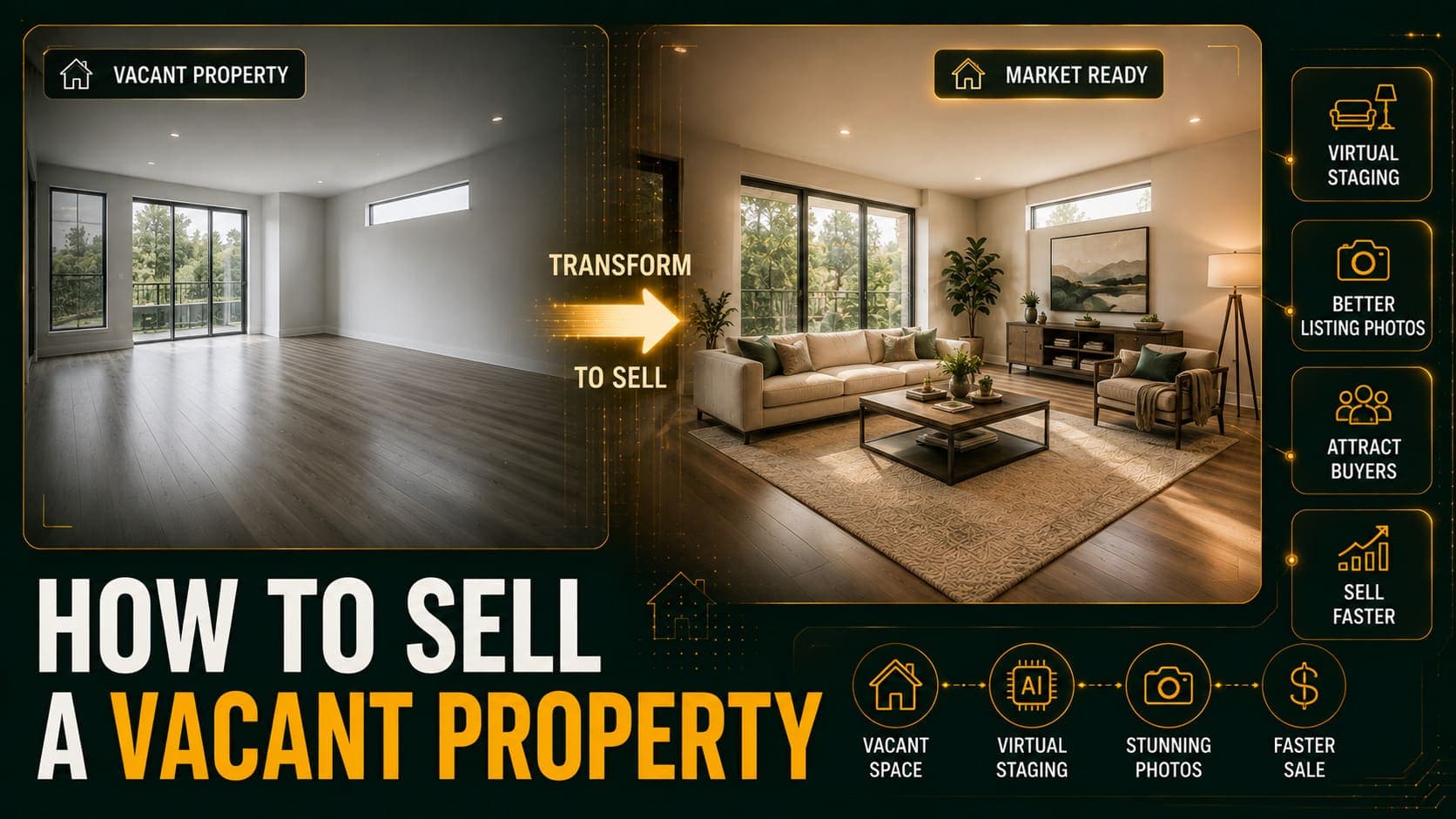
Vacant properties sell slower and often for less than comparable occupied ones. That isn't a market quirk — it's a predictable consequence of how buyers process empty rooms.
Understanding why makes the fixes obvious. Most of them cost very little.
Why Empty Properties Underperform
Buyers Can't Judge Scale
This is the primary issue. Without furniture as a reference, people are remarkably poor at estimating room size.
An empty 18 m² living room and an empty 24 m² living room look similar in photographs. Add a sofa to each and the difference becomes immediately readable.
The counter-intuitive result: empty rooms often look smaller than furnished ones, despite containing more visible floor.
Every Flaw Becomes Focal
With nothing to look at, the eye finds the scuff on the skirting board, the patch where a picture hung, the slightly uneven paint above the door.
In a furnished room these register as background. In an empty one they become the subject.
No Emotional Anchor
Buyers don't fall in love with square footage. They fall in love with a mental image of their life in the space, and empty rooms give them nothing to build that image from.
It Signals Motivation
An empty property often implies the seller has already moved, is carrying two mortgages, or has been trying to sell for a while. Buyers factor that into their offers.
Photographs Poorly
Empty rooms are difficult to photograph well. Large expanses of bare floor and blank wall produce flat, uninteresting images that don't stop the scroll.
Try DecoAI Free
3 free credits. No credit card needed. Stage any room in 30 seconds.
Get 3 Free CreditsThe Fixes, Ranked by Impact
1. Stage the Photos
The highest-impact fix by a wide margin.
Staged listings see roughly a 90% increase in click-through rates compared to empty-room photos, and viewers spend 70% more time on staged listing pages.
Virtual staging costs $0.10–$3 per image with AI tools and takes about 30 seconds per room. For a five-room property, that's roughly 50 cents and twenty minutes.
What to stage: Living room, primary bedroom, kitchen, and one or two additional rooms. Four to six images total.
Standard practice is to label staged images as "virtually staged" and include at least one unstaged photo of each room. Most agents do this as a matter of course.
2. Fix the Small Cosmetic Issues
In an empty property, small flaws dominate. Fixing them is cheap and disproportionately effective.
Worth doing:
- Fill and paint nail holes and picture hooks
- Touch up scuffed skirting and door frames
- Replace any blown bulbs
- Clean windows inside and out
- Deep clean floors — especially carpet
- Fix dripping taps and squeaking doors
Cost: A day's work and under $100 in materials for most properties.
3. Get the Lighting Right
Empty rooms photograph and show badly under poor light.
For photography: All curtains open, every light on, shoot between 10am and 2pm.
For viewings: Same. Arrive fifteen minutes early and turn everything on before the buyer arrives.
Worth buying: If any room has no light fitting — common in properties where the seller took the fixtures — install a basic one. A bare bulb hanging from a ceiling rose reads badly.
4. Add Minimal Physical Props for Viewings
Virtual staging handles the photos. Viewings are a different problem — buyers walk into genuinely empty rooms.
A small set of reusable props helps considerably and costs a fraction of full physical staging.
A useful kit:
- Two or three plants
- A rug for the living room
- Towels for the bathroom
- A mirror for the hallway or living room
- Two folding chairs and a small table for the kitchen or dining area
Cost: $200–$500 for a kit you reuse across every vacant property you handle.
This isn't staging — it's just enough to stop rooms feeling stark.
5. Control the Temperature and Smell
Empty properties get cold, and cold rooms feel unwelcoming. They also develop a closed-up smell.
Before viewings:
- Heat the property to a comfortable temperature
- Open windows for twenty minutes, then close them before the buyer arrives
- Avoid air fresheners — buyers read them as masking something
6. Photograph More Angles Than Usual
Empty rooms benefit from multiple perspectives because scale is harder to read from a single shot.
Two or three angles per room, and choose the one that best conveys the room's proportions.
Try DecoAI Free
3 free credits. No credit card needed. Stage any room in 30 seconds.
Get 3 Free CreditsThe Staging Question: Virtual, Physical, or Both
Virtual Staging
Cost: $0.50–$245 per property depending on method Covers: Listing photos, portal images, brochures, social media Doesn't cover: The viewing experience
Physical Staging
Cost: $2,300–$3,200 per property, recurring monthly Covers: Photos and viewings Doesn't cover: Cost-effectiveness on most properties
The Practical Answer for Vacant Properties
Virtual staging for photos + minimal physical props for viewings.
This costs roughly $200–$500 for a reusable prop kit plus 50 cents per property in staging, versus $2,300–$3,200 per property for full physical staging.
It captures most of the benefit at a fraction of the cost.
When full physical staging is still worth it: Premium properties where buyers attend in person, open-house-driven markets, and properties with confusing layouts that need furniture to explain them.
Pricing a Vacant Property
Vacancy affects pricing strategy in two ways worth understanding.
The Carrying Cost Pressure
An empty property costs the seller money every month — mortgage, insurance, utilities, council tax or property tax. Every 15 days on market typically costs $1,050–$1,950 in carrying costs.
That creates real pressure to reduce price, which is often the wrong first move.
Presentation Before Price Reduction
If a vacant property isn't generating viewings, the problem is usually presentation rather than price.
The order of operations:
- Improve the photos — stage them
- Fix visible cosmetic issues
- Reassess after two weeks
- Only then consider price adjustment
A price reduction is permanent and signals weakness. Improving the photos costs 50 cents and can be reversed if it doesn't work.
The Motivated Seller Signal
Buyers assume vacant means motivated. You can't fully counter this, but good presentation reduces it. A well-presented empty property reads as prepared rather than abandoned.
A Practical Timeline
Week Before Listing
- Fix cosmetic issues — fill holes, touch up paint, replace bulbs
- Deep clean, including windows and carpets
- Confirm every light fitting works
Day Before Listing
- Photograph all rooms — empty, well-lit, from corners at chest height
- Stage the four to six key images
- Prepare the prop kit for viewings
Listing Day
- Lead with the strongest staged image
- Label staged photos as virtually staged
- Include unstaged photos after the staged set
Ongoing
- Heat the property before every viewing
- Air it out, then close windows before the buyer arrives
- Turn on every light fifteen minutes early
- Place props before viewings, collect after
Common Mistakes with Vacant Properties
1. Listing with Empty-Room Photos
The single biggest error. It costs 50 cents to fix.
2. Reducing Price Before Improving Presentation
Price reductions are permanent and signal weakness. Photos can be improved and reversed for pennies.
3. Ignoring Small Cosmetic Flaws
In an empty room, every mark is visible. In a furnished one, most aren't.
4. Cold, Unlit Viewings
An empty property that's cold and dim feels abandoned rather than available.
5. Full Physical Staging on a Modest Property
$2,300–$3,200 rarely makes sense on a property where that exceeds the entire marketing budget.
6. Not Airing the Property
Closed-up smell is one of the fastest ways to lose a buyer's interest, and it's entirely preventable.
7. Over-Relying on Staging to Fix Fundamentals
Staging changes perception at the margin. It doesn't fix a bad layout, a poor location, or genuine structural issues. Be realistic about what it can do.
Frequently Asked Questions
Do vacant properties sell for less?
They frequently attract lower offers, partly because buyers infer seller motivation and partly because empty rooms present poorly. Good presentation reduces both effects.
Why do empty rooms look smaller in photos?
Without furniture as a reference, people struggle to judge scale. Adding furniture — real or virtual — gives the eye something to measure against.
Should I stage a vacant property?
Yes. Staged listings see substantially higher click-through rates. Virtual staging costs about 50 cents per property with AI tools.
Is virtual staging enough, or do I need physical staging?
Virtual staging covers the photos, which is where 96% of buyer attention starts. For viewings, a small reusable prop kit costing $200–$500 handles most of the gap at a fraction of physical staging cost.
How much does it cost to stage a vacant property?
$0.50 with AI virtual staging for five rooms. $80–$245 with human designer services. $2,300–$3,200 with physical staging.
Should I reduce the price if a vacant property isn't selling?
Improve the presentation first. Staging and better photos cost pennies and are reversible. Price reductions are permanent and signal weakness.
What should I do before every viewing?
Heat the property, air it for twenty minutes then close the windows, turn on every light, and place your prop kit. Arrive fifteen minutes early.
Do buyers dislike empty properties?
Not inherently — some buyers prefer seeing a property without someone else's belongings. The problem is that empty rooms photograph badly and make scale hard to judge, not that emptiness itself is off-putting.
How many photos should a vacant property listing have?
Twelve to twenty, with four to six of them staged. Include unstaged versions of the staged rooms.
Summary
Vacant properties underperform for specific, addressable reasons: buyers can't judge scale, small flaws become focal, and there's no emotional anchor.
The fixes in order of impact:
- Stage the listing photos — 50 cents, highest impact by far
- Fix small cosmetic issues — a day's work, under $100
- Get lighting right for photos and viewings — free
- Buy a reusable prop kit for viewings — $200–$500, used across every property
- Control temperature and air quality — free
- Shoot more angles than usual — free
Total cost for a properly presented vacant property: roughly $100 in materials plus 50 cents in staging, with a reusable prop kit amortized across every property you handle.
Start with the photos. DecoAI gives 3 free credits with no card required — enough to stage a living room, bedroom, and one more room and see the difference in your listing's performance.