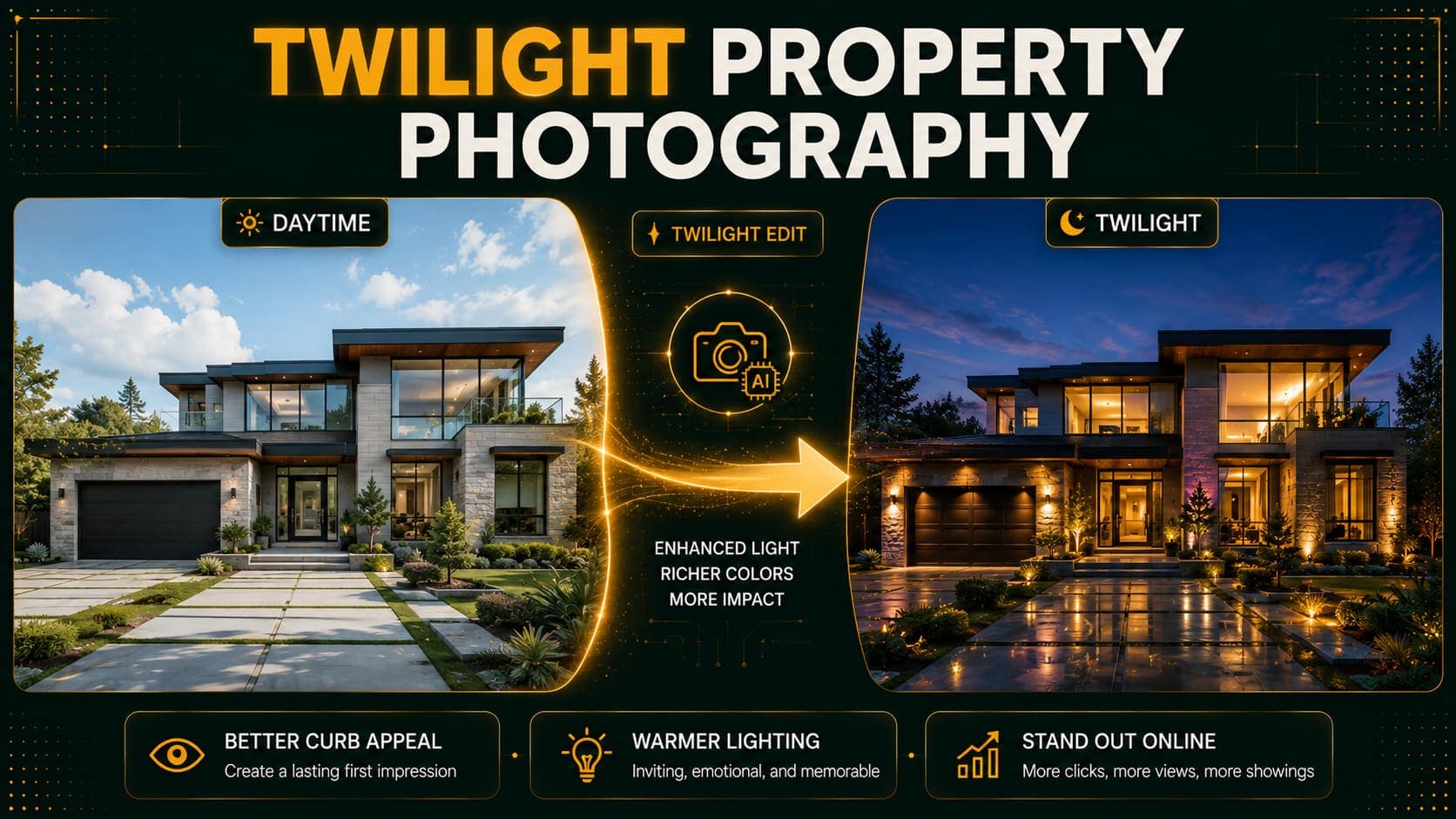
Twilight exterior photographs consistently outperform daytime ones on click-through. Warm interior light against a deep blue sky reads as premium in a way midday sun doesn't.
They also take planning, only work on certain properties, and the AI shortcut — converting a daytime photo to look like dusk — frequently produces something buyers can tell is fake.
This covers when twilight is worth the effort, how to shoot it, and where the conversion tools genuinely help.
Why Twilight Photos Perform
The Contrast Effect
At dusk, interior lights are visible against a darkening sky. That contrast creates a specific impression: the property looks warm, occupied, and inviting.
A daytime exterior shows a building. A twilight exterior shows a home with someone in it.
They Stand Out in Search Results
Most listing thumbnails are daytime shots. A twilight image in a grid of them is visually distinct, which affects click-through independent of the property itself.
They Read as Premium
Twilight photography has historically been used for higher-value properties, so buyers associate it with premium listings. That association works in your favour.
Try DecoAI Free
3 free credits. No credit card needed. Stage any room in 30 seconds.
Get 3 Free CreditsThe Window Is Short
When Twilight Actually Is
The usable window is roughly 20–30 minutes, starting shortly after sunset.
Too early: The sky is still bright and interior lights don't register.
Too late: The sky goes black and the property disappears into it. The contrast that makes twilight work is gone.
The target: Sky is deep blue, not black. Interior lights are clearly visible. There's still enough ambient light to see the building's form.
Planning for It
Check sunset time for your location and date. Arrive 30 minutes before sunset to set up.
You'll get one attempt per evening, and weather can eliminate it entirely.
Seasonal Considerations
Summer: Late sunset means shooting at 9pm or later. Inconvenient but workable.
Winter: Sunset around 4–5pm, which is easier to schedule but often coincides with poor weather.
Best conditions: Clear or lightly clouded sky. Heavy overcast produces a flat grey sky with no colour.
How to Shoot Twilight
Before Sunset
Turn on every light in the property. All rooms, all fixtures, including lamps. Rooms that are dark read as empty gaps in the facade.
Turn on exterior lighting. Porch lights, garden lights, driveway lighting.
Open curtains and blinds. Interior light needs to be visible from outside.
Clear the frontage. Move cars, put bins away, clear the driveway.
Set up your position. Choose an angle that shows the building's form and includes some sky.
During the Window
Use a tripod or stable surface. Low light means longer exposures. Handheld shots at dusk are usually soft.
Shoot continuously. Take images every minute or two through the window. The best moment is often not the one you'd have picked.
Vary the exposure. Some frames exposed for the sky, some for the interior lights. You may want to combine them.
Include some sky. The sky colour is half of what makes a twilight shot work.
Phone vs Camera
A modern phone in night mode handles this acceptably, particularly on a tripod. Dedicated cameras give more control over exposure blending, but the difference matters less than getting the timing right.
When Twilight Is Worth It
Premium Properties
The association with high-value listings is real. For properties in the upper band of their market, twilight reinforces the positioning.
Properties with Good Exterior Lighting
Architectural lighting, garden lighting, and lit entrances all photograph well at dusk. Properties without them have less to work with.
Properties with Large Windows
More visible interior light means more contrast against the sky. Small windows produce a subtler effect.
Distinctive Architecture
Twilight emphasizes silhouette and form. Buildings with interesting shapes benefit; plain rectangular ones benefit less.
Properties with Pools or Water Features
Lit pools at dusk photograph exceptionally well.
When the Daytime Exterior Is Unremarkable
If the property looks ordinary in daylight, twilight can add interest that isn't otherwise there.
Try DecoAI Free
3 free credits. No credit card needed. Stage any room in 30 seconds.
Get 3 Free CreditsWhen It Isn't Worth It
Mid-Market Properties in Fast Markets
The effort-to-benefit ratio is poor if properties in your band sell quickly regardless.
Apartments Within Larger Buildings
You're photographing a building, not the specific unit. The twilight effect applies to the whole block, which is less useful.
Properties with Poor Exterior Lighting
Without lit windows and exterior fixtures, there's nothing to create the contrast that makes twilight work.
Terraced and Densely Packed Properties
Neighbouring properties with dark windows sit either side of yours. The effect is diluted, and sometimes it draws attention to how tightly packed the street is.
When Weather Won't Cooperate
Heavy overcast produces flat grey skies with no colour. In persistently poor weather, the attempt may not be worth repeated visits.
Day-to-Dusk Conversion
AI and editing tools can convert a daytime exterior into an apparent twilight shot. This is common and worth being clear-eyed about.
How It Works
The tool darkens the sky, adds colour gradient, brightens the windows to simulate interior lighting, and adjusts overall colour temperature.
Where It Works Reasonably
Simple skies — A plain sky is easier to replace convincingly than one with complex cloud.
Properties with genuinely lit windows — If the original photo has some interior lights on, the conversion has something real to enhance.
Subtle conversions — Light adjustment rather than dramatic transformation.
Where It Fails
The lighting doesn't match. The building is lit by daylight from one direction, but the sky says it's dusk. The mismatch is subtle but many people register it.
Windows look painted on. Simulated interior lighting frequently has hard edges and uniform brightness that real lit windows don't have.
Shadows are wrong. Daytime shadows persist under a night sky.
Vegetation and surroundings are still lit. Trees, grass, and neighbouring buildings remain daylight-bright.
The Honest Assessment
A well-executed conversion on a suitable image can pass. A poorly executed one is obvious, and obvious editing damages credibility more than a plain daytime photo does.
Practical guidance: if the property justifies twilight photography, shoot it properly. Conversion is a compromise, and it looks like one more often than vendors suggest.
A Practical Approach
For Most Properties
Shoot a good daytime exterior in the hour before sunset — golden hour rather than true twilight.
You get warm directional light, longer shadows, and a more attractive image than midday, without the timing constraints of true twilight.
This is the underused option. Golden hour exteriors are substantially better than midday ones and require no special planning beyond arriving at the right time.
For Premium Properties
Plan a proper twilight shoot. Turn on every light, arrive before sunset, use a tripod, shoot through the window.
For Properties Where Twilight Won't Work
Don't force it. A clean, well-lit daytime exterior serves better than a poor twilight attempt or an obvious conversion.
Frequently Asked Questions
What time should I take twilight property photos?
The 20–30 minutes after sunset, when the sky is deep blue rather than black and interior lights are clearly visible.
Do twilight photos help sell properties?
They improve click-through rates, particularly for premium properties. Whether that translates to faster sales depends on the property and market.
Is day-to-dusk conversion worth using?
It can work on simple images with subtle adjustment. Dramatic conversions frequently look artificial, and obvious editing damages credibility.
Do I need a professional camera for twilight shots?
A modern phone on a tripod handles it acceptably. Timing and preparation matter more than equipment.
Should every listing have a twilight photo?
No. It suits premium properties, distinctive architecture, and homes with good exterior lighting. For most mid-market properties, a golden hour daytime shot is a better use of effort.
What lights should be on for a twilight shot?
Every interior light including lamps, plus all exterior lighting. Dark rooms read as gaps in the facade.
Can I take twilight photos of an apartment?
Only of the building, which is less useful than for a house. The twilight effect applies to the whole block rather than the specific unit.
What's golden hour and how is it different?
Golden hour is the hour before sunset — warm directional daylight, no interior lights needed. Easier to shoot than twilight and substantially better than midday.
Does weather affect twilight photography?
Considerably. Clear or lightly clouded skies work best. Heavy overcast produces flat grey with no colour.
Summary
Twilight works for: Premium properties, distinctive architecture, homes with good exterior and interior lighting, and properties with pools or water features.
Twilight doesn't work for: Mid-market properties in fast markets, apartments within blocks, terraced housing, and anything with poor exterior lighting.
The underused alternative: Golden hour — the hour before sunset. Warm light, no timing pressure, substantially better than midday.
On conversion: it can pass on suitable images with subtle handling. Done badly it's obvious, and obvious editing costs more credibility than a plain daytime shot.
Get the interiors right first. DecoAI gives 3 free credits with no card required — for most listings, staged interior photos affect click-through more than the exterior does.