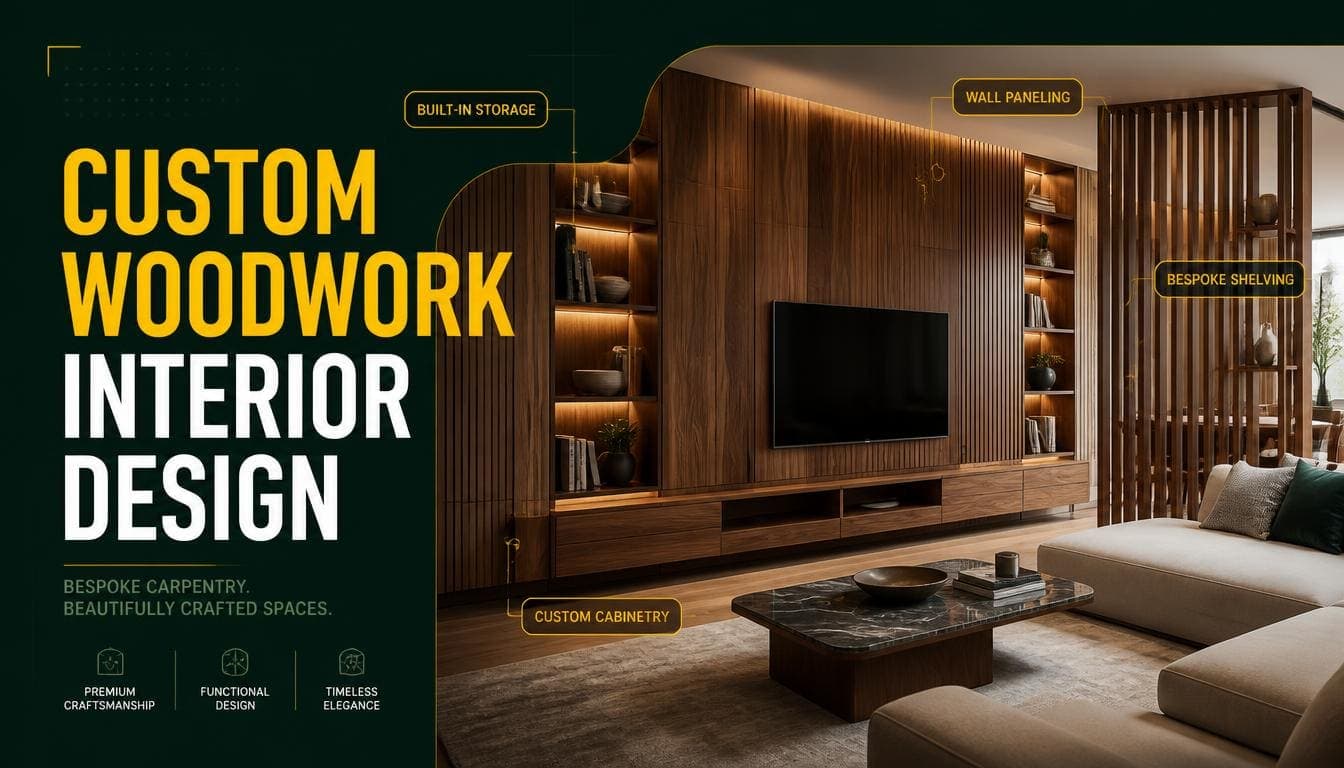
Custom woodwork is the difference between furniture placed in a room and joinery that belongs to it. A freestanding bookcase is an object. A built-in bookcase filling an alcove is architecture.
That distinction affects how rooms read, how much usable space they have, and how permanent they feel — which is why joinery consistently registers with buyers even when they can't name what they're responding to.
This covers where custom woodwork genuinely earns its cost, where it doesn't, and what it does to a room visually.
What Custom Woodwork Does
It Uses Space Furniture Can't
Alcoves either side of a chimney breast. Under-stair voids. Sloped-ceiling eaves. Awkward corners and non-standard widths.
Freestanding furniture is manufactured to standard dimensions and never quite fits these. Joinery is made to the actual measurement, which means no gaps behind, beside, or above.
The practical gain: roughly 15–25% more usable storage volume in the same footprint, simply from eliminating the dead space around standard furniture.
It Reads as Architecture, Not Contents
This is the visual difference.
A freestanding wardrobe is read as a piece of furniture standing in a room. A built-in wardrobe with flush doors is read as a wall. The room appears to have less in it, even though the storage capacity is identical or greater.
It Removes Visual Breaks
No gap between the top of the unit and the ceiling. No shadow line where it meets the wall. No visible sides.
Each of those gaps is a small visual interruption. Joinery removes them.
It Signals Permanence
Buyers read built-in joinery as investment in the property rather than furniture that will leave with the seller. That perception affects how finished a property feels.
Try DecoAI Free
3 free credits. No credit card needed. Stage any room in 30 seconds.
Get 3 Free CreditsWhere Custom Woodwork Works Best
Alcove Shelving and Storage
The most common and most cost-effective application.
Chimney breast alcoves are almost never a standard furniture width, which means freestanding units either don't fit or leave gaps.
Options:
- Full-height shelving both sides
- Cupboards below, open shelving above — the most popular configuration
- Full-height cupboards for a cleaner, more storage-dense result
Cost: typically the cheapest joinery per unit of storage gained.
Visual effect: frames the fireplace and gives a living room symmetry it wouldn't otherwise have.
Under-Stair Storage
Dead space in almost every house with stairs.
Options:
- Pull-out drawers on runners — best use of the deep triangular space
- Cupboards with angled doors
- Open shelving for display
- A compact desk nook in larger voids
Why it works: the space is otherwise entirely unusable, so anything you gain is net gain.
Fitted Wardrobes
The strongest case in bedrooms.
Standard wardrobes are typically 600mm deep and leave gaps at the sides and a dust-collecting void on top. Fitted wardrobes run wall to wall and floor to ceiling.
The perceived space gain: significant. A bedroom with a freestanding wardrobe reads as a bedroom containing furniture. One with flush fitted wardrobes reads as a bedroom with a wall.
Practical note: this is the joinery buyers value most in a property, because bedroom storage is a genuine consideration.
Window Seats
Where a bay or a deep reveal exists, a window seat with storage beneath uses space that has no other function.
Visual effect: creates a focal point and makes a window feel like a feature rather than an opening.
Media and TV Units
Built-in media walls conceal cabling, which is one of the most common visual failures in living rooms.
Caution: heavily designed media walls can date quickly, and they lock the room into one layout. A simpler recessed unit ages better than a full feature wall.
Home Office Joinery
A fitted desk with shelving above uses a small room or an alcove far more efficiently than freestanding equivalents.
Increasingly valued since remote working became standard.
Kitchen and Pantry
Pantry cupboards with internal shelving and drawers make a kitchen substantially more functional than the same volume of standard base units.
The appliance garage — a counter-level cupboard with a roller or bi-fold door — solves the cluttered worktop problem permanently.
What It Costs
Prices vary enormously by region, timber, and finish. These are broad ranges for guidance.
| Item | Typical range |
|---|---|
| Alcove shelving, one side | $600–$1,500 |
| Alcove cupboards and shelving, both sides | $1,800–$4,000 |
| Under-stair storage | $1,200–$3,500 |
| Fitted wardrobe, single wall | $2,000–$6,000 |
| Window seat with storage | $800–$2,500 |
| Built-in media unit | $1,500–$5,000 |
| Fitted home office | $1,800–$5,000 |
What drives the range: timber versus MDF, painted versus veneered, complexity of the space, and whether it's a joiner or a fitted-furniture company.
Painted MDF is the most common approach for painted joinery and costs substantially less than hardwood. For anything that will be painted, MDF is the sensible material.
Try DecoAI Free
3 free credits. No credit card needed. Stage any room in 30 seconds.
Get 3 Free CreditsDoes It Add Value?
Honestly: sometimes, and less than it costs in most cases.
Where the Return Is Strongest
Fitted wardrobes in bedrooms. Buyers actively look for bedroom storage, and fitted wardrobes are the clearest answer.
Alcove storage in living rooms. Relatively cheap, visually strong, and reads as considered.
Under-stair storage. Uses genuinely dead space, so it's perceived as a gain rather than an expense.
Where the Return Is Weak
Elaborate media walls. Expensive, date quickly, and lock the room into one arrangement.
Highly personalized joinery. Anything built around a specific collection or hobby narrows appeal.
Very high-spec joinery in a mid-market property. The spend won't be recovered.
The Honest Position
If you're renovating to live in the property, joinery is one of the better investments — you get the daily benefit for years.
If you're renovating specifically to sell, the return is uncertain. Buyers notice good joinery and it contributes to a property feeling finished, but they rarely pay a premium equal to what it cost.
The exception: properties where storage is genuinely the weakness. A period property with no built-in storage anywhere gains more from joinery than a modern house that already has adequate cupboards.
Design Decisions That Matter
Match the Architecture
Period property: panelled doors, visible frames, traditional profiles, cornice detail on top of tall units.
Modern property: flush doors, handleless, no visible frame, floor to ceiling.
The mismatch to avoid: contemporary handleless joinery in a Victorian room with detailed cornicing, or heavily traditional joinery in a modern flat.
Paint It Into the Wall
For maximum seamlessness, paint joinery the same colour as the surrounding walls.
The effect: the unit reads as architecture rather than furniture, and the room appears to contain less.
The alternative: a contrasting colour makes the joinery a feature. That works when the piece is genuinely worth featuring — an alcove unit framing a fireplace, for instance.
Full Height or Deliberately Not
Full height to the ceiling reads as architecture. No gap, no dust, no visual break.
Deliberately lower — say, 2100mm with a clear line above — can work as a design choice, but only if it aligns with something else, like a door head.
What doesn't work: a unit stopping 300mm short of the ceiling for no reason. It reads as a piece of furniture that didn't quite fit.
Align With Existing Lines
Cabinet tops aligning with window heads or door frames. Shelf heights matching a picture rail. Worktop level with a sill.
These alignments are what separate joinery that looks designed from joinery that looks installed.
Open Versus Closed
Closed storage looks cleaner and hides clutter. Too much of it reads as blank.
Open shelving adds warmth and displays objects. Too much reads as cluttered.
The common balance: cupboards to waist height, open shelving above. It gives you concealed storage for the untidy things and display space for the chosen ones.
Timber and Finish
Painted MDF
The most common choice for painted joinery. Stable, smooth finish, substantially cheaper than hardwood, and takes paint better than most timbers.
Best for: alcove units, fitted wardrobes, anything painted.
Oak
The most popular hardwood for visible-grain joinery. Warm, durable, ages well.
Best for: shelving where the timber is the feature, kitchen islands, worktops.
Walnut
Darker, warmer, more expensive. Reads as premium.
Best for: feature pieces in higher-value properties.
Birch Plywood
Exposed-edge birch ply has become popular in contemporary interiors. Cheaper than hardwood, distinctive edge detail.
Best for: modern properties, home offices, contemporary shelving.
Finish Considerations
Matt paint on joinery reads as more contemporary than gloss or satin, and hides imperfection better.
Consistency with trim matters. Joinery in a different white to the skirting is a visible mismatch.
For Property Presentation
Photographing Joinery
Style it minimally. Shelves with a few objects read as considered. Shelves fully loaded read as storage.
Show the alignment. A photograph that includes the ceiling line demonstrates full-height joinery, which is part of its value.
Include it in the room shot rather than photographing it separately. Its value is how it relates to the room.
Mentioning It in a Listing
Built-in storage is worth naming specifically. "Fitted wardrobes to both bedrooms" and "built-in alcove storage" answer questions buyers have.
When Staging Digitally
AI staging generates freestanding furniture into empty rooms. If a property has good joinery, that joinery should be visible in the photograph before staging — it's a genuine feature, and generated furniture placed in front of it wastes it.
Practical note: photograph rooms with joinery from an angle that shows it clearly, and expect staged furniture to occupy the floor rather than the walls.
Frequently Asked Questions
What is custom woodwork in interior design?
Joinery made to fit a specific space rather than bought as standard furniture — alcove shelving, fitted wardrobes, under-stair storage, window seats, and built-in media units.
Does built-in storage add value to a property?
Sometimes, and usually less than it costs. Fitted bedroom wardrobes and alcove storage return the most; elaborate media walls and highly personalized joinery return the least.
How much does custom joinery cost?
Broadly $600–$1,500 for one alcove, $2,000–$6,000 for a fitted wardrobe wall, $1,200–$3,500 for under-stair storage. Painted MDF costs substantially less than hardwood.
Should joinery be painted the same colour as the walls?
For a seamless effect, yes — it reads as architecture rather than furniture. A contrasting colour makes it a feature, which works when the piece is worth featuring.
Should built-in units go to the ceiling?
Usually yes. Full height reads as architecture, removes the dust gap, and eliminates a visual break. A unit stopping short for no reason reads as furniture that didn't fit.
What's the best material for painted joinery?
MDF. It's stable, takes paint better than most timber, and costs substantially less than hardwood for a finish that will be painted anyway.
Where does custom woodwork add the most usable space?
Alcoves, under-stair voids, and sloped eaves — spaces where standard furniture either doesn't fit or leaves substantial dead space around it.
Does joinery date?
Simple joinery ages well. Heavily designed media walls and strongly styled units date faster. Match the joinery style to the property's architecture and it will age at the same rate the property does.
Should I add joinery before selling?
Only if storage is a genuine weakness in the property. Otherwise the cost is unlikely to be recovered, though it does contribute to a property feeling finished.
Summary
What it does: uses space furniture can't, reads as architecture rather than contents, removes visual breaks, and signals permanence.
Best applications: alcove storage, fitted wardrobes, under-stair storage, window seats, and home office joinery.
Weakest applications: elaborate media walls, highly personalized units, and high-spec joinery in mid-market properties.
The value question: worth it if you're staying, uncertain if you're selling — unless storage is a genuine weakness in the property.
The design rules that matter most: full height, painted into the wall for seamlessness, aligned with existing lines, and matched to the property's architecture.
Show the room properly. DecoAI gives 3 free credits with no card required — staging a room with good joinery works best when the joinery is clearly visible in the photograph.