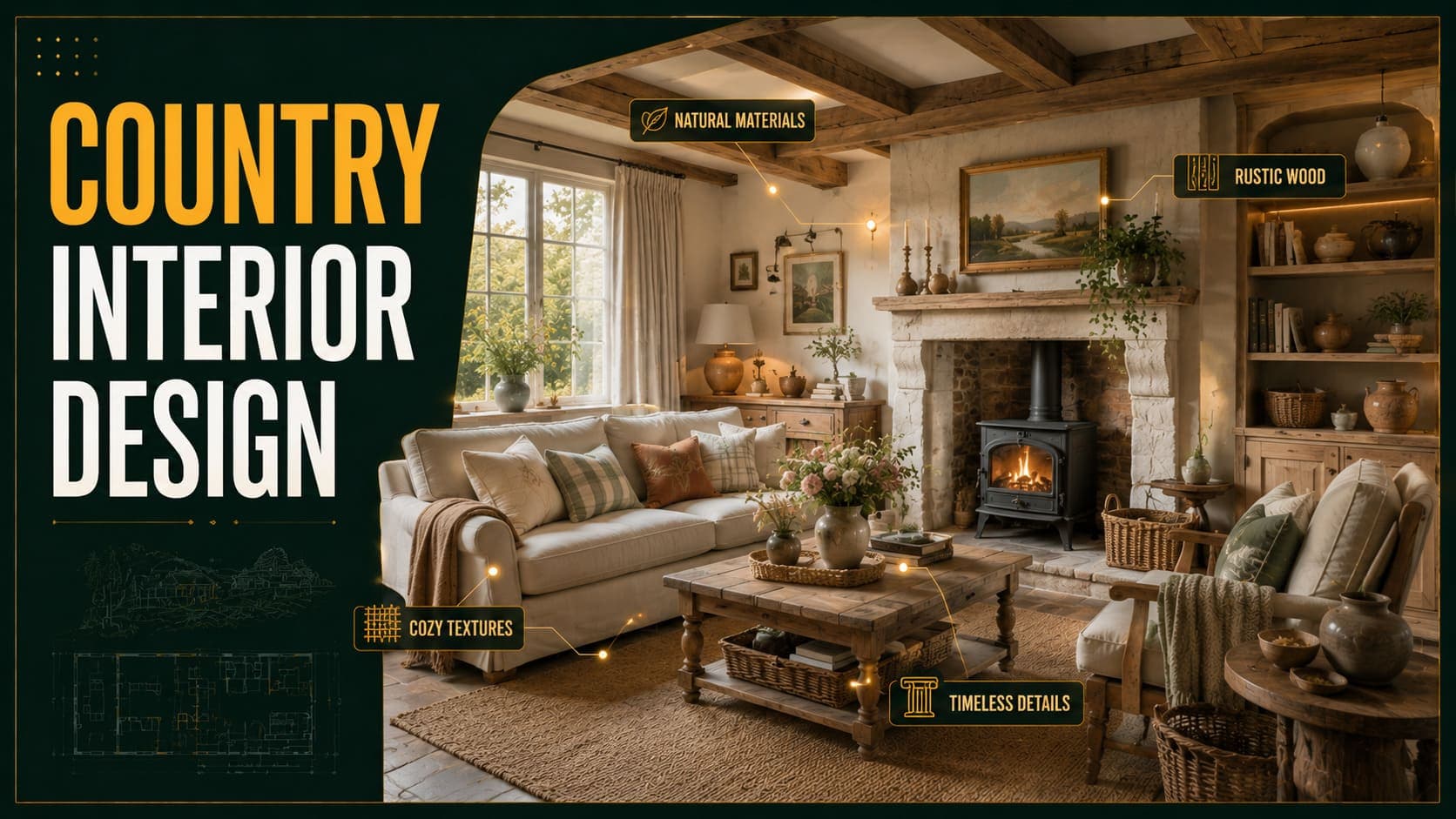
Country interior design isn't one style. It covers at least four distinct regional variations that share a set of underlying principles but look substantially different from each other.
English country, French country, American farmhouse, and modern rustic all get called "country," which is why advice about the style is often contradictory. Someone describing English country and someone describing modern farmhouse are describing different rooms.
This covers what they share, how each differs, and where the style works.
What All Country Styles Share
Natural Materials, Visibly Used
Wood with grain showing, stone, wrought iron, linen, wool, and clay. Nothing that looks manufactured or synthetic.
Comfort Over Formality
Country interiors are meant to be used. Deep seating, soft upholstery, and furniture arranged for practicality rather than symmetry.
Evidence of Age
Worn timber, aged metal, patinated surfaces, and furniture that looks collected rather than bought as a set. Perfect newness is contrary to the register.
A Connection to the Outside
Views to gardens and landscape, plants brought in, natural light prioritized, and palettes drawn from the surrounding environment.
Functional Objects on Display
Copper pans, ceramic jugs, wooden boards, baskets. Useful things visible rather than concealed.
Warm Palettes
Cream, sand, sage, terracotta, warm greys. Cool tones are rare across all country variations.
Try DecoAI Free
3 free credits. No credit card needed. Stage any room in 30 seconds.
Get 3 Free CreditsEnglish Country
The most decorated of the four, and the one furthest from minimalism.
Characteristics
Layered pattern — Florals, chintz, checks, and stripes coexisting. The layering is deliberate rather than accidental.
Deep upholstery — Roll-arm sofas, wing chairs, generous cushioning, often in patterned fabric.
Antique or antique-style furniture — Wooden dressers, sideboards, chests. Mismatched deliberately.
Displayed collections — Ceramics, books, framed pictures hung densely.
Warm colour — Sage, dusky pink, soft yellow, faded red, cream.
Textiles everywhere — Curtains, cushions, throws, rugs layered over each other.
The Register
Comfortable, accumulated, slightly worn. It suggests a house that's been lived in for generations rather than decorated recently.
Best For
Period rural properties, cottages, larger country houses, and anywhere the architecture supports it. The style needs beams, fireplaces, and irregular walls to look correct.
Where It Fails
Modern properties, urban flats, and anywhere with clean-lined contemporary architecture. English country in a new build reads as costume.
French Country
Lighter and more restrained than English country, with a distinct palette.
Characteristics
Pale, chalky finishes — Painted furniture in cream, grey, and pale blue, often with visible wear.
Toile and ticking — The characteristic fabrics. Toile de Jouy for pattern, ticking stripe for texture.
Curved forms — Cabriole legs, curved chair backs, softer profiles than English country's squarer furniture.
Iron and stone — Wrought iron light fittings, stone floors, stone or plaster walls.
Muted palette — Cream, soft grey, lavender, pale blue, faded gold.
Less pattern layering — One or two patterns rather than English country's five.
The Register
Elegant but relaxed. More refined than English country, less formal than French classical.
Best For
Rural properties with stone or plaster walls, farmhouses, and larger properties where the lighter palette suits generous rooms.
The Distinction From English Country
French is lighter, less patterned, and more curved. English is warmer, more layered, and squarer in its furniture.
American Farmhouse
The most current of the four and the one that dominates search results.
Characteristics
High contrast — White walls with black window frames, dark hardware, and dark wood.
Shiplap and panelling — Horizontal timber cladding is the signature element.
Barn doors — Sliding timber doors on exposed track.
Reclaimed timber — Beams, shelving, and furniture in weathered wood.
Practical furniture — Long farmhouse tables, bench seating, simple wooden chairs.
Restricted palette — White, black, natural timber, and one muted accent.
Modern fittings — Contemporary appliances and lighting rather than period ones.
The Register
Clean, practical, high-contrast. Less decorated than English or French country.
Best For
Larger family homes, properties with open-plan living, and markets where the aesthetic is currently popular.
The Caution
American farmhouse — particularly the shiplap-and-barn-door version — became extremely prominent in the 2010s and is now strongly associated with that period.
Practical implication: the heavily styled version will date. The simpler elements — white walls, timber, practical furniture — will not.
Modern Rustic
The contemporary interpretation. Country materials with contemporary restraint.
Characteristics
Natural materials, minimal decoration — Wood, stone, and linen used honestly, with very little ornament.
Clean lines — Contemporary furniture forms in country materials.
Neutral palette — Warm white, natural timber, stone grey, one muted accent.
Texture over pattern — Wool, linen, and rough timber rather than florals and checks.
Contemporary lighting — Simple modern fixtures rather than period ones.
Restrained display — A few chosen objects rather than collections.
The Register
Calm, warm, uncluttered. Country's warmth with contemporary discipline.
Best For
The widest range of properties of any country variation. Works in renovated period properties, contemporary rural builds, and even urban properties where the palette suits.
Why It's the Most Useful
Modern rustic carries country's warmth without the period signals that make English and French country property-dependent, and without the dated associations of heavily styled farmhouse.
For most applications, it's the version worth using.
Try DecoAI Free
3 free credits. No credit card needed. Stage any room in 30 seconds.
Get 3 Free CreditsComparing the Four
| Factor | English | French | Farmhouse | Modern Rustic |
|---|---|---|---|---|
| Palette | Warm, layered | Pale, chalky | White and black | Warm neutral |
| Pattern | Heavy | Moderate | Minimal | Almost none |
| Furniture | Squarer, deep | Curved, painted | Practical, simple | Contemporary forms |
| Ornament | Substantial | Moderate | Minimal | Very little |
| Contrast | Low | Low | High | Low |
| Dates quickly | No | No | Yes | No |
| Property-dependent | Very | Very | Moderate | Least |
Country by Room
Living Room
English: Roll-arm sofa in patterned fabric, wing chair, layered rugs, densely hung pictures, wood-burning stove.
French: Pale linen sofa, painted side tables, stone floor, iron light fitting, restrained display.
Farmhouse: White walls, dark-framed windows, leather or neutral sofa, reclaimed timber coffee table, black metal lighting.
Modern rustic: Linen sofa, timber coffee table, wool rug, one large plant, minimal ornament.
Kitchen
The room where country works best across all variations.
Shared elements: timber or painted shaker cabinets, a range cooker or a range-style oven, a butler or farmhouse sink, open shelving with displayed ceramics, and a substantial table.
English: warmer colours, more displayed objects, dresser with visible crockery.
French: pale painted cabinets, stone worktops, iron pendant lights.
Farmhouse: white cabinets, black hardware, shiplap, large island.
Modern rustic: timber or muted painted cabinets, stone worktop, minimal display.
Bedroom
English: Wooden or upholstered bed, layered patterned bedding, floral curtains, a chair in the corner.
French: Painted bed frame, white or cream linen, ticking stripe cushions, iron bedside lamps.
Farmhouse: Simple timber bed, white bedding, one dark accent, minimal decoration.
Modern rustic: Low timber bed, linen bedding in neutral, wool throw, one plant.
Bathroom
Shared: Freestanding bath where space allows, timber or stone surfaces, simple fittings, minimal built-in furniture.
Practical note: country bathrooms need to balance the aesthetic with the humidity. Untreated timber and natural fibres don't last in wet environments.
Where Country Works and Where It Doesn't
Works
Rural and semi-rural properties — the style originates in and suits them.
Period properties with character — beams, fireplaces, stone, irregular walls.
Larger family homes — the comfort register suits family living.
Renovated barns and outbuildings — modern rustic particularly.
Markets where buyers expect it — in some rural areas, contemporary styling underperforms.
Doesn't Work
Urban apartments — the style has no architectural support and reads as themed.
Modern new builds — clean-lined architecture fights the aesthetic, except for modern rustic which can bridge.
Very small rooms — country's fuller furnishing and pattern make compact spaces feel smaller.
Premium urban markets — country reads as suburban or rural, which works against premium urban positioning.
Common Mistakes
1. Applying It Without Architectural Support
The defining error. English and French country in particular need the building to carry them.
2. Over-Styling Farmhouse
Shiplap on every wall, barn doors throughout, and signs with words on them. This version dates fastest and reads as a decorating scheme rather than a home.
3. Too Much Pattern
Even English country has a limit. Florals on curtains, sofa, cushions, and wallpaper simultaneously produces visual noise.
4. Using It in Small Rooms
Fuller furniture and pattern both work against compact spaces.
5. Mixing the Variations
English florals with farmhouse shiplap and French painted furniture produces something incoherent.
6. Fake Aging
Artificially distressed furniture reads as artificial. Genuinely old pieces or clean new ones both work; deliberately distressed new ones usually don't.
7. Ignoring Practicality
Untreated timber worktops, natural fibre in bathrooms, and pale linen in family homes all look correct and fail in use.
Frequently Asked Questions
What is country interior design?
A group of related styles characterized by natural materials, comfort over formality, evidence of age, warm palettes, and functional objects on display. Main variations are English, French, American farmhouse, and modern rustic.
What's the difference between country and farmhouse?
Farmhouse is one variation of country — specifically the American version, characterized by white and black contrast, shiplap, barn doors, and a more restricted palette than English or French country.
What colours are used in country interiors?
Warm neutrals throughout: cream, sand, sage, terracotta, and warm grey. English country adds dusky pink and soft yellow; French adds pale blue and lavender; farmhouse uses white and black.
What's the difference between English and French country?
French is lighter, less patterned, and uses curved painted furniture. English is warmer, heavily layered with pattern, and uses squarer wooden furniture.
Does country design work in modern homes?
Modern rustic does. Full English or French country in a contemporary property reads as costume because the architecture doesn't support it.
Is farmhouse style dated?
The heavily styled version — shiplap everywhere, barn doors, word signs — is strongly associated with the 2010s and reads as dated. The simpler elements age fine.
Does country style work in small rooms?
Poorly. Fuller furniture and pattern both make compact spaces feel smaller. Modern rustic is the most workable variation in small spaces.
What's the most versatile country style?
Modern rustic. It carries country's warmth without the period signals of English and French country or the dated associations of heavily styled farmhouse.
Can I mix country variations?
Generally no. English florals with farmhouse shiplap produces something incoherent. Pick one variation and hold it.
Summary
Four variations, not one style: English (layered, patterned, warm), French (pale, curved, restrained), American farmhouse (white and black, high contrast), and modern rustic (contemporary forms in natural materials).
Shared principles: natural materials, comfort over formality, evidence of age, warm palettes, connection to outside, functional objects displayed.
The most versatile: modern rustic. It works in the widest range of properties and doesn't date.
The one that dates: heavily styled American farmhouse. Shiplap and barn doors are strongly of the 2010s.
Where it fails: urban apartments, modern new builds without rustic bridging, small rooms, and premium urban markets.
Test country against neutral alternatives. DecoAI gives 3 free credits with no card required — enough to compare a rustic direction against Contemporary in the same room.