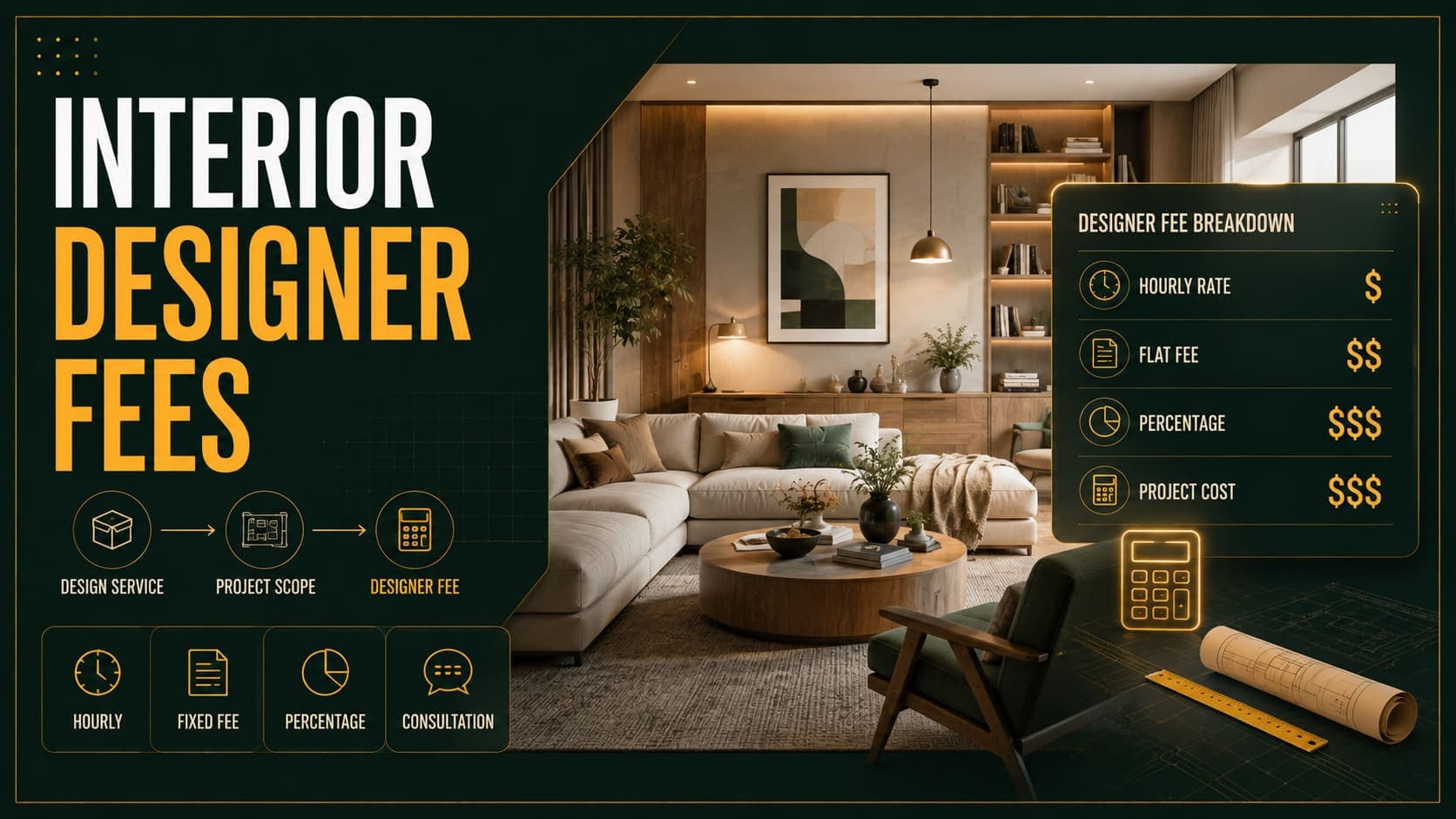
Interior designers use four main fee structures, and the same project can cost substantially different amounts depending on which one applies. Understanding the models matters more than comparing headline rates.
This covers what each structure means in practice, typical figures, what's included and excluded, and which model suits which kind of project.
A note on the numbers: rates vary enormously by region, designer experience, and project type. The ranges here are broad guidance rather than quotations, and local rates may sit well outside them.
The Four Fee Structures
1. Hourly Rate
You pay for time spent.
Typical range: $50–$250 per hour, with most established residential designers in the $75–$150 band.
What drives the range: experience, location, and whether you're engaging a principal designer or a junior on their team.
Best for: Small projects, consultation-only work, and anything with an uncertain scope.
The risk: open-ended cost. Without a cap, an hourly arrangement can run well beyond expectations.
Practical protection: agree an estimated total and a point at which the designer flags overrun before continuing.
2. Flat Fee
A fixed price for a defined scope.
Typical range: $2,000–$15,000 for a single room. $10,000–$50,000+ for a full property.
What drives the range: room size, complexity, level of detail, and whether it includes procurement and project management.
Best for: Clearly defined projects where the scope won't move.
The risk: scope creep. Anything outside the agreed brief becomes a variation, charged separately.
Practical protection: get the scope in writing, including how many revision rounds are included.
3. Cost Per Square Metre
Fee calculated on the area being designed.
Typical range: $50–$250 per square metre for design services.
Best for: Larger projects, commercial work, and developments where the scope is consistent across a floor area.
The nuance: small rooms cost more per square metre to design than large ones, because the design effort doesn't scale linearly. Many designers apply a minimum fee for this reason.
4. Percentage of Project Cost
Fee calculated as a percentage of the total spend on furniture, fittings, and works.
Typical range: 10–30%, with 15–20% common for residential.
Best for: Larger projects with significant procurement, where the designer manages purchasing.
The concern people raise: it appears to incentivize higher spend. In practice, reputable designers work within an agreed budget and the percentage is calculated on that.
Practical protection: agree the budget first, then the percentage against it.
Try DecoAI Free
3 free credits. No credit card needed. Stage any room in 30 seconds.
Get 3 Free CreditsWhat Projects Actually Cost
Broad guidance for residential work. Design fees only — not furniture, fittings, or building work.
| Project | Typical design fee |
|---|---|
| Single consultation (2–3 hours) | $150–$600 |
| Colour and material scheme, one room | $400–$1,500 |
| Full design, one room | $2,000–$6,000 |
| Full design, living and dining | $4,000–$12,000 |
| Kitchen design | $3,000–$10,000 |
| Whole house, 3 bedrooms | $12,000–$40,000 |
| Whole house, larger or high-spec | $40,000–$100,000+ |
What's usually not included: furniture, fittings, building work, trades, and third-party fees. These are separate and typically several times the design fee.
What You Get for the Fee
Fee structures vary, so establish which services are included before comparing quotes.
Typically Included
Initial consultation — Site visit, brief taking, discussion of scope.
Concept design — Mood boards, palette, direction. Usually one or two options.
Space planning — Layout drawings showing furniture placement and circulation.
Material and finish specification — Flooring, paint, tiles, worktops, fabrics.
Furniture specification — What to buy and where from.
Revisions — Usually a defined number of rounds, often two.
Sometimes Included, Sometimes Extra
3D visualization — Often charged separately, particularly for multiple rooms.
Detailed drawings — Elevations, joinery details, electrical layouts.
Procurement — Ordering, tracking, and managing deliveries. Frequently either a percentage or a separate fee.
Site visits during works — May be included up to a number, then charged.
Project management — Coordinating trades and programme. Usually a separate service.
Styling and installation — The final placement of accessories. Often a separate day rate.
Usually Extra
- Structural or architectural drawings
- Planning and building regulation applications
- Third-party consultants
- Bespoke joinery design beyond basic specification
What Drives Cost Up
Project Complexity
Structural changes, unusual layouts, listed buildings, and anything requiring approvals all add design time.
Level of Detail
A colour and furniture scheme is a fraction of the work involved in full construction drawings with joinery details.
Procurement Volume
Sourcing and managing forty items takes substantially longer than specifying eight.
Revisions
Most fee structures include a set number. Beyond that, changes are chargeable — and clients who change direction mid-project are the most common cause of fees exceeding estimates.
Designer Profile
Established designers with published work charge more than newer ones. Whether that difference is worth it depends on the project.
Location
Rates in major cities are typically 30–60% higher than in smaller markets for equivalent work.
Try DecoAI Free
3 free credits. No credit card needed. Stage any room in 30 seconds.
Get 3 Free CreditsHow to Reduce Design Cost
Buy Consultation Only
For $150–$600 you can get a few hours of professional input — layout advice, palette direction, and a list of what to prioritize. For many projects that's most of the value.
Define the Scope Tightly
Vague briefs cost more because they take longer to resolve. A clear brief with defined rooms, budget, and outcomes reduces design time substantially.
Handle Procurement Yourself
Design and specification from the designer; ordering and delivery management from you. This can remove 10–20% of the total fee.
Reduce the Room Count
Designing the main living space and bedroom properly, then applying the same palette and approach yourself elsewhere, costs a fraction of a full-house scheme.
Don't Change Direction Mid-Project
Revisions beyond the agreed rounds are the most common source of fee overrun and the most avoidable.
Prepare Before the First Meeting
Photographs, measurements, a rough budget, and examples of what you like all reduce the time spent establishing the brief.
Is a Designer Worth It?
Depends on the project.
Where a Designer Adds Most
Layout problems. Reconfiguring a space that doesn't work is where professional input is hardest to replicate.
Large budgets. On a $80,000 furnishing budget, a designer preventing two or three expensive mistakes covers their fee.
Complex projects. Multiple rooms, structural work, several trades to coordinate.
Sourcing access. Trade accounts often give designers pricing that offsets part of their fee, though the size of that discount varies considerably.
Time constraints. If you don't have the hours, you're buying them.
Where It's Harder to Justify
Single-room refresh with a modest budget. Where the fee is a substantial proportion of the total spend.
Clear vision already. If you know what you want, you may need sourcing help rather than design.
Small budgets. A $6,000 room budget with a $3,000 design fee leaves very little for the actual room.
The Middle Options
Consultation only — A few hours of professional input, then you execute.
E-design — Remote service delivering a scheme, layout, and shopping list without site visits. Typically $500–$2,500 per room, substantially cheaper than full service.
Design tools — Visualization software and AI tools let you test layouts and styles yourself. Useful for exploring options before committing to anything, though they don't replace professional judgment on layout problems.
Questions to Ask Before Engaging
- Which fee structure do you use, and why for this project?
- What's included, and what's charged separately?
- How many revision rounds are included?
- What happens if the scope changes?
- Do you handle procurement, and how is that charged?
- Do you receive trade discounts, and are they passed on?
- What's the estimated total, and at what point would you flag overrun?
- Can I see a project of similar scope and budget?
The answer to question two causes more disputes than any other. Get it in writing.
Frequently Asked Questions
How much do interior designers charge per hour?
Broadly $50–$250, with most established residential designers in the $75–$150 range. Rates vary substantially by region and experience.
What's the average cost to design one room?
Typically $2,000–$6,000 for full design services, though a colour and material scheme alone may be $400–$1,500.
Do interior designers charge a percentage?
Some do, commonly 10–30% of the project cost, with 15–20% typical for residential. This model suits larger projects with significant procurement.
What's included in an interior design fee?
Usually consultation, concept design, space planning, material and furniture specification, and a set number of revisions. Procurement, project management, and detailed drawings are often extra.
How can I reduce interior design costs?
Buy consultation only, define the scope tightly, handle procurement yourself, reduce the room count, and avoid changing direction mid-project.
Is hiring an interior designer worth it?
Most clearly for layout problems, large budgets, and complex multi-room projects. Harder to justify for single-room refreshes with modest budgets.
What is e-design?
A remote service delivering a scheme, layout, and shopping list without site visits. Typically $500–$2,500 per room — substantially cheaper than full service.
Do designers get trade discounts?
Many have trade accounts with better pricing than retail. Whether that's passed on, and how much it offsets the fee, varies by designer — worth asking directly.
What's the most common cause of fees going over estimate?
Changing direction after the design is agreed. Revisions beyond the included rounds are chargeable and add up quickly.
Summary
Four structures: hourly ($50–$250), flat fee ($2,000–$15,000 per room), per square metre ($50–$250/m²), or percentage of project cost (10–30%).
Typical residential project: $2,000–$6,000 for one room, $12,000–$40,000 for a three-bedroom house — design fees only, excluding furniture and works.
The question that matters most: what's included and what's charged separately. It causes more disputes than any other aspect.
To reduce cost: consultation only, tight scope, self-managed procurement, fewer rooms, and no mid-project changes of direction.
Where a designer earns their fee most clearly: layout problems, large budgets, and complex projects with multiple trades.
Explore layouts before committing. DecoAI gives 3 free credits with no card required — useful for testing style directions before a consultation, so you arrive with a clearer brief.