Published interior design salary figures are usually higher than what most people in the field actually earn. That's not because the figures are fabricated — it's because of how they're collected.
Salary surveys capture employed designers at established firms. They largely miss the substantial number of people working independently, part-time, or below full rate while building a practice. Those people are in the profession and not in the averages.
This covers employed pay by level, independent income realistically, what drives earnings, and where the published numbers mislead.
On the figures: these are broad ranges with substantial regional variation. Major cities run considerably higher; smaller markets considerably lower. Treat them as shape rather than as quotation.
Employed Salaries
The clearer half of the picture, because these figures come from actual payroll.
By Level
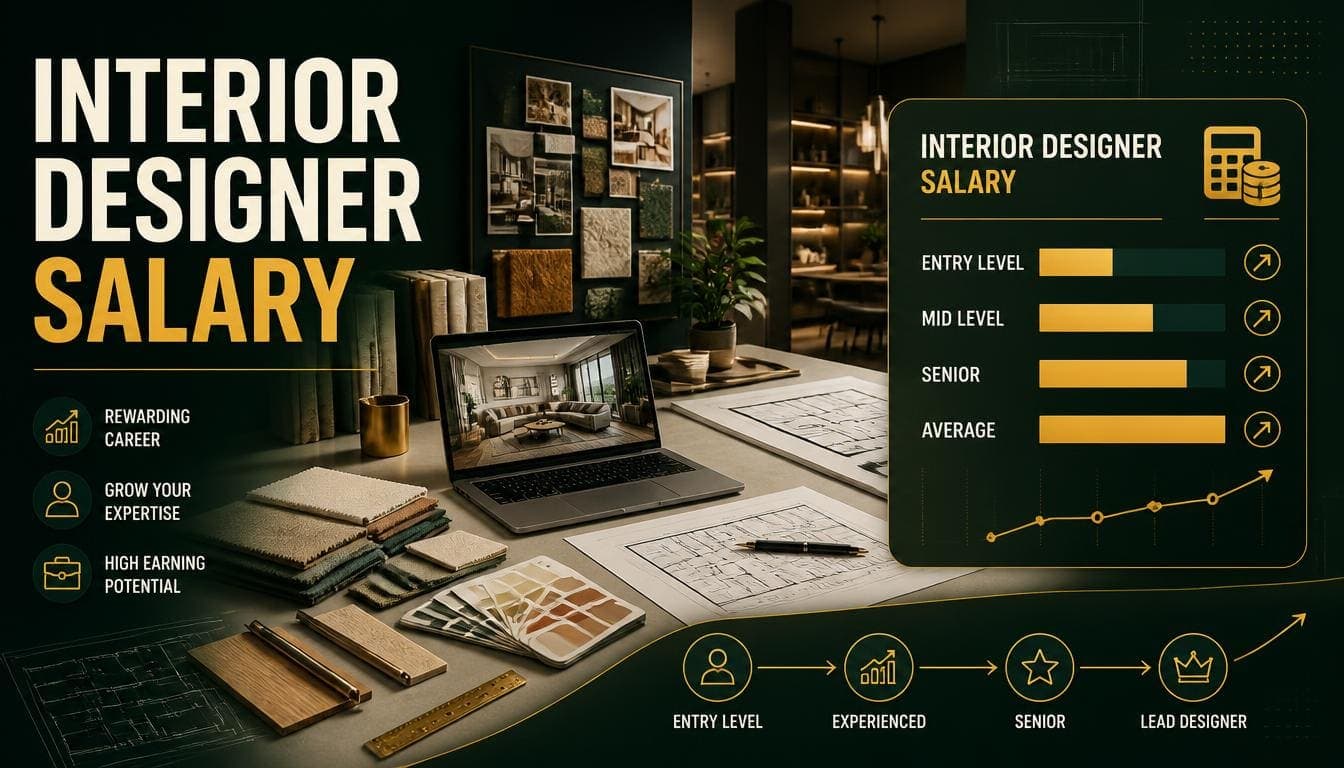
| Role | Typical range | Years of experience |
|---|---|---|
| Design assistant / intern | $24,000–$34,000 | 0–1 |
| Junior designer | $30,000–$42,000 | 1–3 |
| Designer | $40,000–$60,000 | 3–6 |
| Senior designer | $58,000–$85,000 | 6–10 |
| Associate / lead | $75,000–$105,000 | 10+ |
| Design director | $90,000–$150,000+ | 12+ |
What Shifts These Ranges
Sector. Commercial and contract design pays more than residential, generally by 15–30% at equivalent levels. Healthcare, workplace, and hospitality design are typically the better-paying specialisms.
Location. Major cities pay 30–60% more than smaller markets for the same role, though cost of living usually absorbs much of that.
Firm size. Larger practices pay more at junior and mid levels. Small studios sometimes pay better at senior levels but with less structure.
Technical skill. Designers who can produce full construction drawings and coordinate with architects and engineers earn more than those who work at concept and specification level only.
Try DecoAI Free
3 free credits. No credit card needed. Stage any room in 30 seconds.
Get 3 Free CreditsIndependent Income
Considerably harder to characterize, and where most of the misleading figures originate.
Why It's Hard to Measure
Wide distribution. A small number earn very well; a large number earn modestly.
Skewed averages. A handful of high earners pull the mean well above the median. When you see an "average independent designer income," check whether it's a mean or a median — the difference is usually substantial.
Self-selection in reporting. People who volunteer income figures skew toward those doing well.
Inconsistent definitions. Is that revenue or profit? Before or after project costs? Does it include procurement margin?
The Realistic Shape
Years 1–2: Frequently below employed equivalent. Building a client base takes time, early projects are typically underpriced, and business overheads start immediately.
Many people in this phase supplement with other work, and that's normal rather than a sign of failure.
Years 3–5: Improving, if the practice is working. Referral flow begins to compound, pricing improves, and repeat clients reduce the cost of winning work.
Established practice: Can substantially exceed employed equivalents. A designer with consistent referral flow, appropriate pricing, and procurement income can earn well beyond the director-level employed range.
The honest caveat: a meaningful proportion never reach that point. The failure rate for independent design practices is comparable to small businesses generally, which is to say substantial.
Where Independent Income Comes From
| Source | Typical contribution |
|---|---|
| Design fees | 50–70% |
| Procurement margin | 20–40% |
| Project management fees | 5–15% |
| Consultation | 5–10% |
The procurement point matters. Designers who handle purchasing capture trade margin, which can be a substantial part of total income. Designers who specify only and let clients buy directly forgo it.
This is one of the largest single factors in independent income and gets little attention.
What Drives Earnings Up
Ranked by how much they actually move the number.
1. Pricing Correctly
The largest single factor, and the most common failure.
Underpricing is nearly universal in the first two years and is what keeps many practices at low income indefinitely. Designers doing genuinely good work frequently charge 30–50% below what the market would bear.
The practical fix: raise rates on new enquiries and observe the conversion rate. Most people discover they lose less work than they expected.
2. Handling Procurement
Adds 20–40% to project income for work you're partly doing anyway.
The trade-off: procurement is time-consuming and carries risk — damaged deliveries, discontinued items, lead time failures. Some designers deliberately avoid it for that reason.
3. Sector Choice
Commercial pays more than residential. Within residential, higher-value properties pay more per hour of work, because the fee scales with the project while the effort doesn't scale proportionally.
4. Referral Network
Reduces the cost of winning work substantially. A practice running on referrals spends far less time and money on business development than one relying on advertising.
5. Repeat Clients
Developers, landlords, and property investors who need multiple projects are worth substantially more than one-off residential clients.
6. Niche Specialism
Designers known for something specific — kitchens, listed buildings, hospitality, a particular style — command higher rates than generalists.
7. Public Profile
Published work, awards, and media presence support higher rates. The effect is real but slower and less reliable than the factors above.
Try DecoAI Free
3 free credits. No credit card needed. Stage any room in 30 seconds.
Get 3 Free CreditsWhat Holds Earnings Down
Underpricing
Covered above. The single largest factor.
Scope Creep
Unpaid work absorbed into fixed-fee projects. A project quoted at $6,000 that takes 50% more time than planned earns two-thirds of the intended rate.
The fix: written scope, defined revision rounds, and charging for variations.
Taking Unsuitable Projects
Projects too small to be worth the setup time, clients whose budget doesn't support the work, or briefs outside your competence.
Poor Cash Flow Management
Independent designers frequently pay suppliers before clients pay them. Without staged payments, this causes problems regardless of profitability on paper.
The fix: deposit upfront, staged payments through the project, and no procurement without cleared funds.
Not Charging for Consultation
Free initial consultations that run to several hours are unpaid work. Many established designers charge for the initial visit and credit it against the project if it proceeds.
Regional Variation
Substantial, and worth understanding before comparing yourself to published figures.
| Market type | Relative to national average |
|---|---|
| Major metropolitan | +30% to +60% |
| Large city | +10% to +30% |
| Regional city | Around average |
| Small town / rural | −20% to −40% |
The nuance: cost of living usually absorbs much of the metropolitan premium. Higher nominal income in a major city doesn't necessarily mean more disposable income.
The exception: independent designers who can work remotely for metropolitan clients while based somewhere cheaper capture the differential. E-design services make this more feasible than it used to be.
Comparing to Adjacent Roles
For context, roughly:
| Role | Typical mid-career range |
|---|---|
| Interior designer (employed) | $40,000–$60,000 |
| Architect (qualified) | $50,000–$80,000 |
| Architectural technologist | $40,000–$60,000 |
| Kitchen designer (retail) | $32,000–$50,000 + commission |
| Set designer | $35,000–$55,000 |
| Furniture buyer | $38,000–$58,000 |
| Property stager | $32,000–$50,000 |
Interior design sits in the middle of this group. It pays less than qualified architecture and more than most retail-based design roles.
How to Increase Income Practically
In rough order of effect:
1. Raise your rates. Most designers are below market. Test it on new enquiries rather than existing clients.
2. Add procurement if you're not already doing it, and price it explicitly.
3. Define scope in writing with a set number of revisions and a variation rate.
4. Charge for initial consultation, crediting it against the project if it proceeds.
5. Pursue repeat clients — developers, landlords, and investors over one-off residential.
6. Specialize in something specific rather than positioning as a generalist.
7. Improve payment terms — deposit upfront, staged payments, no procurement without cleared funds.
8. Document and publish completed work consistently.
Frequently Asked Questions
How much do interior designers make on average?
Employed: roughly $40,000–$60,000 mid-career, with junior roles from $30,000 and director level exceeding $90,000. Independent income varies enormously and published averages are skewed by high earners.
Do independent designers earn more than employed ones?
Established independents with good referral flow and correct pricing can substantially exceed employed equivalents. Many never reach that point — the distribution is wide and the failure rate is comparable to small businesses generally.
Why are published salary figures higher than what I see?
Salary surveys capture employed designers at established firms. They largely miss independent, part-time, and early-career designers working below full rate.
What's the highest-paying area of interior design?
Commercial and contract design generally — workplace, healthcare, and hospitality. These pay 15–30% more than residential at equivalent levels.
How long before an independent practice pays well?
Typically 3–5 years to reach a stable income, if it works at all. The first two years are frequently below employed equivalent.
Does procurement significantly affect income?
Yes — commonly 20–40% of total project income for designers who handle it. It's one of the largest single factors and gets relatively little attention.
What's the most common reason designers earn less than they could?
Underpricing. It's nearly universal early on and frequently persists. Many designers charge 30–50% below what their market would bear.
Does location matter for interior design income?
Substantially. Major cities pay 30–60% more, though cost of living absorbs much of that. Remote and e-design work allows some designers to capture the differential.
Should I charge for the initial consultation?
Many established designers do, crediting it against the project if it proceeds. Free multi-hour consultations are unpaid work that adds up.
Summary
Employed: roughly $30,000 junior, $40,000–$60,000 mid-career, $75,000–$105,000 senior, $90,000–$150,000+ director. Commercial pays more than residential.
Independent: wide distribution. Below employed equivalent for the first two years, potentially well above it once established — but a meaningful proportion never get there.
The largest factor in earnings: pricing correctly. Underpricing is nearly universal and is what keeps most practices below their potential.
The most overlooked factor: procurement, which contributes 20–40% of income for designers who handle it.
Why published figures mislead: they capture employed designers at established firms and miss the substantial number working independently or below full rate.
Work through concepts faster. DecoAI gives 3 free credits with no card required — quicker concept iteration means more time on the work that's actually billable.