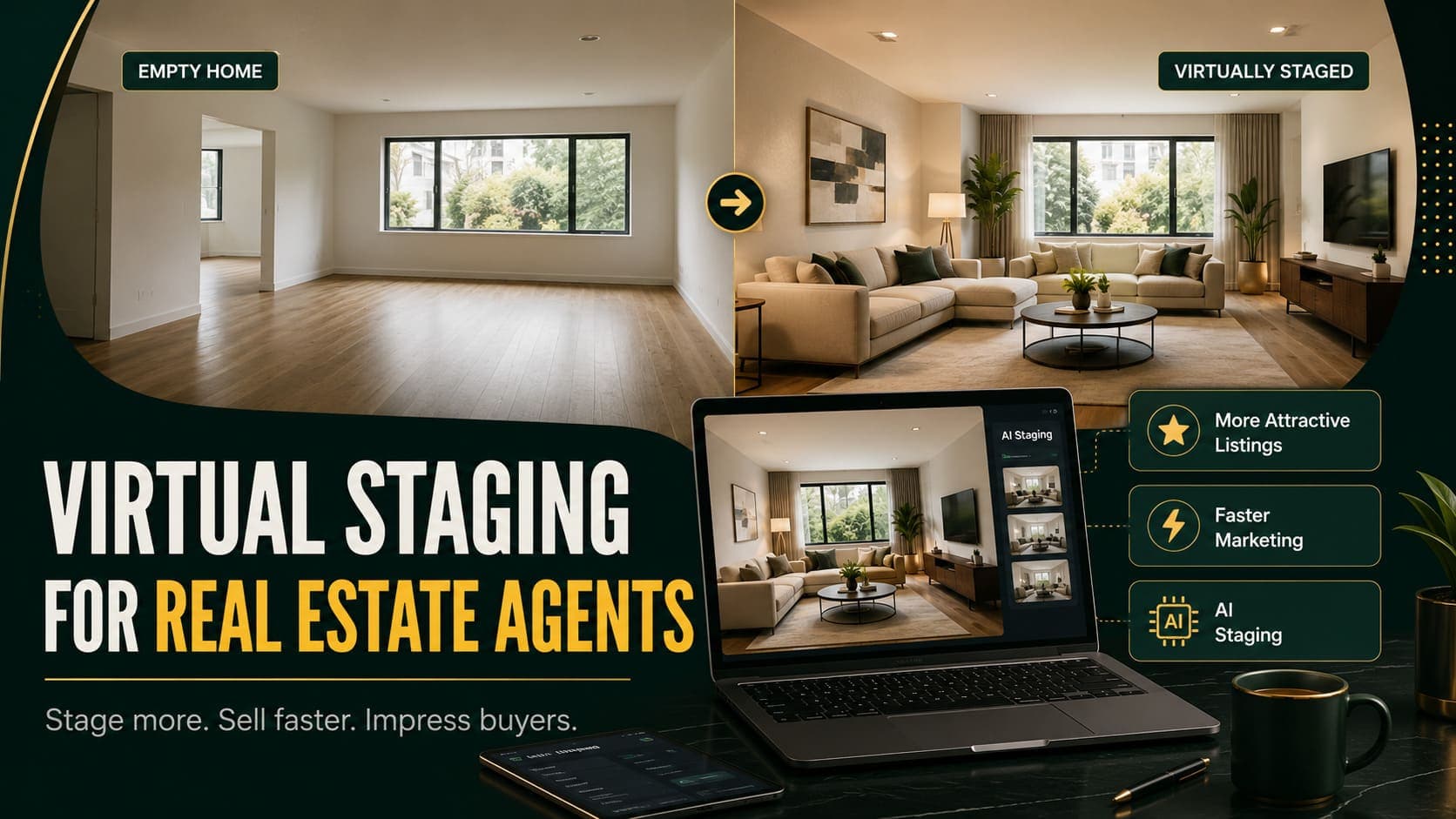
A vacant property photographs badly. Bare walls, empty floors, and no sense of scale — viewers scroll past it in under two seconds. That's the problem virtual staging solves, and in 2026 it costs an agent about 50 cents per property to solve it.
This is a practical playbook: the actual workflow, the numbers that matter, how to pick styles by market, and the mistakes that make staged photos look obviously fake.
Why Vacant Properties Underperform
Three things happen when someone opens a listing with empty-room photos:
No sense of scale. Without furniture, viewers can't judge whether a bedroom fits a king bed or whether the living room seats six. Ambiguity kills interest.
No emotional hook. Buyers don't fall in love with square footage. They fall in love with the image of themselves in a space. Empty rooms give them nothing to project onto.
Every flaw is visible. Scuffs, uneven paint, dated flooring — with nothing else to look at, the eye finds every imperfection.
The data backs this up. Staged listings see a 90% increase in click-through rates compared to empty-room photos (3.5–4.5% versus 1.8–2.2%), and viewers spend 70% more time on staged listing pages.
Try DecoAI Free
3 free credits. No credit card needed. Stage any room in 30 seconds.
Get 3 Free CreditsThe Economics for an Agent
Here's the math that makes this a non-decision.
Cost Per Property
| Method | 5 rooms | Time |
|---|---|---|
| AI virtual staging | $0.50 | 20 minutes |
| Human designer staging | $80–$245 | 1–2 days |
| Physical staging | $2,300–$3,200 | 3–7 days |
Cost Per Year
For an agent handling 20 properties annually:
| Method | Annual cost |
|---|---|
| AI virtual staging | $10 |
| Human designer | $1,600–$4,900 |
| Physical staging | $46,000–$64,000 |
Return on a Single Property
On a $400,000 property, a conservative 1% price lift is $4,000. Against a $0.50 staging cost, the ratio isn't worth calculating precisely — it's simply enormous.
Industry data shows staged properties sell 73% faster, averaging 29–31 days on market versus 52 days unstaged. Every 15 days saved avoids $1,050–$1,950 in carrying costs for the seller — a number worth mentioning in your listing presentation.
One honest caveat: many of the precise ROI figures circulating online come from companies selling staging services. The directional finding — staged sells faster and at a premium — is confirmed independently by NAR and RESA surveys. Even at half the claimed effect, the economics hold.
The Listing-Day Workflow
Here's the sequence that works, refined down to about 45 minutes for a five-room property.
Day Before Listing
1. Walk the property with your phone (15 minutes)
Photograph every room you plan to stage. Clear each room completely first — boxes, cleaning supplies, leftover chairs, all of it.
Shoot from a corner, camera at chest height, level, moderate wide-angle. Two angles per room.
2. Upload and stage (20 minutes)
Upload all photos. For each room, select the room type and your chosen style. Generate.
Review at full size. Regenerate anything with obvious perspective or scale errors — at $0.10 each, there's no reason to accept a mediocre result.
3. Download and organize (10 minutes)
Download at full resolution. Name files clearly (living-room-staged, bedroom-1-staged) so you're not hunting during upload.
Keep one unstaged photo of each room. Including these builds trust and shows the real space.
Listing Day
4. Upload with staged photos leading
Lead with your strongest staged image — usually the living room. Follow with the primary bedroom, then kitchen.
5. Label the staged images
Standard practice is to caption staged photos as "virtually staged." Most agents do this as a matter of course, and viewers appreciate the transparency.
6. Include the unstaged set
Place unstaged photos after the staged ones. Buyers who want to see the real space can, and you avoid any surprise at showing.
Which Rooms to Stage
You don't need every room. Stage the images that drive emotional decisions.
Priority Order
1. Living room — The emotional anchor. This image gets the most views and does the most work.
2. Primary bedroom — Where buyers imagine themselves. Second most important.
3. Kitchen — Light staging only. Counter accessories and bar stools, not full furniture.
4. Dining room — Creates a lifestyle narrative around entertaining and family meals.
5. Home office — Increasingly valued. Worth staging if the property has a candidate room.
What to Skip
Hallways, closets, laundry rooms, garages, and bathrooms in most cases. Staging these adds cost without adding impact, and bathrooms are the hardest room type for AI to handle well.
Choosing Styles by Market
This is where most agents get it wrong — they pick the style they personally like rather than the one that sells locally.
Urban and Metro Markets
Best: Modern, Contemporary, Minimalist
City buyers skew younger and favor clean, uncluttered aesthetics. Minimalist staging also makes compact apartments feel larger, which matters in high-density markets.
Suburban Family Markets
Best: Traditional, Contemporary, Scandinavian
Family buyers respond to warmth and practicality. Traditional staging with warm neutrals and comfortable-looking furniture outperforms sharp modern aesthetics here.
Luxury and Premium Segments
Best: Luxury, Modern
The staging needs to match the price expectation. Budget-looking furniture on a premium property creates a mismatch buyers notice immediately.
Vacation and Short-Term Rental Markets
Best: Bohemian, Scandinavian, Coastal-leaning styles
These properties sell on lifestyle, not practicality. Character-driven staging works better than neutral.
Converted and Character Properties
Best: Industrial, Contemporary
Lofts, warehouse conversions, and properties with exposed structural elements pair naturally with Industrial staging.
The General Rule
Match the style to the price point and the buyer, not to your taste. If you're unsure, Modern is the safest default — it rarely alienates anyone in any market.
Try DecoAI Free
3 free credits. No credit card needed. Stage any room in 30 seconds.
Get 3 Free CreditsMulti-Style Strategy
One underused tactic: stage the same room in two or three styles and use them across different marketing channels.
How it works
Generate the living room in Modern, Scandinavian, and Traditional. Cost: $0.30.
- Use Modern for the main portal listing
- Use Scandinavian for Instagram and social posts
- Use Traditional for print flyers targeting an older demographic
You're testing which aesthetic generates the most engagement without paying three times for staging.
Advanced version
If your portal allows it, rotate the lead image after two weeks. A property that stalls with one aesthetic sometimes moves with another.
Common Mistakes Agents Make
Staging Every Single Room
More staged photos doesn't mean more interest. Six well-staged images outperform fifteen mediocre ones. Focus on the rooms that matter.
Mixing Styles Across the Property
A Modern living room next to a Bohemian bedroom reads as disjointed. Pick one style per property and hold it.
Skipping Room Prep
The single biggest quality killer. A leftover paint can or cardboard box produces visible artifacts in the staged output. Empty every room completely.
Accepting the First Result
At $0.10 per image, generating three to five variations costs under $0.50. Agents who accept the first output are leaving quality on the table for pennies.
Using Luxury Staging on Budget Properties
Creates an expectation the property can't meet at showing. Match the staging tier to the price tier.
Only Posting Staged Photos
Include unstaged images of each staged room. It builds trust and prevents surprise at showings.
Poor Photography
Dark rooms, tilted cameras, and extreme wide-angle produce bad staging regardless of which tool you use. Twenty minutes of careful photography saves multiple regeneration cycles.
Using Staging in Your Listing Presentation
Virtual staging is also a pitch tool.
For Sellers with Vacant Properties
Show them a before-and-after of their own property. Stage one room before the listing appointment — it costs $0.10 and demonstrates value more effectively than any slide.
The pitch: "Here's your living room now, and here's how it'll look in the listing. Physical staging would cost $2,300 a month. This costs me almost nothing, and it's included."
For Sellers Deciding Between Agents
Most agents don't offer staging at all on standard properties because physical staging isn't economical. Offering it as a standard inclusion differentiates you at zero real cost.
For Renovation-Needed Properties
Some tools handle surface changes — paint, flooring, cabinets. Showing a buyer what the property could look like after renovation helps them see past dated finishes.
Scaling Across a Team
For brokerages and teams handling volume:
Standardize the Photography
Write a one-page shooting guide: corner position, chest height, level camera, lights on, curtains open, room completely empty. Consistency in input produces consistency in output.
Standardize the Style
Pick two or three house styles that match your market and use them consistently. It builds visual brand recognition across your listings.
Decide the Pricing Model by Volume
| Team volume | Best model |
|---|---|
| Under 100 images/month | Pay per image |
| 100–290 images/month | Either — run the numbers |
| Over 290 images/month | Subscription |
At $0.10 per image, a team staging 100 images monthly spends $10. A $29 subscription only becomes cheaper above roughly 290 images.
Assign It to an Assistant
The workflow requires no design skill. A transaction coordinator or assistant can handle staging in 20 minutes per property after a single training session.
Frequently Asked Questions
How much does virtual staging cost an agent per property?
$0.50 with pay-per-image AI tools for five rooms. Human designer services run $80–$245. Physical staging averages $2,300–$3,200.
How long does it take to stage a full property?
About 45 minutes total — 15 for photography, 20 for staging, 10 for download and organization.
Should I stage every room?
No. Four to six images covering the living room, primary bedroom, kitchen, and one or two additional spaces. Skip hallways, closets, and garages.
Do I need a professional photographer?
No. Any modern smartphone works. Lighting, angle, and room prep matter far more than camera quality.
Can I stage properties that still have furniture?
Results are inconsistent with most AI tools. The reliable approach is photographing rooms after they're cleared. Some tools offer furniture removal as a separate step.
What style should I use if I'm unsure?
Modern. It's the safest default across virtually every market and price point.
Should I tell sellers the photos are virtually staged?
Yes — it's standard practice and most sellers appreciate knowing what's being marketed. It's also a selling point in your listing presentation, since you're providing something that would otherwise cost thousands.
How many variations should I generate per room?
Three to five. At $0.10 each, the cost is negligible against the quality improvement.
Does virtual staging work for rentals?
Yes, and the economics are even better since rental listings rarely justify physical staging costs at all.
Can I use staged photos in print marketing?
Yes, at full resolution. Check that your tool delivers print-ready output rather than web-sized images.
The Agent's Checklist
Before the shoot
- Every room completely empty
- Floors swept and wiped
- All curtains and blinds open
- Every light switched on
- Shooting between 10am and 2pm
During the shoot
- Standing in a corner, facing diagonally
- Camera at chest height (~1.2m)
- Camera level, not tilted
- Moderate wide-angle
- Two angles per room
During staging
- Correct room type selected each time
- One style used consistently across the property
- Style matched to market and price point
- Three to five variations generated per room
- Reviewed at full size, not thumbnail
Before publishing
- Downloaded at full resolution
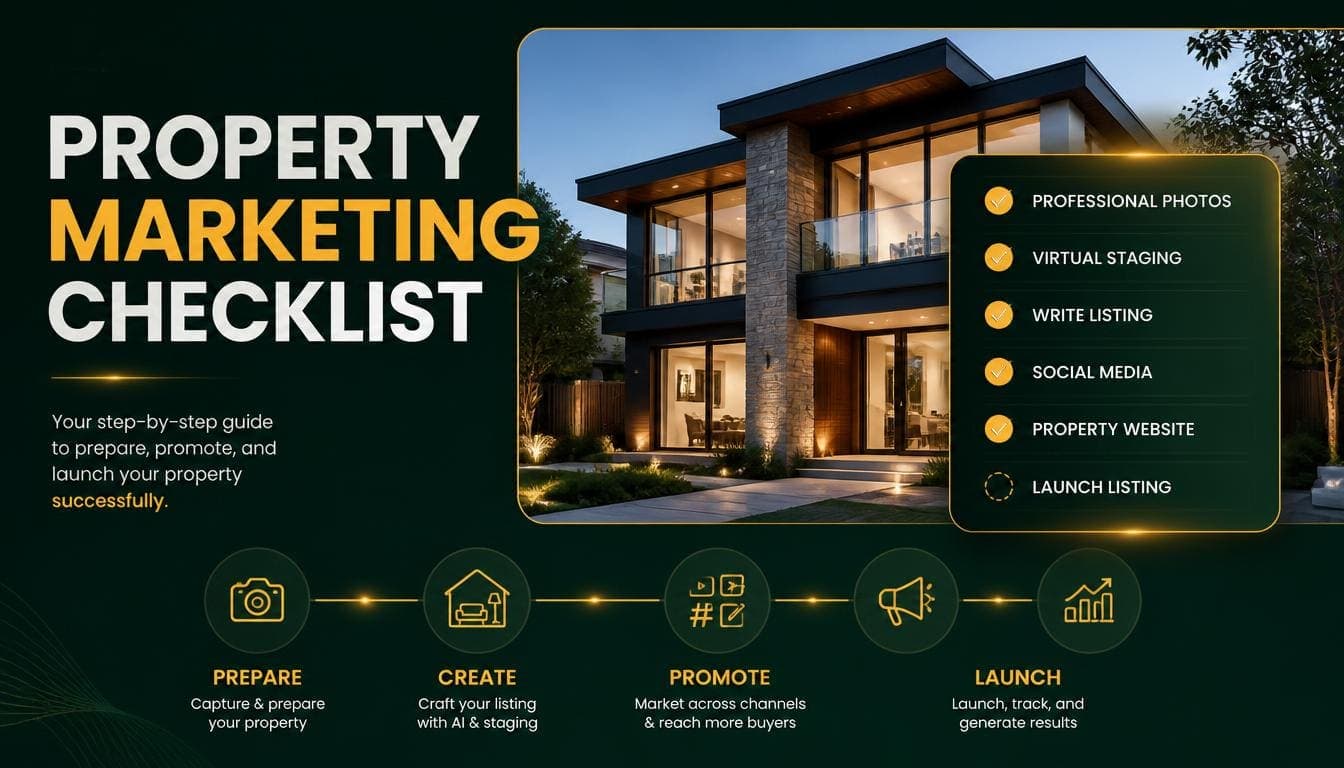
- Staged images captioned as virtually staged
- One unstaged photo per staged room included
- Strongest image leading the gallery
Bottom Line
For a vacant property marketed online, virtual staging in 2026 is the highest-return, lowest-cost action an agent can take. Fifty cents and forty-five minutes against a documented 73% reduction in time on market.
The barrier isn't cost or complexity anymore — it's just knowing the workflow.
Test it on your next vacant property. DecoAI gives you 3 free credits with no card required. Stage one room, put it in the listing, and watch what happens to your view count.