Photographs get buyers through the door. What happens after that is a different problem, and it uses different senses.
A property can photograph beautifully and disappoint in person — usually because of temperature, smell, light levels, or small details that don't register in a still image but do when someone is standing in the room.
This covers the preparation that closes that gap.
The Gap Between Photos and Viewings
What Photos Can't Convey
Temperature. A cold property feels unwelcoming in a way no photograph shows.
Smell. The most immediate sensory impression and the most commonly mishandled.
Sound. Traffic noise, neighbours, creaking floors, echo in empty rooms.
Actual light levels. A room photographed at midday with every light on looks different at 4pm in November.
Flow. How rooms connect, whether doors clash, whether the layout works.
Why This Matters
A buyer arriving with expectations set by good photographs and finding something colder, darker, or smellier than expected doesn't just feel neutral — they feel misled.
The gap costs more than under-promising would have.
Try DecoAI Free
3 free credits. No credit card needed. Stage any room in 30 seconds.
Get 3 Free CreditsThe Hour Before
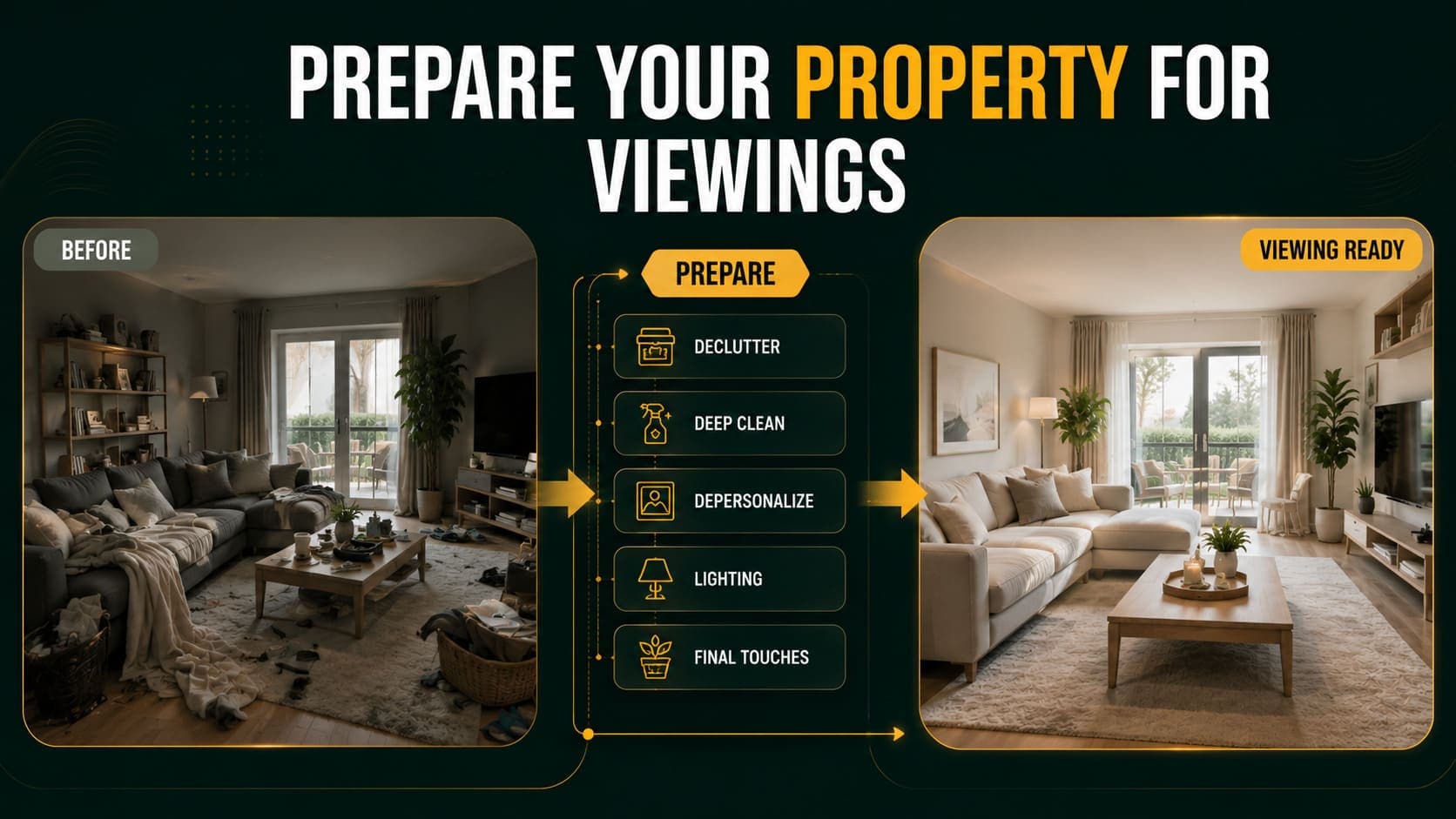
Most viewing preparation happens in the 60 minutes before someone arrives.
60 Minutes Before
Set the heating. Aim for comfortable — around 20–21°C. A cold property is the single most common viewing mistake.
In summer, the opposite: open windows early, close them before arrival, and consider closing blinds on the sunny side.
Open all windows. Air the property thoroughly for at least twenty minutes.
30 Minutes Before
Close the windows. You want the property aired, not cold and draughty.
Turn on every light. All rooms, all fixtures, including lamps. Even in daylight.
Open all curtains and blinds fully.
15 Minutes Before
Final tidy. Kitchen counters clear, sink empty, beds made, toilet lids down.
Empty the bins. Including bathroom bins.
Remove pets and pet items — beds, bowls, toys, litter trays.
Move cars off the driveway.
Clear the frontage — bins away, path clear.
5 Minutes Before
Final walk-through. Look at each room as a stranger would.
Leave. If you're the seller, go out. Buyers assess more thoroughly and speak more freely without you there.
Smell: The Most Common Mistake
What Sellers Get Wrong
Air fresheners. Plug-ins, sprays, and diffusers. Buyers read strong artificial scent as masking something and start looking for what.
Baking bread and fresh coffee. The most-repeated advice in property, and buyers have heard it too. It reads as a technique rather than an accident.
Scented candles. Same problem.
What Works
Neutral. A property that smells of nothing is better than one that smells of anything.
Air it thoroughly. Twenty minutes with windows open removes most background odour.
Address the source. Cooking smells, damp, pets, and smoke need dealing with at source, not covering.
Sources Worth Addressing
- Pets — Wash bedding, clean litter trays, vacuum thoroughly. Consider removing pets during viewings entirely.
- Damp — This is a property issue, not a smell issue. Covering it doesn't work and it will surface at survey.
- Cooking — Don't cook anything strong on viewing days.
- Bins — Empty everything, including the outside bin if it's near the door.
- Drains — A persistent drain smell needs fixing, not masking.
Temperature
Winter
Target: 20–21°C. Set the heating an hour before.
A cold property feels unloved and raises questions about heating costs and insulation. It's a false economy to save on heating during viewings.
Also: if the property has a fireplace or wood burner and it's genuinely functional, lighting it works well. Only if it's genuinely functional.
Summer
Target: cool but not cold.
Open windows early morning, close them and draw blinds on the sunny side before it heats up. A stuffy property in August is as off-putting as a cold one in January.
Empty Properties
Vacant properties get cold and stay cold. If the property is empty, arrive earlier and give the heating longer.
Lighting
Turn On Everything
Every room, every fixture, including lamps. This applies regardless of time of day.
Why: rooms with unlit corners read as smaller. Interior lighting fills the shadow that windows don't reach.
Open All Curtains and Blinds
Fully, not partially. Natural light does more than any fixture.
Check for Blown Bulbs
Before the viewing, not during. A dark room with a dead bulb reads as neglect.
Consider the Time
If viewings are in the evening in winter, the property will be seen entirely by artificial light. Make sure that light is adequate and warm-toned rather than harsh.
Try DecoAI Free
3 free credits. No credit card needed. Stage any room in 30 seconds.
Get 3 Free CreditsRoom-by-Room Final Check
Entrance
- Doormat clean
- Coats and shoes cleared
- Post picked up
- Hall light on
First impressions compound. A cluttered hallway sets the tone for everything after.
Living Room
- Cushions straightened
- Cables tucked away
- Remote controls out of sight
- Surfaces clear except one or two items
- Curtains fully open
Kitchen
- All counters clear
- Sink empty and dry
- Dishwasher closed
- Bin emptied
- Fridge front clear
- Tea towels folded or removed
Bathrooms
- All toiletries away
- Toilet lids down
- Fresh towels hung
- Mirror clean
- Bath and shower dry
- Bin emptied
Bedrooms
- Beds made properly
- Clothes away
- Surfaces clear
- Curtains open
- Wardrobe doors closed
Garden and Outdoor
- Lawn cut recently
- Path clear
- Furniture tidy
- Bins out of sight
- Toys and tools away
During the Viewing
If You're the Seller
Leave. This is the single most useful thing you can do.
Buyers spend longer, ask more questions, and speak more freely when the owner isn't present. They also feel free to open cupboards and look at things properly.
If you can't leave: stay in one room, don't follow buyers around, and let the agent lead.
If You're the Agent
Let them look. Buyers need time to form impressions without commentary.
Answer questions directly. Vague or evasive answers about condition, boundaries, or issues raise concerns.
Don't oversell. Buyers discount enthusiastic descriptions. Facts land better.
Have information ready — heating type and age, council tax band, service charges, recent work, what's included in the sale.
What Buyers Are Actually Doing
- Checking storage
- Assessing whether their furniture fits
- Listening for noise
- Checking water pressure sometimes
- Looking at ceilings for signs of damp
- Working out where they'd put things
Give them space to do this.
Common Viewing Mistakes
1. Cold Property
The most common and most damaging. Set the heating an hour before.
2. Air Fresheners
Buyers read them as masking. Air the property instead.
3. Seller Present
Buyers behave differently and assess less thoroughly.
4. Lights Off
Rooms with unlit corners look smaller and darker than they are.
5. Curtains Half Closed
Reduces natural light for no reason.
6. Pets Present
Some buyers are allergic, some are nervous, and pet items read as clutter regardless.
7. Not Airing
Background odour that the occupants no longer notice is immediately apparent to visitors.
8. Rushing the Buyer
Viewings that feel hurried don't convert. Let people take their time.
The Empty Property Case
Vacant properties have specific viewing challenges.
Cold — Nobody's been heating it. Arrive earlier and turn everything on.
Echo — Empty rooms echo, which reads as unhomely. Nothing much to do about this beyond acknowledging it.
Stale air — Closed-up smell develops quickly. Air thoroughly.
Bare and stark — A small kit of props helps: a rug, some plants, towels in the bathroom, a mirror in the hall. $200–$500 for something reusable across every property.
Dust — Empty properties accumulate dust visibly. Check before each viewing.
Frequently Asked Questions
What temperature should a property be for viewings?
Around 20–21°C in winter. Set the heating an hour before. A cold property is the most common viewing mistake.
Should I use air freshener before a viewing?
No. Buyers read strong scent as masking something. Air the property thoroughly instead — twenty minutes with windows open removes most background odour.
Does baking bread before a viewing work?
It's the most-repeated advice in property and buyers have heard it too. It reads as a technique rather than an accident. Neutral is better.
Should the seller be present at viewings?
No. Buyers assess more thoroughly, spend longer, and speak more freely without the owner there.
Should I turn on lights during a daytime viewing?
Yes, all of them. Rooms with unlit corners read as smaller regardless of the time of day.
What should I do about pets during viewings?
Remove them and their items where possible. Some buyers are allergic, some are nervous, and pet beds and bowls read as clutter.
How long before a viewing should I start preparing?
An hour. Heating and airing take that long. The final tidy takes fifteen minutes.
What's the most common viewing mistake?
A cold property. It's entirely avoidable and immediately noticeable.
How do I prepare an empty property for viewings?
Arrive earlier for heating, air thoroughly, check for dust, and consider a small reusable prop kit — a rug, plants, towels, a mirror — to stop rooms feeling stark.
Summary
The hour before: Heating on, windows open for twenty minutes, then closed. Every light on. Curtains fully open. Final tidy. Bins emptied. Cars moved. Then leave.
On smell: Neutral beats pleasant. Air thoroughly and address sources rather than masking them.
On temperature: 20–21°C in winter. Cool but not cold in summer. This is the most common failure.
On presence: Sellers should leave. Buyers assess more thoroughly without them.
For empty properties: Arrive earlier, air longer, and consider a reusable prop kit to stop rooms feeling stark.
Photos get them through the door. DecoAI gives 3 free credits with no card required — staged photos generate the viewings that this preparation then converts.