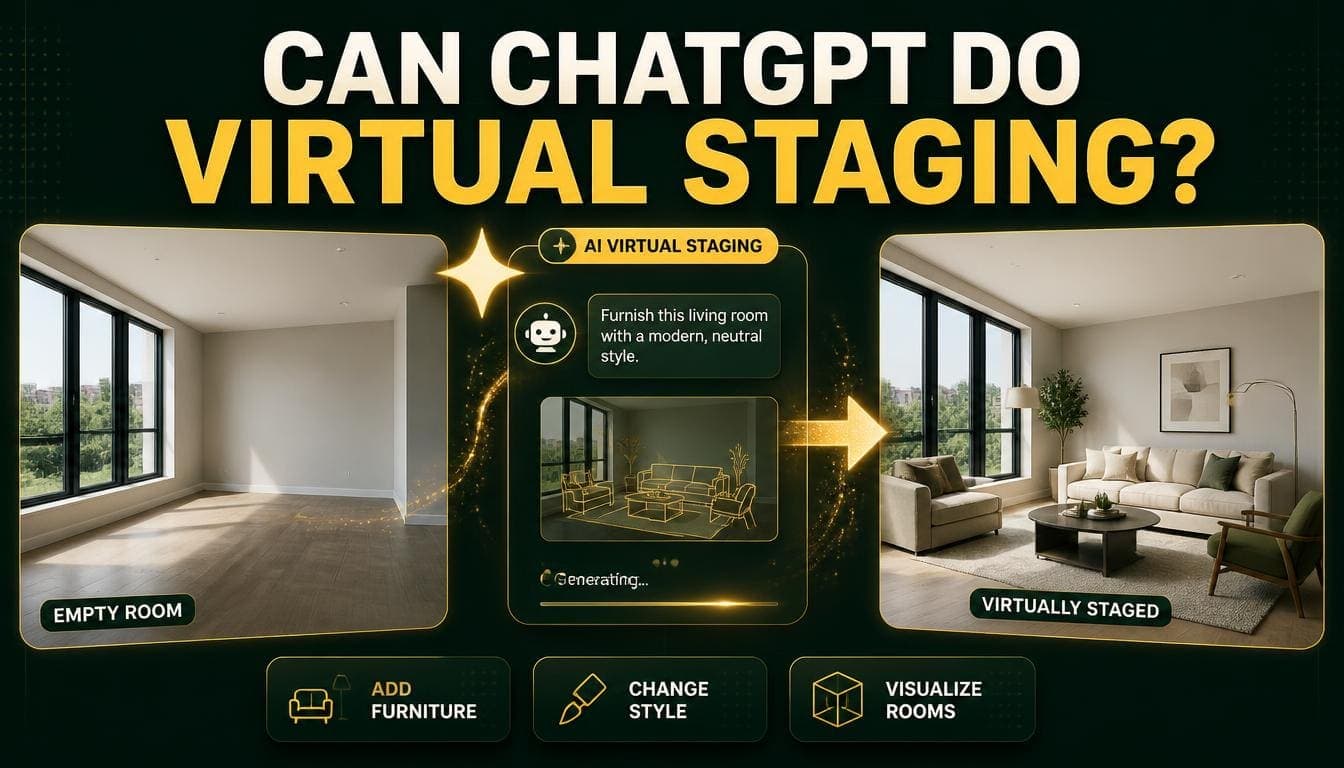
Virtual staging is the process of digitally adding furniture, decor, and lighting to a photo of an empty room — creating a professionally staged image without renting a single piece of furniture. In 2026, AI-powered tools complete this in 30 seconds for as little as $0.10 per image, compared to $2,000–$5,000 and 3–7 days for physical staging.
If you have a vacant listing, an unfurnished Airbnb, or a room you're planning to renovate, this guide covers everything you need to know.
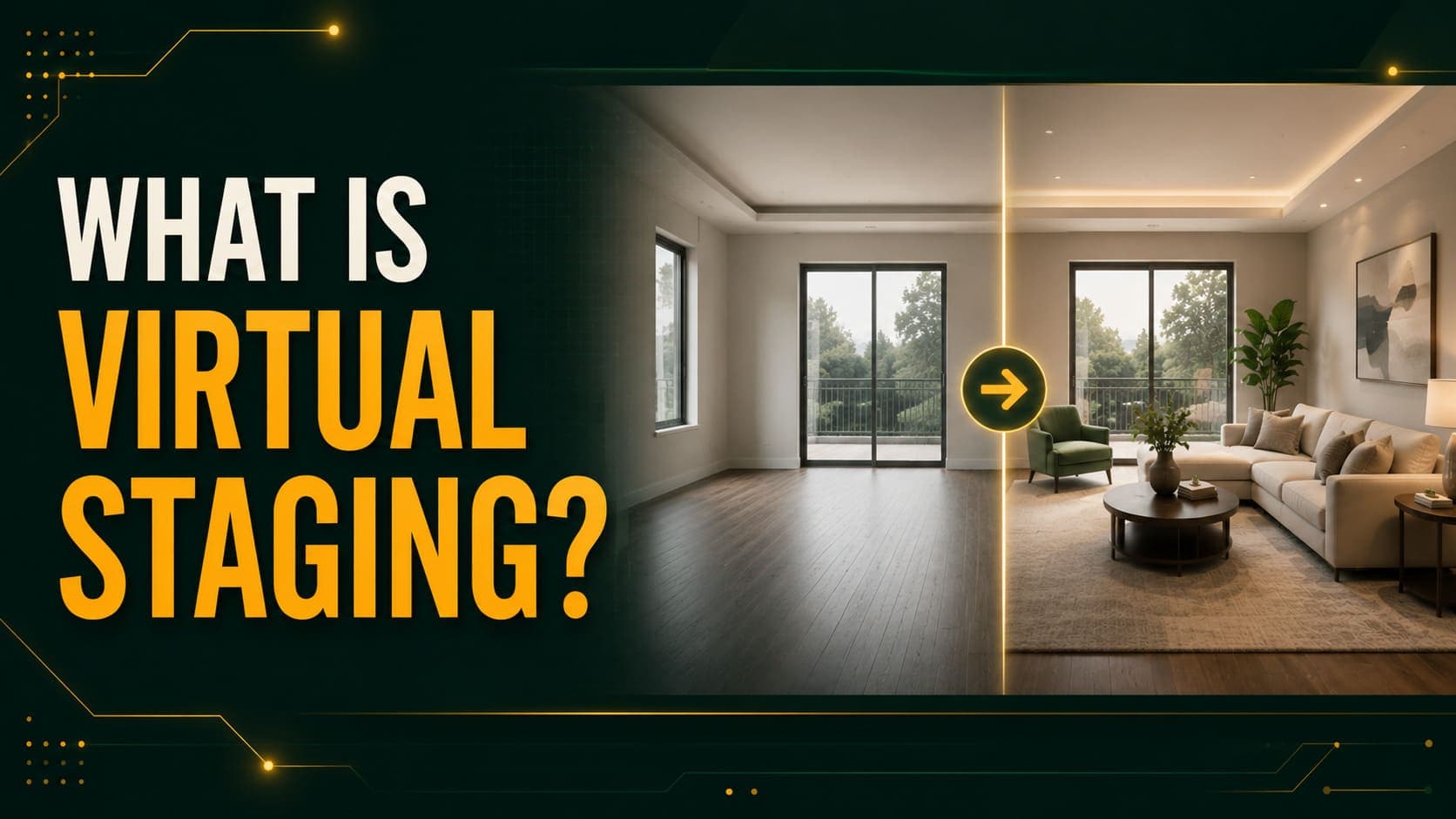
What Is Virtual Staging?
Virtual staging takes a photograph of an empty or sparsely furnished room and digitally inserts realistic furniture, rugs, artwork, and lighting. The result is a photorealistic image that shows buyers what the space could look like — without physically staging it.
The concept isn't new. Home staging as a discipline started in the 1970s, and digital staging emerged in the early 2000s when designers began manually compositing 3D furniture models into property photos. That process took a skilled designer 2–4 hours per image and cost $50–$200.
What changed in 2023–2026 is AI. Diffusion models — the same technology behind image generators like Midjourney and Stable Diffusion — can now analyze a room's geometry, lighting, and perspective, then generate furniture that fits naturally into the scene. No manual compositing, no designer, no waiting.
Try DecoAI Free
3 free credits. No credit card needed. Stage any room in 30 seconds.
Get 3 Free CreditsHow Does Virtual Staging Work?
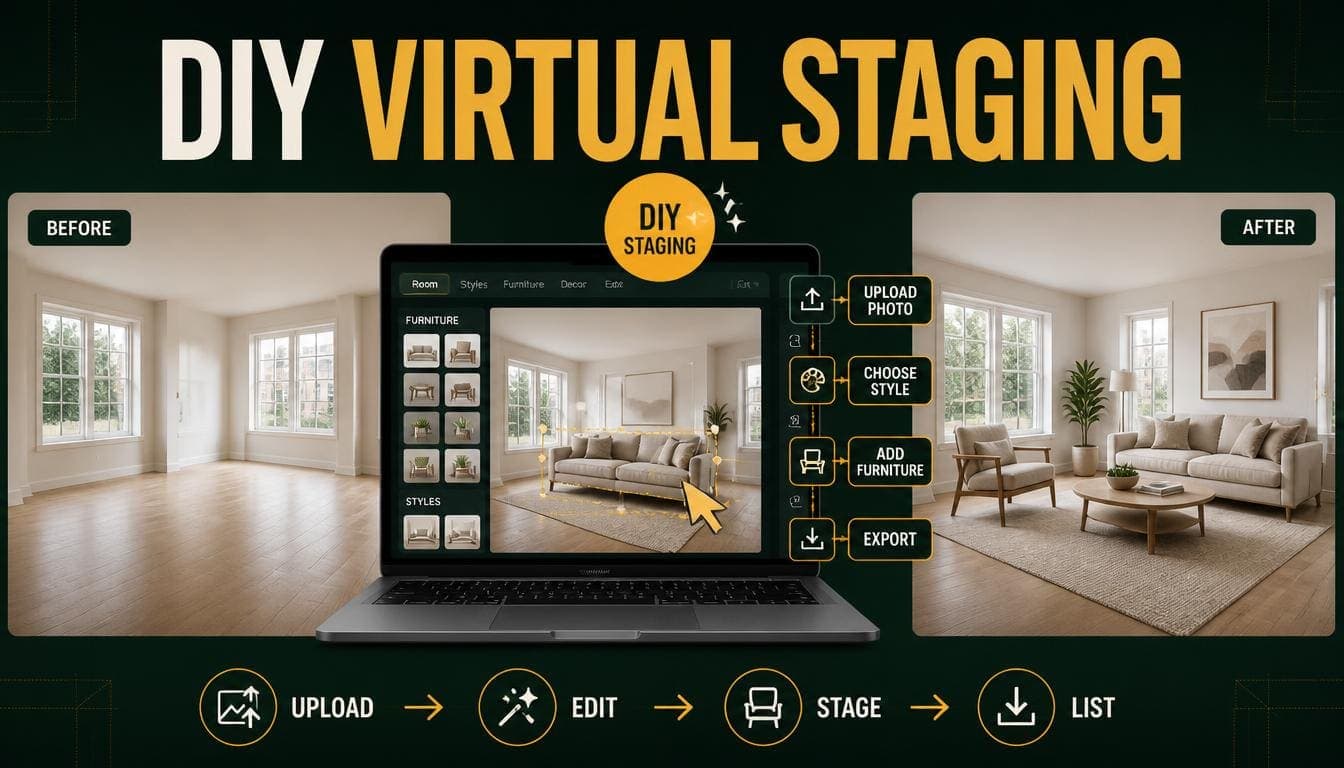
Modern AI virtual staging follows a four-step process. Here's exactly what happens:
Step 1: Photograph the Empty Room
Take a photo with any modern smartphone. You don't need professional equipment. What matters:
- Empty the room completely — remove boxes, cleaning supplies, and personal items
- Shoot in daylight — natural light produces far better results than flash
- Stand in a corner — this captures maximum floor area and gives the AI more space to work with
- Hold the camera at chest height — roughly 1.2 meters, level with the horizon
- Use wide-angle mode if your phone has it
Step 2: Upload to a Virtual Staging Tool
Drag and drop the image into the platform. Most AI tools accept JPG, PNG, and WEBP up to 10MB. Higher resolution inputs produce sharper outputs, so don't compress your photos before uploading.
Step 3: Select Room Type and Design Style
You'll typically choose two things:
Room type — living room, bedroom, kitchen, bathroom, home office, or dining room. This tells the AI what furniture category to generate.
Design style — Modern, Luxury, Scandinavian, Minimalist, Industrial, Bohemian, Traditional, or Contemporary. This determines the aesthetic direction.
Step 4: Generate and Download
The AI analyzes the room's dimensions, window positions, floor material, and existing lighting, then generates furniture that matches the perspective. With DecoAI, this takes about 30 seconds. You download the result in HD and it's ready to use.
What Virtual Staging Costs in 2026
This is where the numbers get interesting. Here's the full breakdown across every staging method available today:
| Method | Cost per room | Turnaround | Revisions |
|---|---|---|---|
| Physical staging | $500–$2,000 | 3–7 days | Extra cost |
| Designer virtual staging | $16–$75 per image | 24–48 hours | Limited |
| AI subscription tools | $12–$29/month | 30–120 seconds | Usually unlimited |
| DecoAI (pay per image) | $0.10 | 30 seconds | Unlimited |
Physical Staging: The Full Cost
Physical staging in the US averages $2,300–$3,200 per property, according to 2026 industry data. That breaks into three parts:
- Consultation fee: $300–$600 one-time
- Furniture rental: $500–$3,000 per month, averaging around $2,000
- Setup and removal: $500–$1,000
Stage a four-bedroom home in Los Angeles for a typical three-month listing period and you're looking at $7,000–$9,000. For luxury properties, that climbs to $5,000–$15,000.
AI Virtual Staging: The Full Cost
With AI, the entire cost structure collapses. A five-room property staged with DecoAI costs $0.50 total. Even the more expensive AI subscription tools rarely exceed $75 per property.
The Real Estate Staging Association reports that staging spend averaged $3,813 in Q3 2025 with an average ROI of 3,551% — meaning sellers recovered their investment roughly 36 times over. When your staging cost drops from $3,813 to $0.50, the ROI math becomes almost absurd.
Virtual Staging ROI: What the Data Shows
Here's what independent research says about staging's impact — these figures come from NAR, RESA, and industry surveys, not vendor marketing:
Speed to sale
- Staged homes sell 73% faster than unstaged properties
- Staged listings average 29–31 days on market vs 52 days unstaged
- Every 15 days saved avoids $1,050–$1,950 in carrying costs
Price impact
- 29% of agents observed 1–10% price increases from staging (NAR 2025, surveying 49,806 agents)
- 85% of staged homes sold for 5–23% above list price (RESA Q1 2025)
- Properties in the $750K–$1.49M range showed the highest premium, around 9–10% above list
Online engagement
- Staged listings see a 90% increase in click-through rates (3.5–4.5% vs 1.8–2.2%)
- Buyers spend 70% more time on staged listing pages (45–60 seconds vs 27 seconds)
- 96% of homebuyers start their property search online
Buyer perception
- 81% of buyers say staging helps them imagine a property as their future home
- 49% of buyer's agents now rate virtual staging as equal to or better than traditional staging (HomeLight 2025)
A word of caution on these numbers: many precise percentages circulating online come from companies selling staging services. The directional pattern — staged sells faster and at a premium — is confirmed independently by NAR and RESA. Treat the exact percentages as directional rather than gospel.
Try DecoAI Free
3 free credits. No credit card needed. Stage any room in 30 seconds.
Get 3 Free CreditsVirtual Staging vs Physical Staging
Both approaches work. They just work differently, and the right choice depends on your situation.
| Factor | Physical Staging | Virtual Staging |
|---|---|---|
| Cost per room | $500–$2,000 | $0.10–$75 |
| Time to result | 3–7 days | 30 seconds–48 hours |
| Style options | 1 (what you rented) | 8+ |
| Revisions | Costly re-staging | Free, instant |
| In-person impact | Buyers touch and feel | Photos only |
| Open house effect | Strong | None |
| Works for occupied homes | Yes, with prep | Limited |
| Scales to volume | No | Yes |
When Physical Staging Still Wins
Physical staging is the better choice when:
- The property is high-end and buyers will attend in-person showings
- The listing relies on open houses to generate offers
- Local buyers strongly expect furnished walkthroughs
- The budget supports it and the commission justifies the spend
When Virtual Staging Wins
Virtual staging is the better choice when:
- The property is vacant and marketed primarily online
- You're staging multiple properties and need cost efficiency
- You want to show multiple design styles to different buyer segments
- The price point can't absorb $2,000+ in staging costs
- Speed matters and you're going live this week
For most agents in 2026, the answer isn't either/or. It's virtual staging for the photos and light physical touches for showings.
AI Virtual Staging vs Designer Virtual Staging
Not all virtual staging is AI-powered. Traditional virtual staging services employ human designers who manually place 3D furniture models into your photo. Here's how they compare:
Where Human Designers Win
- Custom requests — "Add a piano near the window, make the sofa navy blue"
- Photo cleanup first — designers can remove wall marks, hide cables, and fix lighting before staging
- Unusual rooms — home gyms, nurseries, wine cellars, and specialty spaces AI tools don't have presets for
- Guaranteed consistency — every image in a set will match
Where AI Wins
- Cost — $0.10 vs $16–$75 per image
- Speed — 30 seconds vs 24–48 hours
- Iteration — try 10 style variations for the price of one designer image
- Availability — no queue, no business hours, no rush fees
Where AI Still Falls Short
Being honest about this matters. AI virtual staging in 2026 has real limitations:
- Occasional geometry errors — furniture that overlaps oddly or doesn't match the room's perspective
- Limited room types — most tools handle 6 standard room types well and struggle beyond that
- Poor input, poor output — a dark, cluttered photo will produce a bad result no matter which tool you use
- No structural changes — AI adds furniture, it doesn't change layouts unless you use a dedicated renovation tool
The practical workaround: generate multiple variations and pick the best. With DecoAI at $0.10 per image, generating five variations costs $0.50 — still less than 1% of a single designer image.
Design Styles Explained
Choosing the right style matters more than most people expect. Here's what each one signals to a viewer:
Modern
Clean lines, neutral palette, low-profile furniture. The most universally appealing style and the safest default for urban properties.
Luxury
Premium materials, statement lighting, rich fabrics, gold or brass accents. Best for high-end properties where the price point supports the expectation.
Scandinavian
Light wood, white walls, soft textures, plenty of negative space. Makes small rooms feel larger and appeals broadly to younger buyers.
Minimalist
Only essential pieces, monochrome palette, maximum open floor. Excellent for studio apartments and compact spaces.
Industrial
Exposed textures, metal fixtures, dark tones, leather. Fits lofts, converted spaces, and properties with existing character.
Bohemian
Layered patterns, warm earth tones, plants, rattan. Works well for vacation rentals and properties targeting creative buyers.
Traditional
Classic wooden furniture, warm neutrals, symmetrical arrangements. Strong choice for family homes and suburban markets.
Contemporary
Current trends, mixed materials, bold accent pieces. Sits between Modern and Traditional — broad appeal without feeling dated.
Try DecoAI Free
3 free credits. No credit card needed. Stage any room in 30 seconds.
Get 3 Free CreditsWho Benefits from Virtual Staging?
Real Estate Agents
The primary users. Agents use virtual staging to make vacant properties competitive against furnished ones. The economics are compelling: a five-room property costs $0.50 to stage with AI and can shorten time on market by weeks.
Practical workflow: photograph every room the day before going live, stage all of them in an hour, and publish with a complete furnished-looking gallery.
Real Estate Photographers
Photographers add virtual staging as an upsell service. Charge clients $25–$50 per staged image, deliver in an hour, and pay $0.10 per image in tool costs. It's one of the highest-margin add-ons in the business.
Airbnb and Short-Term Rental Hosts
Listing photos are the entire first impression on Airbnb. Hosts use virtual staging two ways: to make an under-furnished property look complete, and to test furniture styles before buying anything. A $0.30 investment in staging three rooms can meaningfully move booking rates.
Interior Designers
Designers use AI staging as a rapid concept tool. Show a client five directions in an hour instead of five days, then develop the winner properly. It compresses the discovery phase dramatically.
Property Developers
For off-plan and pre-construction sales, virtual staging turns floor plans and empty shells into marketable visuals months before completion.
Home Sellers
If you're selling on your own, or your agent doesn't offer staging, doing it yourself costs less than a coffee and takes an afternoon.
Best Virtual Staging Tools in 2026
Here's an honest comparison of the leading options:
| Tool | Pricing | Speed | Model |
|---|---|---|---|
| DecoAI | $0.10/image | 30 seconds | Pay per image |
| Virtual Staging AI | From $16/month | 10–30 seconds | Subscription |
| ReimagineHome | From $29/month | 1–2 minutes | Subscription |
| ApplyDesign | From $20/month | 1 minute | Subscription |
| BoxBrownie | $24/image | 24 hours | Human designer |
| Styldod | $16/image | 24–48 hours | Human + AI |
| Stuccco | $29/image | 24–48 hours | Human designer |
How to Choose
Stage occasionally (1–5 images per month)? Pay-per-image pricing wins. Subscriptions waste money on unused capacity.
Stage in volume (50+ images per month)? A subscription may work out cheaper per image — do the math against your actual volume.
Need custom work or unusual rooms? A human designer service is worth the premium.
Need speed above all? AI tools deliver in under a minute; designer services take a day or more.
How to Get the Best Results
These are the patterns that consistently produce better output:
Photography
- Shoot between 10am and 2pm — the light is even and shadows are soft
- Turn on all interior lights even in daylight — it fills shadow areas
- Wipe the floors — dust and marks show up clearly in AI output
- Open curtains fully — natural light dramatically improves realism
- Avoid extreme wide-angle — heavy fisheye distortion confuses the AI's perspective mapping
Style Selection
Match the market, not your taste. Research what sells in your area. Modern performs well in urban markets; Traditional resonates in suburban family neighborhoods; Luxury fits premium price bands.
Match the price point. Luxury staging on a budget property creates a mismatch viewers notice immediately.
Generate multiple options. At $0.10 per image, there's no reason to accept the first result. Generate three to five and pick the strongest.
Room Priority
If you're staging selectively, prioritize in this order:
- Living room — the emotional anchor of any property
- Primary bedroom — buyers imagine themselves here
- Kitchen — light staging only, accessories rather than furniture
- Dining room — creates a lifestyle narrative
- Home office — increasingly valued post-2020
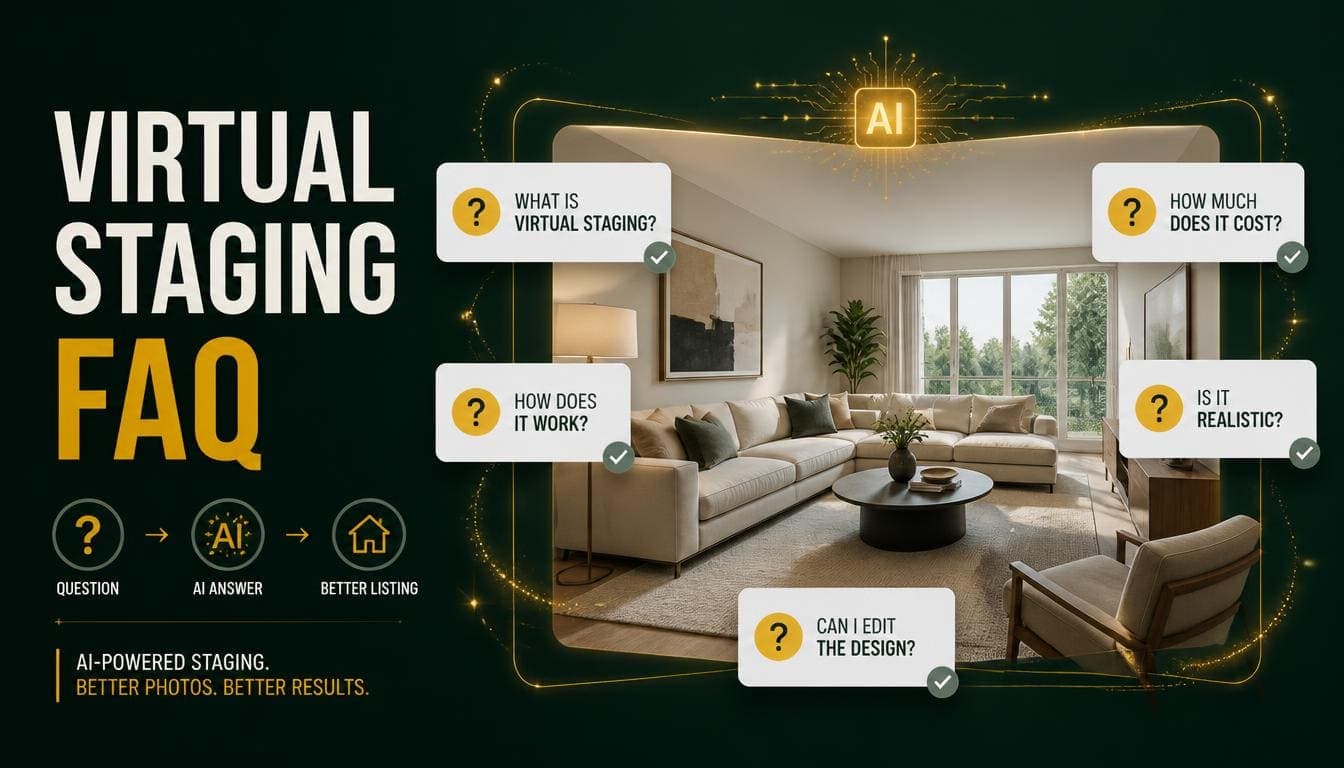
Frequently Asked Questions
Is virtual staging worth it?
For vacant properties marketed online, yes. At $0.10–$75 per image against a documented 73% faster sale and potential 1–10% price premium, the risk-reward is heavily favorable. Even a conservative 1% price lift on a $400,000 property is $4,000 — against a staging cost under $1 with AI tools.
Can viewers tell if a room is virtually staged?
High-quality AI staging in 2026 is difficult to distinguish from physical staging in photos. Standard practice across the industry is to label staged images as "virtually staged" — most agents do this as a matter of course, and viewers appreciate the transparency.
How long does AI virtual staging take?
30 seconds to 2 minutes depending on the tool. DecoAI delivers in about 30 seconds. Human designer services take 24–48 hours.
What photo quality do I need?
Any modern smartphone photo works. JPG, PNG, or WEBP up to 10MB. Higher resolution produces sharper results, but you don't need a DSLR or professional photographer.
Can virtual staging work on furnished rooms?
Some tools can replace existing furniture, but results are inconsistent. The reliable approach is staging genuinely empty rooms. If a room is furnished, either photograph it after clearing it or use a dedicated furniture-removal tool first.
Do I need design skills?
None. You upload a photo, select a style, and download the result. That's the entire process.
Does virtual staging work for commercial properties?
Yes for offices and retail spaces, though most AI tools are optimized for residential interiors. Results tend to be better for office spaces than for specialized commercial environments.
How many photos should I stage?
Stage the rooms that drive emotional decisions — typically 4–6 images covering the living room, primary bedroom, kitchen, and one or two additional spaces. Staging every room isn't necessary and can look excessive.
What's the difference between virtual staging and virtual renovation?
Virtual staging adds furniture to an existing room. Virtual renovation changes finishes — paint colors, flooring, cabinets, countertops. Some tools do both; most specialize in one.
Can I use the same photo for multiple styles?
Yes, and you should. Generating the same room in Modern, Scandinavian, and Luxury costs $0.30 total with DecoAI and lets you test which style resonates with your audience.
The Bottom Line
Virtual staging in 2026 has moved from a niche technique to standard practice. Physical staging dropped from 37% of agents in 2017 to 21% in 2025, largely because AI made the alternative so much cheaper and faster.
The core question isn't whether to stage — the data on staged versus unstaged properties is unambiguous. It's which method fits your property, budget, and timeline.
For vacant properties marketed online, AI virtual staging is the clear economic winner. At $0.10 per image with 30-second turnaround, there's no meaningful barrier to staging every property you handle.
Try it yourself. DecoAI gives you 3 free staging credits — no credit card required. Upload a photo of any empty room and see what 30 seconds of AI can do.