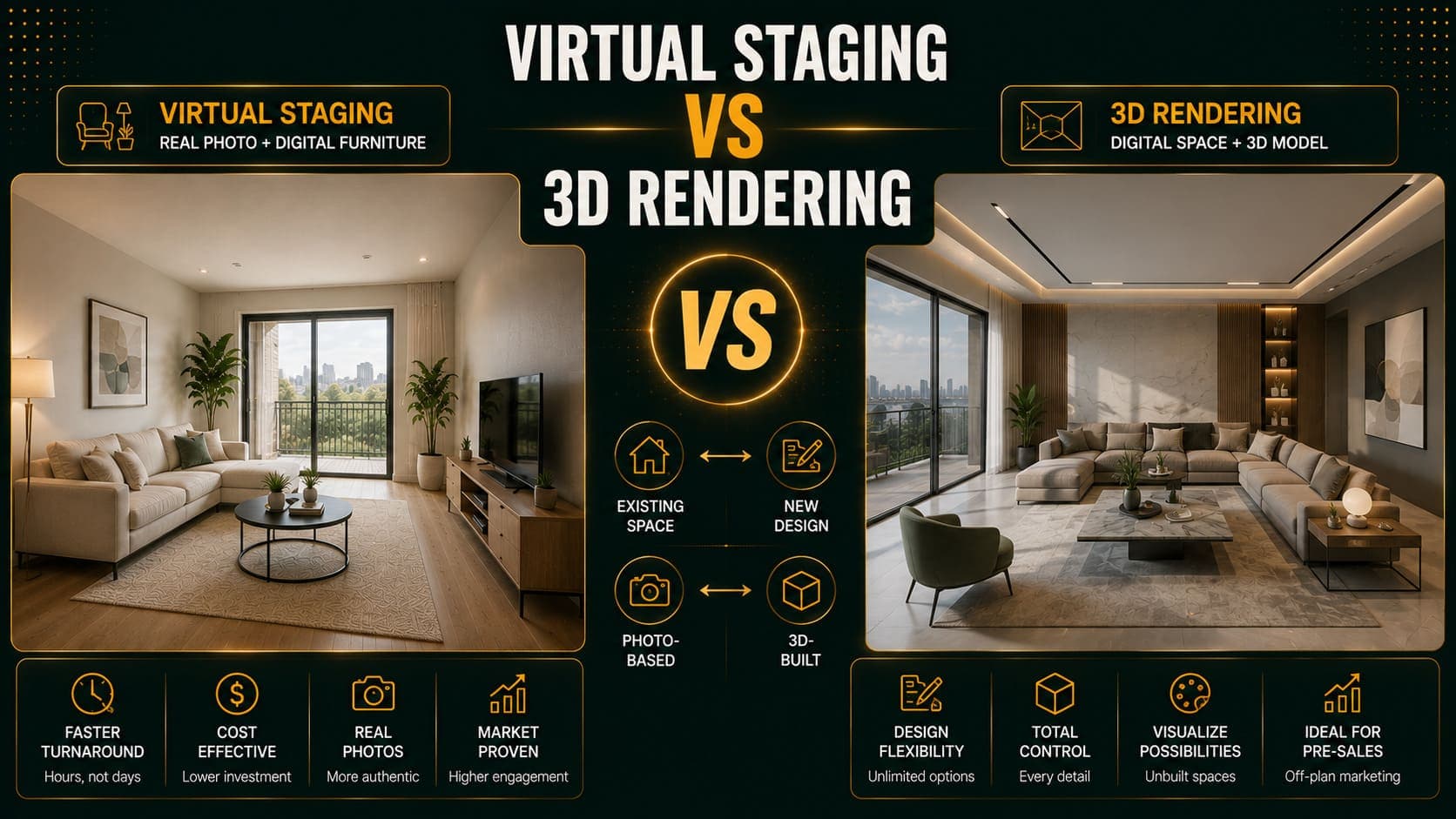
Virtual staging and 3D rendering both produce images of furnished interiors. That's where the similarity ends.
Virtual staging starts with a photograph of a real room and adds furniture to it. It requires the room to exist.
3D rendering builds the room from scratch in modelling software. It requires nothing to exist, but requires a modeller and considerable time.
The choice usually comes down to one question: does the space exist yet?
The Core Difference
| Factor | Virtual staging | 3D rendering |
|---|---|---|
| Starting point | A photograph | Architectural drawings |
| Room must exist | Yes | No |
| Time | 30 seconds–48 hours | 2–20 hours per image |
| Cost | $0.10–$49 per image | $200–$2,000 per image |
| Precision | Style-level | Item-level |
| Realism | Photographic base | Depends on render quality |
| Skill required | None | Significant |
| Revisions | Regenerate | Adjust model and re-render |
Try DecoAI Free
3 free credits. No credit card needed. Stage any room in 30 seconds.
Get 3 Free CreditsWhen You Need 3D Rendering
The Property Doesn't Exist Yet
Off-plan sales, pre-construction marketing, and development launches before ground is broken.
There's no photograph to work from, so rendering is the only option.
You Need Precise Item Placement
Furniture retailers, kitchen designers, and interior designers specifying exact products need item-level control.
"This specific sofa, in this specific fabric, positioned here" is a rendering requirement. AI staging works from style presets.
The Layout Is Changing
Showing a property after a proposed extension, wall removal, or reconfiguration requires modelling the new geometry. Photo-based tools can't create space that doesn't exist.
You Need Multiple Camera Angles of the Same Design
A 3D model can be rendered from any viewpoint with perfect consistency. AI staging generates each image independently, so the same room staged twice produces different furniture.
Aerial and Contextual Views
Development site plans, building exteriors in context, and aerial views require modelling.
Marketing Requires Absolute Consistency
Brochures and campaigns for large developments often need every image to share a coherent design language. A single 3D model guarantees this.
When You Need Virtual Staging
The Room Exists and You Have a Photograph
The default case. If you can photograph the space, staging is faster, cheaper, and more photorealistic because it starts from a real photograph.
You're Marketing an Existing Property
Vacant sales listings, rentals, and completed developments. Rendering these would be an odd choice — the real room is right there.
You Need Speed
30 seconds versus days.
You Want to Test Multiple Styles
Generating a room in eight styles costs $0.80 with AI staging. Rendering eight variations means eight separate render jobs.
Budget Is a Real Constraint
The cost difference is roughly 2,000x at the low end. For individual property listings, rendering rarely makes economic sense.
You Need Volume
Staging fifty rooms costs $5. Rendering fifty rooms costs $10,000–$100,000.
The Overlap Cases
New Developments Mid-Construction
Some units are complete, others aren't.
Practical approach: render the unbuilt phases, stage the completed ones. Once a unit type reaches practical completion, photograph and stage it — the result is more photorealistic than the render and costs a fraction.
Properties Needing Renovation
Showing a dated property after modernization sits between the two.
Surface changes — paint, flooring, cabinets — can be handled by AI renovation tools on the existing photograph.
Structural changes — removing walls, extending — require rendering.
High-End Property Marketing
Some premium developments use rendering for the marketing campaign and staging for individual unit listings. Rendering establishes the design language; staging handles the volume.
Try DecoAI Free
3 free credits. No credit card needed. Stage any room in 30 seconds.
Get 3 Free CreditsCost Comparison in Practice
Single Property, Five Rooms
| Method | Cost | Time |
|---|---|---|
| AI virtual staging | $0.50 | 20 minutes |
| Designer virtual staging | $80–$245 | 1–2 days |
| 3D rendering | $1,000–$10,000 | 1–3 weeks |
Development, Six Unit Types, Five Rooms Each
| Method | Cost | Time |
|---|---|---|
| AI virtual staging | $3 | 2 hours |
| Designer virtual staging | $480–$1,470 | 3–5 days |
| 3D rendering | $6,000–$60,000 | 4–12 weeks |
The caveat: these aren't equivalent outputs. Rendering gives item-level control, guaranteed consistency, and works before construction. Staging gives photographic realism, speed, and volume.
The right comparison isn't cost alone — it's cost against what the project actually requires.
Quality Comparison
Where Rendering Wins
Consistency — Every image from the same model shares identical furniture, lighting, and design language.
Control — Exact products, exact positions, exact materials.
Impossible views — Cutaways, aerials, and angles no camera could achieve.
Pre-construction — The only option when nothing exists.
Where Staging Wins
Photorealism — Staging starts from an actual photograph, so the room's real light, texture, and proportions are already correct. High-end rendering achieves this but requires substantial time and skill.
Speed — Seconds versus days.
Accuracy to the real space — A render is an interpretation of drawings. A staged photograph is the actual room.
The Realism Point Is Worth Expanding
A common assumption is that rendering produces higher-quality images. For architectural visualization, top-tier rendering is extraordinary.
But for a standard property listing, a staged photograph of the real room is frequently more convincing than a mid-budget render — because it is the real room, with real light and real proportions.
Buyers can often tell a render from a photograph. That's not always a disadvantage, but for existing properties it usually is.
Decision Framework
Answer these in order:
1. Does the space physically exist and can you photograph it? No → Rendering Yes → Continue
2. Do you need to show layout changes or structural work? Yes → Rendering No → Continue
3. Do you need specific products placed precisely? Yes → Rendering or designer virtual staging No → Continue
4. Do you need multiple angles of the same design, perfectly consistent? Yes → Rendering No → Continue
5. Everything else → Virtual staging
For the substantial majority of individual property listings, this resolves to virtual staging.
Common Mistakes
1. Rendering an Existing Property
Spending $1,000+ to model a room you could photograph and stage for 50 cents. This happens more than it should, usually from habit.
2. Trying to Stage a Property That Doesn't Exist
AI staging requires a photograph. There's no workaround.
3. Using Renders as Listing Photos for Completed Units
Once a unit is built, the render is less accurate than a photograph. Buyers who notice the gap lose confidence.
4. Expecting Item-Level Control from AI Staging
AI works from style presets. "Put the navy sofa against the left wall" isn't a request it can fulfil.
5. Expecting Speed from Rendering
Days to weeks, not hours. Plan accordingly.
6. Not Switching to Staging Once Units Complete
Developments frequently continue using launch-phase renders long after real units exist. Photographing and staging completed units produces better marketing at lower cost.
Frequently Asked Questions
What's the difference between virtual staging and 3D rendering?
Staging adds furniture to a photograph of an existing room. Rendering builds the entire room in 3D software from drawings. Staging requires the room to exist; rendering doesn't.
Which is cheaper, staging or rendering?
Staging, by roughly 2,000x at the low end. AI staging costs $0.10–$3 per image; rendering costs $200–$2,000.
When should I use 3D rendering instead of staging?
Pre-construction marketing, layout changes, precise product placement, multiple perfectly consistent angles, and aerial or contextual views.
Is 3D rendering more realistic than virtual staging?
Not necessarily. Staging starts from an actual photograph, so light and proportions are already real. High-end rendering matches this but requires substantial time and cost.
Can AI staging replace 3D rendering?
For existing properties, largely yes. For pre-construction, structural changes, and precise specification, no.
How long does 3D rendering take?
2–20 hours per image depending on complexity, typically 1–3 weeks for a full property set including revisions.
Should developers use rendering or staging?
Rendering before construction, staging once units complete. Switching once real units exist produces more accurate marketing at a fraction of the cost.
Can I get multiple angles of the same staged room?
Not with consistent furniture. AI staging generates each image independently, so the same room staged twice produces different arrangements. Rendering handles this properly.
Which do buyers prefer?
Buyers generally respond better to photographs of real spaces than to renders, when both are available. For pre-construction, renders are the only option and buyers understand that.
Summary
Use 3D rendering when: The space doesn't exist, the layout is changing, you need precise product placement, or you need multiple perfectly consistent angles.
Use virtual staging when: The room exists and you can photograph it — which covers the substantial majority of property listings.
The most common error: rendering something you could photograph. Once a space exists, staging is faster, cheaper, and often more convincing.
The developer rule: render the unbuilt, stage the built. Switching once units complete improves accuracy and reduces cost substantially.
If your property exists, start here. DecoAI gives 3 free credits with no card required — enough to see how a staged photograph compares to what a render would have cost you.