Almost every statistic you'll read about staging ROI comes from a company that sells staging. That's not automatically disqualifying, but it should shape how much weight you give specific numbers.
This piece separates what's independently supported from what's marketing, and shows how to calculate the return for a specific property rather than relying on industry averages.
The Source Problem
Who Publishes Staging Statistics
Trade bodies with a stake: The Real Estate Staging Association surveys its own members — professional stagers — about outcomes on properties they staged. Useful directionally, but the sample and the incentive both skew.
Staging companies: Marketing material citing figures that frequently trace back to other marketing material, sometimes circularly.
Independent bodies: The National Association of Realtors surveys agents broadly, not just stagers. Their data is the most reliable available, and notably more modest than industry claims.
What This Means Practically
When you see "staged homes sell for 20% more," check the source. NAR's actual finding is considerably more conservative.
The direction is well supported across sources. The magnitude varies enormously depending on who's counting.
Try DecoAI Free
3 free credits. No credit card needed. Stage any room in 30 seconds.
Get 3 Free CreditsWhat the Data Actually Supports
Well Supported: Faster Sales
Multiple sources agree that staged properties sell faster than unstaged ones.
NAR data: Agents consistently report staged homes spending less time on market. Industry figures: Staged listings averaging 29–31 days versus 52 days unstaged.
The specific numbers vary, but the direction is consistent across independent and industry sources.
Confidence: high
Well Supported: Higher Online Engagement
Staged listing photos get more clicks and hold attention longer than empty-room photos.
Reported figures: Roughly 90% higher click-through rates, 70% more time on listing pages.
This is the most mechanically plausible claim on the list. Photos that look better get clicked more — this doesn't require any complex causal chain.
Confidence: high
Moderately Supported: Price Premium
NAR 2025 (surveying 49,806 agents): 29% of agents observed price increases of 1–10% from staging.
Note what this actually says: less than a third of agents observed any increase, and the range tops out at 10%.
RESA Q1 2025: 85% of staged homes sold for 5–23% above list price. This is a stager trade body surveying its own members — treat accordingly.
Confidence: moderate for a modest premium, low for large ones
Weakly Supported: Specific Large Percentages
Claims like "staging returns 586% ROI" or "staged homes sell for 20% more" generally trace to industry marketing rather than independent research.
Confidence: low
Calculating ROI for a Specific Property
Industry averages are less useful than a calculation for the actual property in front of you.
The Inputs You Need
- Property value
- Staging cost — $0.50 for AI, $80–$245 for designer services, $2,300–$3,200 for physical
- Monthly carrying cost — mortgage, insurance, utilities, tax
- Expected days saved — be conservative
The Calculation
Carrying cost saving = (days saved ÷ 30) × monthly carrying cost
Price benefit = property value × expected premium %
Net return = (carrying cost saving + price benefit) − staging cost
Worked Example: $400,000 Property, AI Staging
| Input | Value |
|---|---|
| Property value | $400,000 |
| Staging cost (AI, 5 rooms) | $0.50 |
| Monthly carrying cost | $2,400 |
| Days saved (conservative) | 15 |
| Price premium (conservative) | 1% |
Carrying cost saving: (15 ÷ 30) × $2,400 = $1,200 Price benefit: $400,000 × 1% = $4,000 Total benefit: $5,200 Cost: $0.50 Net return: $5,199.50
Even at a fraction of these assumptions, the return dwarfs the cost.
Worked Example: $400,000 Property, Physical Staging
| Input | Value |
|---|---|
| Property value | $400,000 |
| Staging cost (3 months) | $6,500 |
| Monthly carrying cost | $2,400 |
| Days saved | 15 |
| Price premium | 1% |
Total benefit: $5,200 Cost: $6,500 Net return: −$1,300
At a 1% premium, physical staging doesn't cover its own cost on this property.
Break-even premium for physical staging here: roughly 1.3%.
Try DecoAI Free
3 free credits. No credit card needed. Stage any room in 30 seconds.
Get 3 Free CreditsWhy AI Staging Changes the Calculation
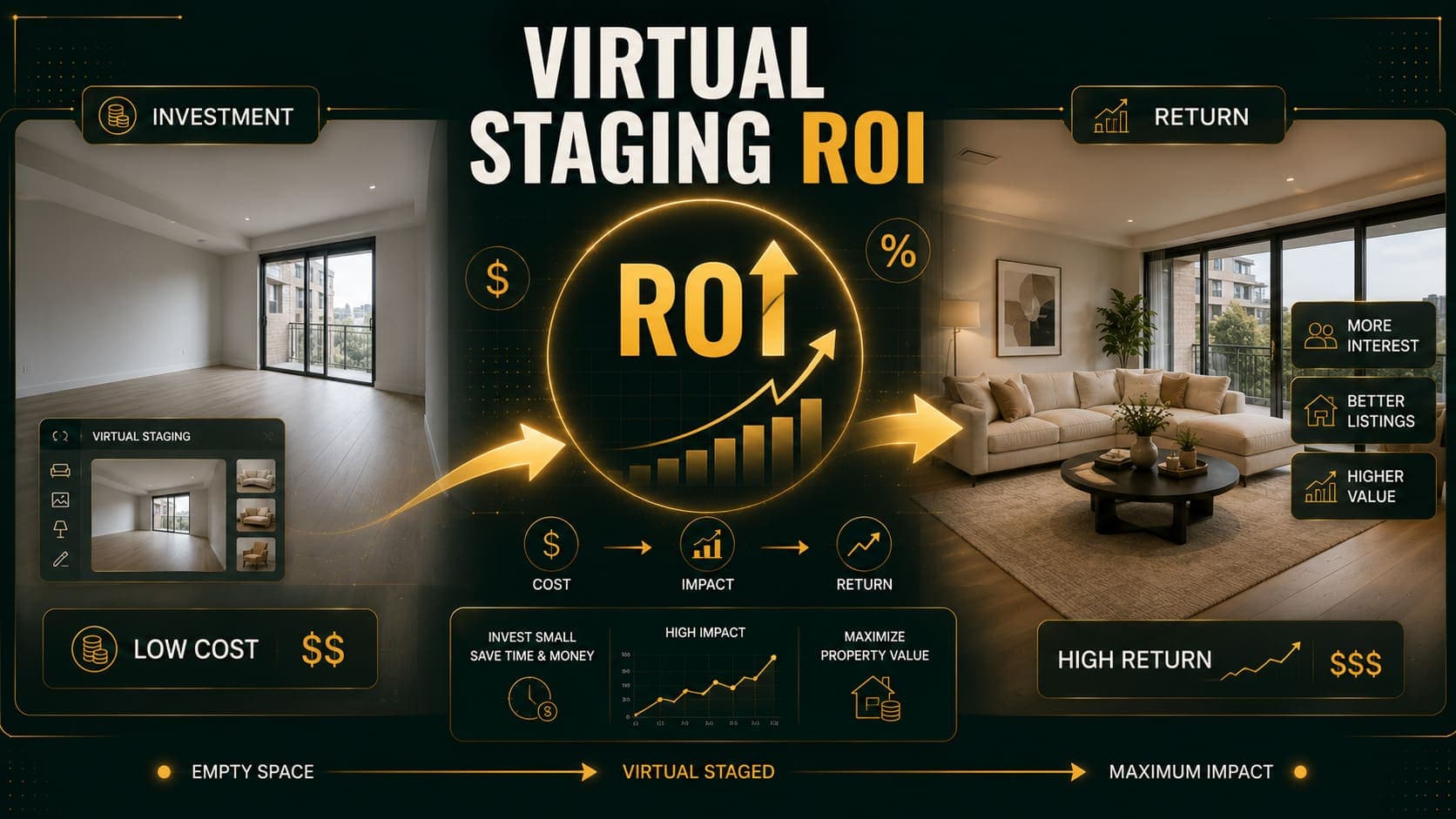
The ROI question used to be genuinely difficult. Physical staging costs thousands, so whether it returned more than it cost was a real analysis.
At $0.50 per property, that analysis becomes trivial.
The Asymmetry
If staging works: You gain thousands. If staging does nothing: You lose 50 cents.
There's no scenario in which AI staging is a meaningful financial risk. That's a different decision than the one physical staging presents.
Where the Real Cost Sits
Not in the tool cost — in the time.
- Photography: 15 minutes
- Staging and review: 20 minutes
- Total: 35 minutes per property
For an agent, that's the actual investment. Whether 35 minutes is worth a potential 15-day reduction in time on market is a straightforward yes.
When Staging ROI Is Weakest
Being honest about where the case is thin.
Hot Markets
In a market where properties sell in a week regardless of presentation, staging adds less. The days-saved component approaches zero.
The price premium component may still apply, but the urgency argument doesn't.
Very Low Value Properties
A 1% premium on a $100,000 property is $1,000. Still well above AI staging cost, but the absolute numbers matter less than on higher-value properties.
Properties with Fundamental Problems
Staging changes perception at the margin. It doesn't fix a bad layout, a poor location, structural issues, or an overambitious asking price.
A property that isn't selling because it's overpriced won't start selling because the photos improved.
Occupied Properties with Good Existing Furniture
If the property is well-furnished and photographs well, staging adds little. Decluttering and better photography may do more.
Comparing Staging Methods on ROI
| Method | Cost (5 rooms) | Break-even premium on $400K | Verdict |
|---|---|---|---|
| AI staging | $0.50 | 0.0001% | Effectively free |
| Designer virtual | $80–$245 | 0.02–0.06% | Very easily justified |
| Physical staging | $2,300–$6,500 | 0.6–1.6% | Depends on property |
Break-even premium is the price increase needed to cover the staging cost alone, ignoring carrying cost savings.
For AI staging, the break-even is so low it's not a meaningful consideration. For physical staging, it requires a genuine premium to justify.
How to Judge Whether Staging Worked
Most people never measure this, which is why the industry runs on vendor statistics.
Measurable Signals
Views in the first week — Compare against your own recent listings of similar properties. This is the metric staging most directly affects.
Enquiry rate — Views converting to enquiries.
Viewing bookings — Enquiries converting to appointments.
Days to first offer — Longer feedback loop but the most meaningful.
The Practical Test
If you stage half your listings and not the other half, you'll have your own data within six months. That's more reliable than any industry statistic.
What You Can't Isolate
Price, location, market conditions, and timing all affect outcomes more than staging does. Attributing a specific sale to staging is not possible with confidence.
What you can observe is the aggregate pattern across many listings.
Frequently Asked Questions
Does staging increase home value?
It doesn't change the property's value. It may affect the price achieved by influencing buyer perception. NAR 2025 found 29% of agents observed increases of 1–10%.
Is virtual staging worth the money?
At $0.10–$3 per image with AI tools, the cost is low enough that the question barely applies. Even a marginal effect returns many times the cost.
What's the ROI on physical staging?
Highly variable. On a $400,000 property with a 1% premium, physical staging at $6,500 doesn't cover its cost. At a 3% premium it returns roughly $5,500 net. It depends heavily on the property and market.
Are staging statistics reliable?
The direction is well supported — staged sells faster and often at a premium. Specific large percentages usually trace to companies selling staging, and should be treated as directional rather than precise.
How many days does staging save?
Reported figures suggest 15–20 days on average. Treat this as directional. In fast markets the effect is smaller; in slow markets it may be larger.
Does staging work in a hot market?
Less. When properties sell quickly regardless, the time-saving benefit approaches zero. The price effect may persist.
What's the cheapest way to get staging ROI?
AI virtual staging at $0.10 per image. A five-room property costs 50 cents, which makes the return calculation almost meaningless — any positive effect at all justifies it.
How do I know if staging worked for my listing?
Compare first-week views and enquiry rates against your own recent comparable listings. Over several listings, patterns become visible.
Should I stage every listing?
For vacant properties marketed online, the cost-benefit strongly favours yes at AI pricing. For well-furnished occupied properties, decluttering and good photography may do more.
Summary
What holds up: Staged properties sell faster and generate more online engagement. Both are well supported across independent and industry sources.
What's more uncertain: The size of any price premium. NAR's data suggests a modest effect observed by a minority of agents. Larger claims generally come from vendors.
What's changed: At $0.50 per property, the ROI question that mattered for physical staging no longer really applies to AI staging. The downside is 50 cents; the upside is potentially thousands.
What to actually do: Stage vacant properties, measure your own first-week views against comparable unstaged listings, and build your own data rather than relying on industry averages.
Run the numbers on your own listings. DecoAI gives 3 free credits with no card required — enough to stage one property and compare its first-week performance against your recent unstaged listings.